Every walk with a leash-reactive dog feels like defusing a bomb—but what most owners don’t realize is they’re accidentally making it worse. The secret isn’t getting your dog closer to triggers. It’s the opposite.
Key Takeaways:
- Leash reactivity is rooted in emotional overwhelm, not disobedience — dogs bark and lunge because they’re over-aroused, not because they’re “bad.”
- Distance is the most powerful first tool in any reactivity plan — working below a dog’s threshold is where real learning happens.
- Reactivity tends to get worse over time without intervention because every blowup on a walk reinforces the behavior.
- Balanced training — combining positive reinforcement with timely corrections — gives reactive dogs both a clear “yes” and a clear “no,” which speeds up behavior change.
- The right program length depends on severity: mild reactivity and leash pulling require different structure than dog-to-dog aggression or a documented bite history.
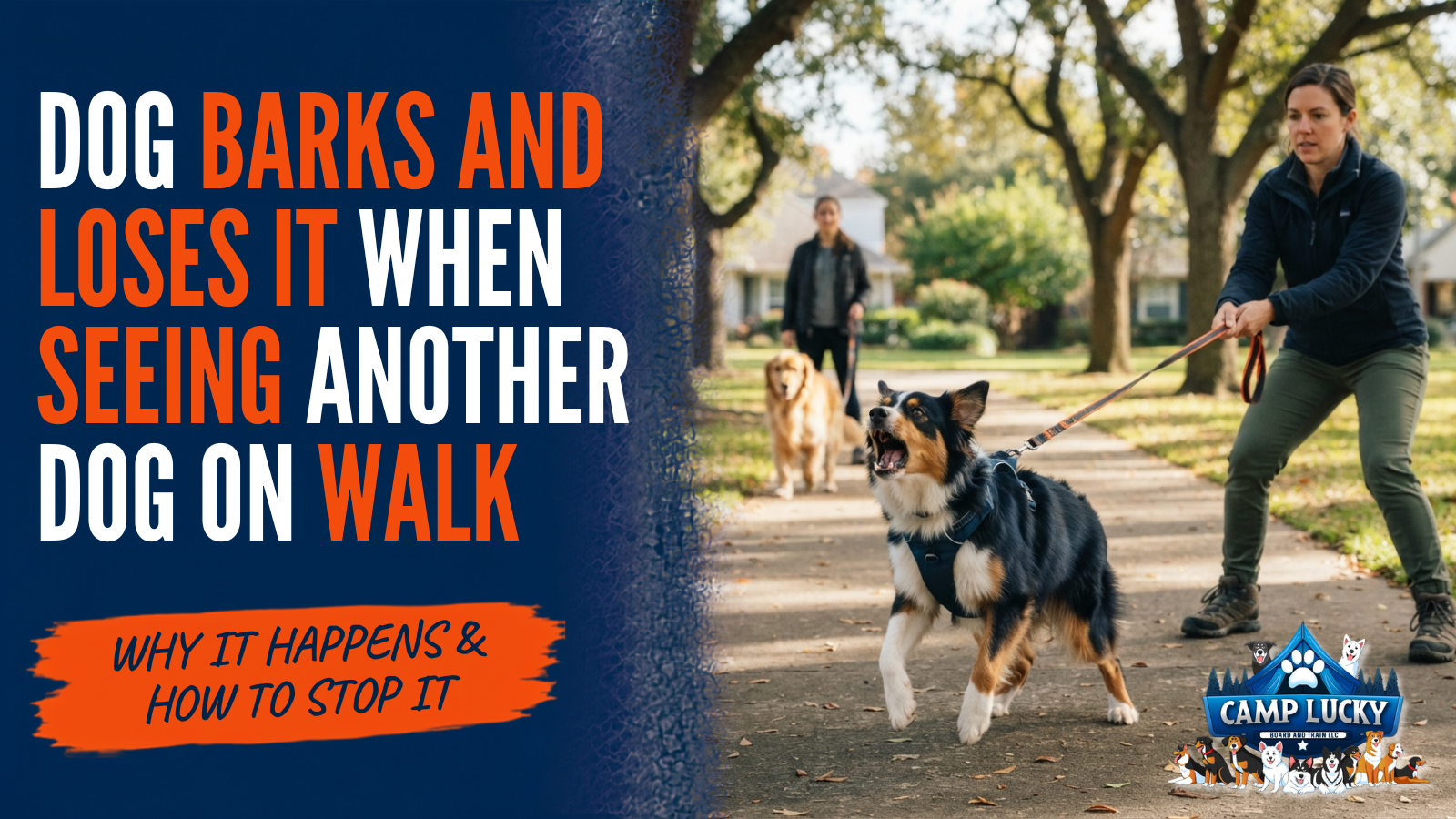
Every walk feels like defusing a bomb. Another dog turns the corner, and before anything can be done, the leash goes tight, the barking starts, and it’s over. Sound familiar? For owners of leash-reactive dogs, this is Tuesday. It’s exhausting, embarrassing, and it doesn’t get better by itself.
What most owners don’t realize is that the dog isn’t acting out — it’s shutting down. Reactivity is an emotional response, and fixing it requires understanding what’s happening inside the dog before trying to change what’s happening on the outside. Distance management is where that process begins.
Your Dog Isn’t ‘Bad’ — It’s Emotionally Overwhelmed
When a dog explodes on leash at the sight of another dog, the instinct is to think something is wrong with the dog — that it’s aggressive, dominant, or just badly behaved. But the behavior is almost always emotional, not defiant. Cornell University’s College of Veterinary Medicine describes reactive dogs as overly aroused by common stimuli, with causes tied to genetics, poor early socialization, prior bad experiences, or a thin training history.
Common drivers of leash lunging include over-excitement, fear, and leash frustration. The same bark-and-lunge on the surface can come from very different internal states — which is why a one-size-fits-all correction often makes things worse. When a dog is already flooded with stress and a handler adds more pressure, the dog doesn’t learn “stop barking.” It learns “another dog appearing predicts something bad.” The pattern intensifies rather than breaks.
Our trainers at Camp Lucky Board and Train who work with reactive dogs consistently frame reactivity as an emotional regulation problem first. The dog isn’t choosing to be difficult. It’s operating in survival mode, not problem-solving mode, and no amount of correction lands cleanly in that mental state.
Why Distance Is the First Tool, Not the Last
Most owners try to “work through” reactivity by getting closer to the trigger — more exposure, more practice, more walks past the dog park. The logic seems reasonable. In practice, it tends to backfire. Distance isn’t a workaround. It’s the foundation everything else is built on.
What ‘threshold’ means for your dog
A dog’s threshold is the distance at which a trigger causes a reaction. Below threshold, the dog notices the trigger but can still think, take food, and follow cues. Above threshold, the dog is over-aroused — the nervous system has taken over, and learning stops. A widely used field indicator: if the dog can still notice the trigger and eat a treat, it’s likely below threshold. If the dog ignores food entirely and fixates on the trigger, that line has already been crossed.
Threshold distance is different for every dog and every trigger. A dog might hold it together when a stranger jogs past at 30 feet but completely fall apart when another dog appears at 50. The goal isn’t to eliminate distance — it’s to identify the dog’s specific threshold and work just below it, building new associations before the arousal spiral begins.
Why flooding your dog with exposure backfires
Flooding — immersing a dog in a triggering environment with no way to escape — is the accidental strategy most reactive-dog owners end up using. Every busy sidewalk walk, every unavoidable encounter, every “let’s just get through this” moment is a micro-flooding event. Cornell’s veterinary behaviorists warn that exposure beyond a dog’s comfort level increases fear and worsens behavior over time. Controlled exposure at a manageable distance produces learning. Uncontrolled exposure at full intensity produces rehearsal of the exact behavior you want to eliminate.
The fix isn’t fewer walks — it’s smarter walks. Choosing quieter routes, crossing the street early, turning around before a trigger gets close enough to spark the sequence: these aren’t failures. They’re training decisions that protect the dog’s ability to learn.
What Happens Below Threshold
Understanding what the dog looks like before the explosion is one of the most practical skills a reactive dog’s owner can develop. Most people only notice the bark-lunge moment. By then, the window for intervention has already closed.
Early stress signals before the explosion
Dogs telegraph emotional overload well before the outburst. The early warning signals include:
- Body stiffening — the dog goes rigid rather than fluid in its gait
- Fixed staring — eyes lock onto the trigger and don’t release
- Closed mouth — a sudden stop to panting or a relaxed jaw posture
- Lip licking or yawning — low-level stress displacement behaviors
- Weight shifting forward — a subtle forward lean as arousal builds
These signals appear in a window of seconds to minutes before the lunge. Recognizing them early means the handler can intervene — increase distance, redirect attention, cue a known behavior — while the dog is still capable of responding. Missing them means reacting to the explosion after it’s already happened.
The window where real learning happens
Below threshold is the only place a reactive dog can actually learn something new. When a dog sees a trigger at a safe distance and experiences something positive — a treat, a game, a calm handler who redirects attention — the brain begins building a new association: other dog at a distance equals something good. Counterconditioning, a well-documented behavioral technique, works by pairing the trigger with a reward consistently enough that the emotional response shifts at the root level. This doesn’t happen above threshold. Corrections don’t land above threshold. Nothing meaningful does. The goal is to get enough calm, successful repetitions below threshold that the threshold itself starts to move — the dog can handle being a little closer without going over the edge.
Why Reactivity Keeps Getting Worse on Walks
Owners often describe their reactive dog’s behavior as getting worse over time, despite trying harder. That’s not a coincidence — it’s the structure of the problem itself.
The self-reinforcing cycle of barking and lunging
From the dog’s perspective, barking and lunging works. The other dog moves away — either because it passes naturally or because the handler retreats. Either way, the trigger disappears. The dog’s nervous system logs that as a success: I did the thing, and the scary or frustrating thing went away. Behavior that gets reinforced gets repeated.
Over enough repetitions, the walk itself becomes a cue. The leash goes on, and the dog starts scanning. The arousal level rises before a single trigger has appeared. This is why reactive dogs often seem to get more worked up over time — the anticipation of the trigger becomes part of the reaction pattern. Each unmanaged outburst is a practice session for the behavior you’re trying to stop. Breaking this cycle requires interrupting the rehearsal pattern entirely, not just managing it walk by walk.
Balanced Training’s Role in Breaking the Pattern
Distance management and threshold awareness create the conditions for learning. But the dog still needs to be taught something in that space — a new behavior, a new emotional association, a new default response when a trigger appears. That’s where training methodology comes in.
Teaching what to do, not just what to stop
Reactive dogs need two things simultaneously: a clear signal that the reactive behavior isn’t working anymore, and a clear alternative they can offer instead. Balanced training addresses both sides of that equation. Positive reinforcement builds the new behavior — look at me, heel, find it — and pairs it with the trigger at a safe distance. The dog learns that there’s a better option available when another dog appears, and that option pays off. Teaching an alternative behavior like a “look at me” command, a focused heel, or a scatter-feed redirect gives the dog something to do with its energy rather than simply suppressing the outburst.
How e-collars enable precise, timely redirection
Timing is everything in reactivity work. The difference between catching a dog at early arousal and catching it mid-explosion is a matter of seconds — and a leash correction that arrives late can land as just more stress on top of stress. E-collars, when used correctly, give trainers a precision tool for that narrow window. We use the ET300 by E-Collar Technologies, operating at the minimum effective stimulation level — often one the handler can barely feel themselves. The collar isn’t used to cause pain or fear. It functions as a precise communication tap: a way to redirect the dog’s attention back to the handler at the exact moment it’s needed, before the arousal curve spikes past the point of no return.
This level of timing precision is difficult to achieve with a leash alone, especially at distance or in high-distraction environments. The e-collar bridges that gap cleanly.
Where corrections fit — and where they don’t
Corrections have a specific role in reactive dog training, and a specific place they don’t belong. A dog that is already above threshold — already barking, already lunging, already past the point of rational processing — is not a candidate for a productive correction. Adding pressure to a dog in crisis escalates rather than resolves. Many professional trainers adhere to a “least intrusive, minimally aversive” (LIMA) framework, which prioritizes positive reinforcement and uses corrections only after the dog clearly understands the desired behavior and has demonstrated the ability to perform it. The correction communicates “that choice isn’t available anymore” — but only once the dog knows what choice is available. Corrections without prior positive reinforcement of an alternative are just pressure with no exit, which deepens the problem.
Why Board and Train Accelerates Reactivity Work
Managing a reactive dog in real life is a full-time job. Every walk is a variable — different dogs, different distances, different handler stress levels. Consistency is what drives behavior change in dogs, and consistency is exactly what everyday life makes difficult.
Consistent exposure without owner inconsistency
Board and train programs remove the variables that slow progress at home. A professional trainer can control the distance, the trigger, the timing, and the handler response in every single repetition. There’s no “off day,” no panicked overcorrection, no accidentally letting the dog blow past threshold because attention wandered. The dog gets clean, consistent repetitions of the new behavior under controlled conditions — which is what actually moves the needle on reactivity.
Owners who try to work through reactivity alone often find themselves reinforcing the pattern without realizing it — tensing up on the leash before a dog appears (which the dog reads immediately), retreating inconsistently, or avoiding certain triggers while accidentally allowing others. A board and train removes that feedback loop from the equation during the critical early training phase.
Training in a home, not a kennel
The environment dogs are trained in matters. A dog spending long stretches in a loud kennel run surrounded by other dogs is not a dog that’s recovering from reactivity — it’s a dog that’s marinating in it. Our board and train model places dogs inside a trainer’s personal home for the duration of the program. That means the dog is practicing real-life skills in a real-life setting: door manners when guests arrive, calm behavior at mealtimes, crate training in an actual domestic environment. When triggers are introduced during training, they’re introduced in a controlled, structured way — not as background noise the dog has no break from. The difference in outcomes between home-based and facility-based programs isn’t subtle.
Matching the Program to the Severity
Not every reactive dog needs the same intervention. Mild leash pulling and overexcitement around other dogs is a different problem than a dog with documented aggression and a bite history. Matching the program length to the severity of the behavior isn’t just a scheduling question — it determines whether the work actually sticks.
3-week: mild reactivity and leash pulling
Our three-week board and train is designed for dogs with minor behavioral issues — low-level reactivity, leash pulling, situational overreaction, or mild fear responses. By the third week of training, our skilled trainer has already worked through the dog’s foundational obedience in week one and begun real-world distraction exposure in week two. Week three is where that foundation gets applied directly to the dog’s specific challenges. The trainer has a clear picture of what sets the dog off and can design targeted, repetition-heavy sessions around those exact scenarios. For owners whose dog is manageable but exhausting — the dog that occasionally loses it but doesn’t have a history of serious aggression — this tier is typically the right fit.
4-week: dog-to-dog aggression and significant bite history
The four-week program is reserved for dogs with high-level behavioral challenges: serious dog-to-dog aggression, a documented bite history, or combinations of extreme stubbornness with reactive behavior. Week four’s function is immersion and repetition — placing the dog in triggering scenarios over and over in a structured, controlled way until the new response becomes default behavior rather than a deliberate choice. This depth of change doesn’t happen in three weeks for a dog with a significant bite history. The extra time isn’t padding — it’s the difference between a dog that behaves on a good day and a dog that has genuinely internalized a new pattern.
Leash-Reactive Dogs Can Change — With the Right Structure
Leash reactivity isn’t a personality flaw or a life sentence. It’s a learned pattern, and learned patterns can be changed — but the structure around that change has to be right. Distance management creates the conditions where learning is possible. Balanced training fills that space with clear communication and real alternatives. Consistent, professional repetition in a controlled environment builds the new pattern until it becomes the dog’s default.
Progress in reactivity work is rarely linear. Some dogs improve quickly; others need more time, more repetition, and more careful trigger management before the behavior meaningfully shifts. What matters most is stopping the rehearsal of the reactive pattern and replacing it with something the dog can actually use on a real walk, in a real neighborhood, around real dogs.
The owners who see the biggest results are usually the ones who stopped trying to brute-force the problem and started working with how their dog actually learns — below threshold, one clean repetition at a time, with a handler who knows when to reward and when to redirect.
For families dealing with a leash-reactive dog and looking for structured, professional help, we at Camp Lucky Board and Train offer board and train programs built around exactly this kind of work — from mild reactivity to serious aggression cases, across multiple locations nationwide.