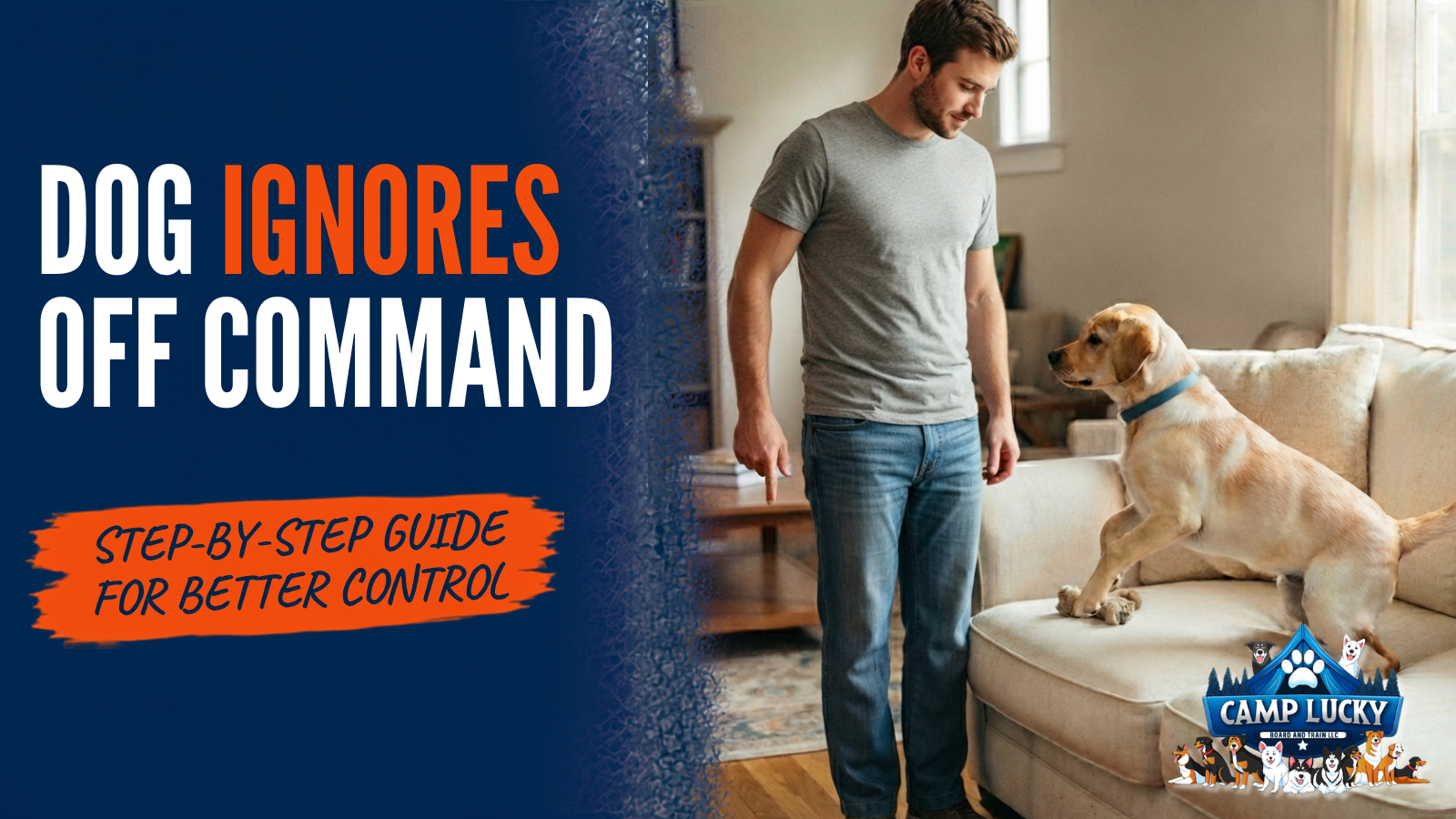
If you’ve been repeating “off” to your dog while they stare blankly from the couch, you’re not dealing with a stubborn pet—you’re dealing with a broken cue. Here’s the surprising reason your command stopped working, and the professional method that actually fixes it.
Key Takeaways
- Dogs that ignore the ‘off’ command are almost never being defiant — they simply haven’t been taught the cue in a way that sticks.
- Mixing up ‘off’ with ‘down,’ repeating the word without follow-through, and inconsistent furniture rules are the three most common patterns that destroy the cue.
- Even attention-seeking scolding can accidentally reward a dog for jumping or staying on the couch.
- Professional board and train programs work not just because dogs are trained, but because owners learn how to maintain the results at home — the handoff is everything.
- There’s a specific professional method for teaching ‘off’ that starts long before the couch becomes a battlefield — keep reading to see how it works.
If saying ‘off’ has become a full-blown negotiation in the household, the dog isn’t the problem. The cue is. Understanding why that happens — and what it actually takes to fix it — changes everything about how owners approach this frustrating daily struggle.
Your Dog Isn’t Stubborn — Your Cue Is Broken
It’s easy to chalk it up to personality. The dog stares back with what looks like total indifference, stays planted on the couch, and the word ‘off’ might as well be background noise. Owners describe it the same way across the board: ‘She pretends she doesn’t even hear me.”He listens to the trainer but not to me.”I feel like I’ve tried everything.’
That experience is nearly universal, and it has almost nothing to do with the dog’s personality. What’s actually happening is that the cue itself has never been properly built. ‘Off’ gets shouted at the dog during high-stress moments, repeated five or six times with no consistent consequence, and mixed up with other words until it means absolutely nothing to the dog’s brain.
Dogs are not wired to understand human frustration as a correction. They respond to clear, consistent signals followed by predictable outcomes. When ‘off’ has no reliable meaning — and no reliable consequence — dogs do what any rational creature does: they ignore it and stay where it’s warm and comfortable. The good news is that a broken cue can be rebuilt. Our dog trainers at Camp Lucky Board and Train work through exactly this pattern with dogs whose owners have spent months hitting a wall with this command, and the fix almost always starts with reexamining how the cue was taught in the first place — not how stubborn the dog is.
What ‘Off’ Actually Means (And What It Doesn’t)
In modern U.S. dog training, ‘off’ has one specific job: get all four paws off something. Off the couch. Off the guest. Off the counter. That’s it. It’s a movement cue — a physical action with a clear start and a clear finish.
The confusion starts when ‘off’ gets used as a catch-all word for anything the dog is doing wrong. ‘Off the couch.’ ‘Stop jumping.’ ‘Move away from the table.’ ‘Get down.’ When the same word gets stretched to cover five different meanings, it never builds clean meaning for the dog. The brain needs a consistent signal that predicts a consistent outcome — and a cue that means everything ends up meaning nothing.
How Mixing ‘Off’ With ‘Down’ Destroys the Cue
This is one of the most common — and most damaging — mistakes in home training. ‘Down’ already has a job in most training systems: it means lie down on the floor. When owners use ‘down’ and ‘off’ interchangeably, dogs don’t just get confused about furniture — they get confused about both commands. The result is a dog that hesitates, offers random behaviors, or freezes because neither cue has a reliable meaning anymore.
Keeping these two cues completely separate is a foundational step that professional trainers treat as non-negotiable. ‘Off’ means paws off the surface. ‘Down’ means lie down. Simple, distinct, and consistent.
Why Repeating ‘Off’ With No Follow-Through Trains Dogs to Ignore It
Every time ‘off’ gets said and nothing happens, the dog learns something — just not what was intended. What they learn is that ‘off’ is optional. Worse, a word that’s repeated five times before anything changes teaches the dog to wait for the fifth repetition, or the louder tone, or the physical nudge that finally signals the cue is ‘real’ this time.
In behavioral science terms, this is called cue poisoning — a cue becomes so diluted by inconsistent outcomes that it loses stimulus control entirely. Dogs are not being rude when this happens. They are responding exactly as they’ve been conditioned to respond. The cue simply doesn’t mean anything reliable, so staying on the couch is still the best available option.
The Real Reasons Dogs Blow Off the Command
Getting to the root of why ‘off’ fails requires a hard look at what’s actually been reinforced in the household — not just in training sessions, but all day, every day.
Reinforcement History: The Furniture Always Wins
The couch is genuinely better than the dog bed in most homes. It’s softer, warmer, elevated, and right in the middle of where the family spends time. Every single time a dog climbs up and stays up, the couch delivers a reward: comfort, proximity to people, warmth. The dog bed in the corner? Usually thinner, less central, and far less social.
Behavior that gets rewarded gets repeated. When furniture has been delivering consistent comfort and closeness for months or years, a single ‘off’ cue from a frustrated owner simply can’t compete with that history. The payoff for staying put is just too good.
Inconsistent Rules Create the Most Persistent Habits
This one is especially hard for households with multiple people. One family member doesn’t mind the dog on the couch. Another enforces the rule strictly. On tired evenings, the dog gets invited up to cuddle. On weekends with guests, the dog gets scolded for the same behavior. What the dog is actually learning from this pattern is not ‘stay off the couch’ — it’s ‘sometimes this works out really well, so it’s worth trying every time.’
That’s called intermittent reinforcement, and research on canine learning shows it produces some of the most persistent, durable behaviors possible. Inconsistent rules don’t weaken the couch habit — they make it almost unbreakable.
Your Attention — Even Scolding — Is a Reward
This surprises most owners, but it’s one of the most well-documented patterns in dog behavior: negative attention is still attention. For a social animal motivated by human contact, being looked at, spoken to, and physically engaged — even in frustration — can function as a reward.
When ‘off’ comes with intense eye contact, a raised voice, repeated commands, and hands trying to push the dog away, the dog isn’t experiencing a correction. They’re experiencing a high-interaction social event. Pushing a jumping dog away, for example, registers less as a correction and more as rough play and physical contact. The jumping gets reinforced while the owner feels like they’re disciplining. Both parties leave the interaction more frustrated than before.
Over-Arousal and Emotional State Derail Even ‘Trained’ Dogs
A dog that reliably responds to ‘off’ during a quiet Tuesday afternoon can completely fall apart the moment guests arrive, kids are running through the house, or food is out on the coffee table. This isn’t regression — it’s a predictable feature of how dog brains work under arousal.
When a dog’s nervous system is activated — by excitement, novelty, social stimulation, or anxiety — the ability to access learned behaviors gets harder. The dog isn’t choosing to ignore the cue; they’re genuinely less capable of processing and responding to it in that moment. The emotional drive to seek contact, comfort, or stimulation is simply overpowering the trained response.
Three emotional states most commonly push dogs past the point where ‘off’ lands: comfort-seeking (the couch or bed feels safe and warm), social contact-seeking (jumping on people because proximity feels good), and foraging or curiosity (counter-surfing when interesting smells are present). None of these involve defiance. They’re all driven by strong, natural motivations that haven’t been given a better outlet yet.
This is also why proofing matters so much. A dog that ‘knows’ off in a calm living room hasn’t actually generalized the behavior — they’ve learned it in one specific context. Real-world reliability requires practicing the cue in the environments where it needs to work most.
Why Common DIY Fixes Backfire
When the standard advice isn’t working, most owners escalate. They say it louder. They try it more urgently right when guests are arriving. Neither approach teaches the dog anything new — and both tend to make the problem worse.
Saying It Louder Doesn’t Teach It Clearer
Volume is not clarity. When a cue lacks meaning because it was never properly taught, increasing the emotional intensity behind it doesn’t repair the gap in understanding — it just adds frustration to a situation the dog already finds confusing. For some dogs, especially those that are sensitive or have been corrected harshly in the past, a loud or angry ‘off’ doesn’t produce movement. It produces anxiety. The dog may freeze, roll over, or pace — behaviors owners often read as defiance, but are actually stress responses to an emotionally charged situation without a clear exit.
The cue isn’t failing because the dog didn’t hear it. It’s failing because the dog doesn’t have a clean, trained understanding of what it means.
Practicing Only in High-Stakes Moments Sets Dogs Up to Fail
Most owners only enforce ‘off’ when it actually matters — when guests are over, when the dog is excited, when the stakes are highest. But those are precisely the moments where a weak cue has zero chance of working. High-arousal environments require a well-trained behavior, not a barely-started one.
Trying to install a new behavior in the middle of a distracting, emotionally loaded situation is like expecting someone to perform a piano piece for the first time on stage — without ever having practiced it at home. The behavior has to be built in calm, low-distraction settings first, then gradually introduced to harder situations as fluency grows. Skipping that process and jumping straight to the hard version is the most common reason DIY training stalls.
How Professionals Actually Teach ‘Off’
A professional approach to ‘off’ doesn’t start on the couch during a chaotic evening. It starts with deliberate, structured teaching in an environment where the dog can actually succeed — then progressively raises the difficulty from there. Here’s what that process looks like in practice.
1. Teach the Movement First, in Low-Arousal Settings
Before the word ‘off’ means anything, the physical movement needs to be trained clearly. Trainers often begin by luring the dog off a surface — whether that’s a low platform, a step, or the furniture itself — guiding them through the movement until all four paws hit the floor, then immediately marking and rewarding that outcome. The specific starting surface may vary, but the principle stays the same: the dog needs to understand the movement before the word gets attached to it.
Only once the dog is reliably offering that movement does the verbal cue ‘off’ get added — said just before the dog steps down, then immediately followed by a reward when paws hit the floor. This sequence builds a clean association: the word predicts the movement, the movement predicts the reward. That’s what stimulus control actually looks like.
2. Build Fluency Across Surfaces, People, and Distractions
Dogs don’t automatically generalize. A dog that has learned ‘off’ from the couch hasn’t necessarily learned ‘off’ from the bed, the ottoman, or the car seat — those all feel like different situations. Trainers systematically practice the cue across different surfaces and locations, then introduce different people giving the cue, and gradually layer in distractions.
Difficulty only increases when the dog is reliably succeeding at the current level. Jumping ahead too quickly just introduces failure into the practice history, which weakens the cue all over again.
3. Pair ‘Off’ With an Attractive Alternative Behavior
One of the most powerful things a trainer can do is make sure that ‘off’ never just means giving something up. Teaching a place command — directing the dog to go to a specific mat or cot — means ‘off’ is immediately followed by ‘go to your place,’ where the dog receives reinforcement, comfort, and attention.
The dog’s designated spot also needs to actually compete with the couch. That means making it central, comfortable, and loaded with value — chews, toys, and positive attention. When the alternative is genuinely attractive, ‘off’ stops being a loss and starts being a direction toward something good.
4. Manage the Environment to Stop Rehearsing the Problem
Every time a dog climbs on the couch unsupervised and stays there, that behavior gets stronger. Environmental management — baby gates, physical barriers on cushions, closed doors — prevents the habit from self-reinforcing when no one is watching. This isn’t a permanent solution, but it’s a critical part of the process while the new behavior is being built.
When the dog does climb up anyway, the response should be calm and neutral: cue ‘off,’ guide if needed, and reinforce the moment paws hit the floor. Emotional outbursts add drama and social reward to exactly the moment that should feel unremarkable.
When Board and Train Is the Right Call
For some households, the problem with ‘off’ isn’t knowledge — it’s that the conditions needed for consistent training simply don’t exist at home. Multiple people with different rules, busy schedules, fatigue, kids, and the general chaos of daily life make it extremely hard to maintain the kind of consistency that turns a weak cue into a reliable behavior. That’s the environment board and train is specifically built to address.
Home-Based Training Closes the Consistency Gap
What makes our board and train model particularly effective for issues like this is that dogs live inside our trainer’s personal home — not a kennel facility. That distinction matters more than it might seem. Real household routines create real training opportunities: door manners every time someone enters or exits, counter manners during actual mealtimes, crate training in a genuine domestic setting, and ‘off’ practiced calmly and consistently across every surface, every day, with zero mixed messages.
That kind of immersive repetition — done in a structured home environment rather than in isolated training sessions — is what builds the reliable behavior that owners have been chasing. The dog isn’t just learning ‘off’ in theory; they’re living it until it becomes their default response.
Why Owner Transfer Sessions Determine Lasting Results
Even the most thorough board and train program can unravel quickly if owners return to the same patterns that broke the cue in the first place. The most experienced trainers are clear about this: the handoff is where results are either preserved or lost. Transfer sessions — where owners learn leash handling, timing, reinforcement, and household management — aren’t a bonus. They’re the whole point.
What owners walk away with isn’t just a trained dog. It’s an understanding of how to maintain the structure the dog now expects. When ‘off’ has been trained clearly and the household rules support that clarity, the daily negotiation stops — and so does the frustration on both sides.
A Reliable ‘Off’ Means a Calmer, Closer Relationship — Not a Power Struggle
The goal was never really about the couch. What owners actually want is the freedom to invite their dog up when they feel like it and calmly ask them to step down when needed — without yelling, without drama, and without feeling like the dog is running the house. That’s a reasonable thing to want, and it’s completely achievable.
A well-built ‘off’ cue doesn’t create distance between a dog and their owner. It does the opposite. When the boundary is clear and enforced calmly, dogs are less anxious because the rules are predictable. Owners are less frustrated because the response is reliable. The relationship stops being a daily argument about furniture and starts being what it was supposed to be all along.
Getting there requires teaching the cue the right way — with clear mechanics, consistent follow-through, and an attractive alternative that makes compliance feel like a win for the dog, not a loss. That process is learnable. And for households where inconsistency has already dug a deep hole, having a professional rebuild it first makes maintaining it far more realistic than starting from scratch alone.
For dog owners ready to stop repeating themselves and start seeing real results, we at Camp Lucky Board and Train offer structured board and train programs designed to build exactly this kind of reliability — and the owner coaching to make it last.