Your dog bolting through the door isn’t defiance—it’s overwhelming arousal they’ve never learned to control. But here’s the real issue most owners miss: inconsistency at home is quietly undoing every training attempt. One case recently resulted in a $150,000 settlement.
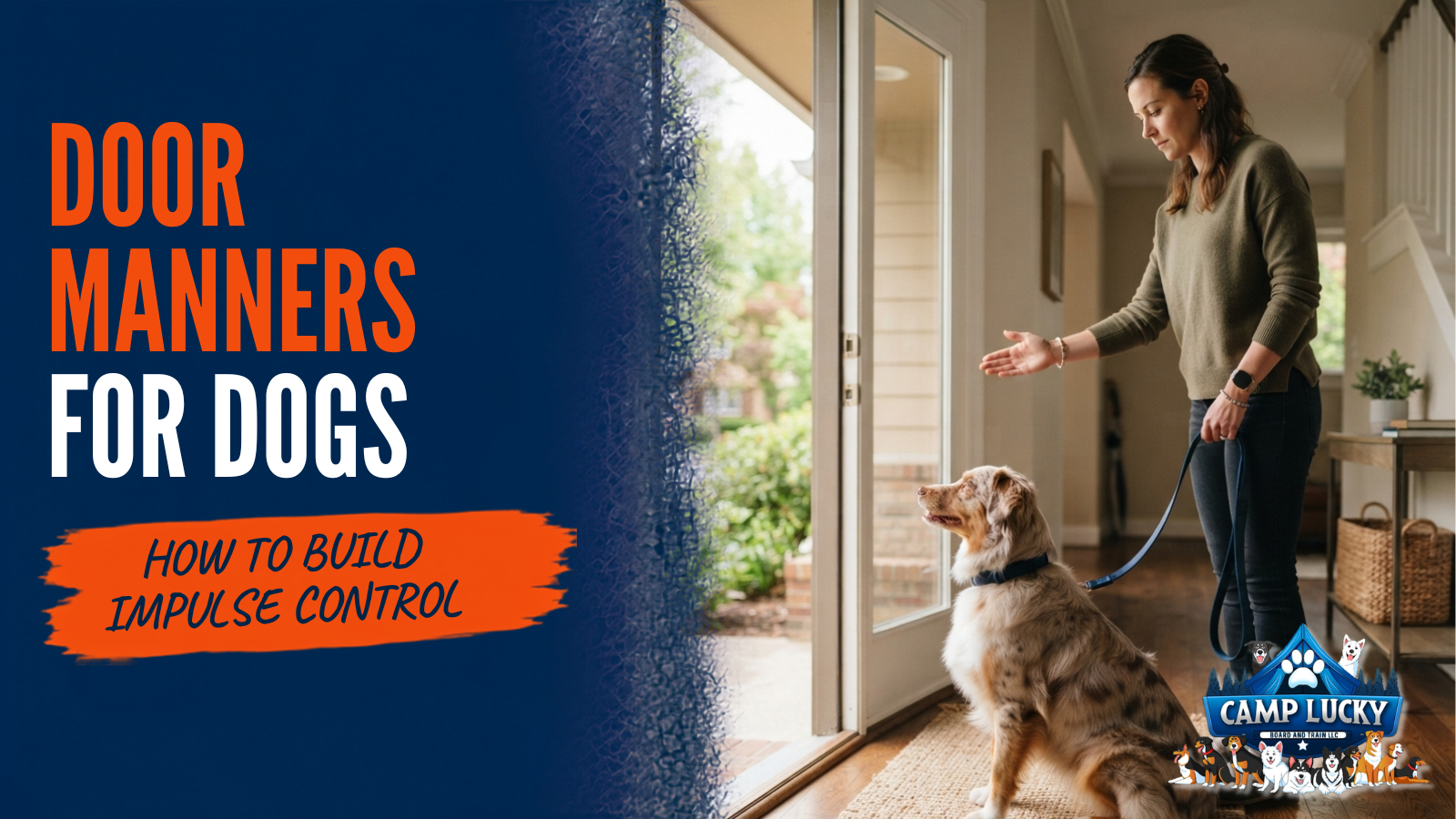
- Door manners are impulse control: Teaching a dog to wait at any threshold — front door, car door, yard gate — is one of the most practical safety skills a dog can learn.
- The real culprit is arousal, not attitude: Dogs that bolt or blast past you aren’t being defiant; they’re overwhelmed by excitement and have never learned a clear rule about thresholds.
- The safety stakes are higher than most owners expect — door dashing has led to serious injuries, legal liability, and five-figure settlements for dog owners across the U.S.
- Inconsistency at home is often the biggest obstacle to fixing door behavior, and it’s a pattern that’s easy to miss but hard to break without a structured plan.
- Professional board and train programs — like we offer at Camp Lucky — build real door manners through daily, real-world repetition inside an actual home environment, not a kennel.
Every dog owner knows the feeling: someone knocks, and the whole house erupts. The dog is spinning, barking, and throwing themselves at the door before a hand even touches the knob. It’s exhausting, embarrassing — and for many families, it’s genuinely dangerous. The good news is that door chaos isn’t a personality flaw in a dog. It’s a training gap, and it’s fixable.
Dogs Don’t Bolt Out of Spite — Here’s What’s Really Happening
A dog that blows past you at the front door isn’t making a power move. At the behavioral level, what looks like stubbornness or dominance is almost always arousal — a spike in excitement so intense that the dog loses the ability to think clearly, let alone follow a cue. The doorbell, a knock, footsteps on the porch, the smell of outside — these stack up fast, and by the time a hand touches the doorknob, many dogs are already past the point of listening.
What makes this worse is reinforcement history. Every time a dog has rushed the door and gotten through — even once — the behavior got stronger. Dogs don’t distinguish between “I let them out on purpose” and “they squeezed past me.” To the dog, bolting worked. That memory sticks.
This is why the fix isn’t about being stricter in the moment. It’s about rebuilding the dog’s expectation from the ground up: calm behavior opens doors, frantic behavior closes them. That’s a learned association, and it takes deliberate repetition to install — not just a firm “no” during the chaos.
What Door Manners Actually Mean
More Than “Sit at the Door”
The phrase “door manners” sounds simple, but in professional dog training, it covers a whole system of linked behaviors. It’s not just getting a dog to sit once before going outside. True door manners means the dog holds a calm position while the doorknob turns, while the door swings open, while a person steps through — and only moves when given a clear release cue.
Trainers treat this as a form of impulse control, similar to making a dog wait before eating from a food bowl. The dog is highly motivated — freedom, smells, visitors, excitement — and is being asked to regulate that energy in real time. That’s a cognitive skill, not just a command. And like any skill, it requires teaching, not just expecting.
The behaviors that fall under door manners in a well-structured training plan typically include: waiting calmly while the door opens, not jumping on guests who enter, staying in position until released, and greeting visitors with four paws on the floor. Each piece connects to the others, and all of them hinge on the dog learning that stillness is what makes good things happen.
Every Threshold Counts: Front Doors, Car Doors, Gates
One of the most important concepts in door manners training is threshold generalization — the idea that the rule applies everywhere, not just the front door. A dog that waits politely at the front door but launches out of the car or blows through a yard gate hasn’t really learned impulse control. They’ve learned one specific trick in one specific spot.
Professional trainers apply the same “wait and release” framework to every exit: front doors, back doors, car doors, crate doors, and yard gates. This consistency is what makes the behavior stick. When the rule is the same everywhere, the dog eventually stops treating each threshold as a separate negotiation and starts defaulting to calm — because calm is what always works.
For busy households, this generalization is also what makes life manageable. Families don’t have to remember which doors have rules and which don’t. The dog learns all thresholds require permission, and that predictability reduces household stress dramatically.
The Safety Stakes Are Higher Than Most Owners Realize
Door Dashing Leads to Lost Dogs, Car Accidents, and Bites
Door dashing isn’t just an annoyance — it’s a safety emergency waiting to happen. A dog that bolts out a front door and into traffic, runs at a cyclist, or charges a child on the sidewalk can cause serious harm in seconds. Shelters and behavior organizations consistently flag door-dashing as one of the leading causes of lost dogs and roadway injuries involving pets.
The risk compounds at property lines, where dogs encounter delivery workers, mail carriers, and strangers in rapid, unpredictable succession. Dog attacks on delivery drivers are a well-documented problem across the U.S., with thousands of reported incidents each year resulting in injuries that require medical attention. Most of those encounters begin at — or because of — an open door.
For families with young children, the danger is doubled. A dog bolting past a toddler in a doorway can knock the child into traffic or down stairs. These aren’t hypothetical scenarios. They’re the moments owners describe when they say, “That’s when I realized we needed real training.”
Legal and Financial Liability for Dog Owners
When a dog dashes out and injures someone, the consequences don’t stop at the emergency room. In many U.S. states, dog owners face strict liability — meaning they can be held legally responsible for any injury their dog causes, regardless of whether they knew the dog was dangerous. Washington state, for example, holds owners strictly liable for bite injuries to delivery employees, even on the owner’s own property.
The financial exposure can be significant. In one documented case, a DoorDash driver received a $150,000 settlement after two dogs knocked her down and bit her at a client’s home, causing lacerations, scarring, and a diagnosed PTSD. That outcome wasn’t from a dog with a long history of aggression — it was from an uncontrolled greeting that turned dangerous in seconds.
Door manners aren’t just a quality-of-life upgrade. For dog owners, they’re a form of practical risk management that protects the dog, visitors, and the owner’s financial future.
Why Your Dog Keeps Blowing Past You
Arousal, Not Attitude, Is the Root Cause
High arousal is the engine behind almost every door problem. When a dog hears a knock or a doorbell, their nervous system lights up — heart rate climbs, focus narrows, and the brain shifts into a mode that prioritizes action over self-regulation. In that state, commands that work perfectly in a calm kitchen become invisible. The dog isn’t ignoring; they genuinely can’t process.
This is why yelling louder, repeating the same command, or physically blocking the dog in the moment rarely produces lasting change. The arousal itself has to be addressed — by teaching the dog, in calm conditions first, that stillness and breathing are what get them access to what they want. Once that association is built through repetition, it starts to hold even when excitement is high.
Inconsistency at Home Reinforces the Problem
Arousal explains the dog’s behavior. Inconsistency explains why it doesn’t improve on its own. In most households, door behavior is handled differently by different people at different times. One family member holds the dog back physically. Another lets them rush out “just this once.” A visitor laughs off the jumping. A kid swings the door open without thinking. Each of those moments reinforces the exact behavior the owner is trying to stop.
What this creates is a dog with no stable expectation — the rules change depending on who’s at the door, what time it is, and how rushed everyone is. Dogs don’t generalize well under inconsistency. They learn from patterns, and if the pattern is random, the behavior stays random. Structured training replaces that randomness with a clear, repeatable rule the whole household can uphold.
How Trainers Actually Teach Door Manners
1. Door Games and Wait Training
The foundation of door manners training is a simple but powerful concept: the door only opens when the dog is still. Trainers teach this through what’s often called “door games” — repetitive, low-stakes drills where the handler reaches for the door, the door opens a crack, and the door immediately closes if the dog breaks position. When the dog holds still, the door opens wider. The door itself becomes the reward and the consequence.
This approach builds a new reflex. Instead of lunging when the doorknob moves, the dog learns that movement equals loss of access, and stillness equals progress. Over many short sessions — typically three to five minutes — the behavior becomes automatic. The dog starts to sit or stand calmly simply because the doorknob moved, before any verbal cue is even given.
2. Stationing: Mat, Leash, and Barrier Setups
Before a dog has enough self-control to hold a threshold independently, trainers use management tools to prevent rehearsal of the wrong behavior. Leashing the dog before opening any door, sending them to a designated place mat, or positioning a baby gate between the dog and the entryway are all legitimate training steps — not shortcuts.
The place command is especially useful here. A dog stationed on a mat several feet from the door can’t physically practice bolting, which means every door opening becomes a repetition of the correct behavior rather than the wrong one. Over time, the mat becomes the dog’s default when a door opens — a calm anchor point instead of a launching pad.
3. Simulated Visitor Protocols
Real-world door manners have to be trained in conditions that match real-world door chaos. That means using helpers — friends, family members, or a trainer — to simulate knocks, doorbells, and entries while the dog practices holding position. Visitors are coached to ignore excitement completely, step back out if the dog breaks, and only interact with a calm dog.
This kind of repetition is hard to manufacture on accident, which is one reason DIY door training often stalls. The household can’t create enough controlled reps during actual deliveries and genuine visitors to build the behavior reliably. Simulated scenarios allow the training to happen on the owner’s schedule, at the dog’s current ability level, with enough repetition to make the behavior stick.
4. Threshold Generalization Across All Exits
Once a dog understands the wait-and-release rule at one door, trainers intentionally transfer it to every other threshold in the dog’s life. Car doors, crate doors, yard gates, and back doors all get the same treatment. The cue and the expectation stay consistent: no crossing until released.
This generalization phase is what separates a dog that “sort of” has door manners from one that genuinely does. A dog who waits calmly at every exit isn’t just trained — they’ve internalized a rule about how thresholds work. That understanding transfers to new environments too, which is why dogs trained this way tend to behave well even at unfamiliar doors.
When DIY Training Isn’t Enough
Signs the Problem Needs Professional Intervention
Many dog owners spend months working on door manners at home and see real improvement — then the doorbell rings, a stranger walks in, and it’s like the training never happened. That’s a normal part of the process, but there are situations where the gap between home practice and real-world performance signals something more than just needing more reps.
Professional intervention is worth considering when:
- Door dashing has repeatedly put the dog in dangerous situations — running into traffic, charging strangers, or breaking through barriers
- Consistent, sustained DIY effort over weeks or months has produced no lasting improvement
- The door behavior is paired with aggression — growling, snapping, or biting when people enter or try to leave
- The dog’s arousal at the door is so extreme that learning simply isn’t happening during practice sessions
- Anxiety or fear underlies the threshold behavior, requiring a different behavioral approach than standard manners training
These aren’t signs of a bad dog or a failed owner. They’re signs that the problem has layers — arousal, reinforcement history, emotional state — that benefit from a professional’s timing, tools, and structured environment.
How Board and Train Programs Build Real Door Manners
Home-Based Training Creates Real-World Reps
One of the biggest advantages of a quality board and train program is volume. A professional trainer working with a dog full-time can create dozens of door repetitions in a single day — at breakfast, after walks, during deliveries, and before and after every training session. That accumulation of reps in a short time period compresses months of home practice into days.
What makes our approach at Camp Lucky Board and Train particularly effective is that dogs live inside our trainer’s personal home — not a commercial kennel. That means door manners aren’t practiced in a controlled facility environment. They’re practiced at real front doors, real car doors, and real yard gates, with real household foot traffic, multiple times a day. The behavior gets built in the exact kind of context it needs to hold up in.
This is a meaningful distinction. A dog that learns to wait at a door in a training facility still has to transfer that behavior to a home. A dog that learns it inside a trainer’s home is already practicing in the right environment from day one.
What a One-Week Board and Train Covers
Our one-week program is built around foundational home manners and basic obedience — and door behavior is explicitly part of what gets addressed. Dogs in the program learn not to bust through doors, with the expectation that they sit before going outside. That’s paired with other household skills: no jumping, no counter surfing, no excessive barking, and on-leash control within the home.
It’s worth being clear about what the one-week program is designed for: foundational manners for puppies, newly adopted dogs, or any dog that needs a clean behavioral baseline. It’s the right starting point for dogs whose door problems stem from a lack of training — not from fear-based reactivity, off-leash reliability needs, or significant behavioral history. Those cases call for the two-, three-, or four-week tiers, which build progressively on the foundation.
The program also includes two refresher sessions after completion, giving owners the chance to work through the handoff with trainer support — because maintaining door manners at home requires the owner to uphold the same rules the dog just spent a week learning.
Calm Doors Are Possible — Professional Training Gets You There Faster
Door chaos isn’t permanent. It’s a pattern — and patterns can be replaced. The dog that currently turns every knock into a five-alarm event is operating on habits that were never intentionally taught, reinforced inconsistently over time, and never given a clear alternative. With the right training structure, those habits change.
The shift that owners describe after door manners training isn’t just behavioral — it’s emotional. The dread before the doorbell rings fades. The daily scramble to block the dog while managing kids and packages becomes a non-event. Guests walk in without being tackled. That’s not a small quality-of-life change. For many families, it’s the difference between a household that feels manageable and one that feels out of control.
Whether the path is structured DIY work, private lessons, or a board and train program, the core principle holds: door manners are built through clear rules, consistent repetition, and training that happens in realistic conditions. The faster that environment is created, the faster the behavior changes.
We work with dogs of any age or behavior level across multiple U.S. locations — find the right fit for your dog at campluckytraining.com.