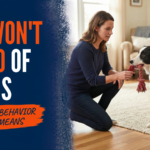
Think your dog is just being stubborn when they pull on the leash? There’s actually a hardwired reflex at play—and the way most owners respond makes it exponentially worse. Here’s what’s really happening in your dog’s nervous system during every walk.

Key Takeaways
- Leash pulling is largely driven by the opposition reflex — a hardwired instinct that makes dogs pull harder the moment they feel tension on the leash.
- Yanking back or using retractable leashes actively makes the problem worse by amplifying this reflex, not correcting it.
- Dangerous pulling causes real injuries to owners every year — and quietly damages dogs’ bodies too.
- Fixing leash pulling requires changing three interconnected systems: equipment, leash rules, and arousal management before walks even begin.
- When pulling crosses into a genuine safety issue, professional board and train programs can deliver results that most owners struggle to achieve on their own.
Most dog owners assume a dog that constantly pulls on the leash is just being stubborn, defiant, or poorly socialized. The reality is more interesting — and more fixable — than that. Understanding the actual biological mechanism behind leash pulling changes everything about how to approach it.
Your Dog Isn’t Being Stubborn — It’s Hardwired
The leash clips on, your dog rockets toward the door, hits the end of the lead, and digs in harder. You pull back. They pull harder. By the time you reach the end of the block, your shoulder aches and your dog hasn’t looked back at you once. It feels like a battle of wills. It isn’t.
What’s actually happening is a physiological reflex — one that has nothing to do with dominance, spite, or poor character. Dogs have an instinctive reaction called the opposition reflex, where their body automatically pushes or pulls against any applied physical force. Feel tension? Push into it. That’s the reflex firing. The dog isn’t choosing to defy anyone — its nervous system is doing exactly what it was built to do.
This distinction matters enormously for training. A behavior rooted in defiance calls for one kind of response. A behavior rooted in reflexive biology calls for a completely different approach — one that works with the dog’s instincts instead of colliding with them head-on.
What the Opposition Reflex Actually Does
First Identified by Ivan Pavlov as the ‘Freedom Reflex’
The opposition reflex isn’t a new discovery. Russian physiologist Ivan Pavlov — best known for his work on conditioned responses — first observed and documented this behavior in dogs, calling it the “freedom reflex.” He noticed dogs instinctively resisting harnesses and restraints, pushing back against any restriction on their movement. That observation, made well over a century ago, describes exactly what happens on millions of leashed walks every single day.
Leash Tension Triggers the Pull, Not Defiance
When a leash goes taut, the dog’s body responds the same way it would to any physical pressure — by pushing back against it. A constantly tight leash doesn’t just fail to slow the dog down; it actively teaches the dog to dig in and pull harder. The tension itself becomes the trigger. Over enough walks, the dog can start the outing already braced and already leaning, before anything exciting has even appeared on the horizon.
Dog trainers at Camp Lucky Board and Train work with this principle directly — recognizing that the leash itself communicates information to the dog, and that chronic tension sends entirely the wrong message.
How Daily Walks Accidentally Reinforce the Reflex
Here’s where learning theory layers on top of biology. Every time a dog hits the end of the leash and still reaches the smell, the lamppost, or the other dog, the environment rewards the pulling. The dog gets what it wanted. From the dog’s perspective, the equation is simple: tension equals forward progress. Repeat that equation across hundreds of daily walks, and what started as a reflex becomes a deeply grooved habit — one the dog has been practicing, and getting paid for, across months or years.
Why Pulling Hard Back Makes It Worse
Force Amplifies the Reflex, Not Corrects It
The instinct for most owners is to match the dog’s force — pull back, hold firm, or deliver a sharp leash correction when the dog surges forward. It feels logical. It doesn’t work. Pulling back harder directly engages the opposition reflex, and the dog’s body responds by pulling forward with even more intensity. Adding force to the equation doesn’t correct the behavior; it escalates it. Beyond the training failure, repeated harsh leash corrections in a state of high arousal often push dogs from excited and frustrated into anxious and reactive — which creates a whole new set of problems on top of the pulling.
Retractable Leashes Train Dogs to Pull Harder
Retractable leashes deserve special mention here because they are, mechanically speaking, a pulling-reinforcement machine. The constant low-level tension they maintain against the dog’s collar is a near-perfect trigger for the opposition reflex — at all times. Worse, the device itself teaches the dog a direct lesson: pull harder, get more leash, go farther. Every walk with a retractable leash is a training session in the wrong direction. For dogs that already pull, this tool actively builds the behavior owners are trying to eliminate.
The Real Dangers Owners Underestimate
Thousands of Owners Land in Emergency Rooms Annually
Leash pulling that feels merely annoying can cross into genuinely dangerous territory faster than most owners expect. Dangerous pulling — the kind where the dog’s forward force can physically overpower the handler — causes shoulder and wrist strains, torn rotator cuffs, back and neck injuries, falls, and fractures. Thousands of dog owners end up in emergency rooms each year as a direct result. The risk compounds significantly with medium-to-large dogs, adolescent energy, and high-arousal triggers like other dogs, cyclists, or fast-moving vehicles. A single hard lunge at the wrong moment — near traffic, at the top of stairs, on a slick sidewalk — can turn a routine walk into a serious accident.
Constant Collar Tension Damages Dogs Too
The physical cost isn’t borne only by owners. Dogs walking against a constantly tight collar — especially a standard flat collar — absorb repetitive pressure on their neck and throat with every step. Veterinary research has linked chronic leash tension to neck and throat damage, joint strain, increased reactivity, thyroid gland damage, and elevated eye pressure. These aren’t dramatic, one-time injuries; they accumulate quietly over months and years of daily walks. The dog that appears to be thriving on its daily drag around the block may be paying a slow physical price that doesn’t show up until much later.
Three Systems That Must Change
Addressing dangerous leash pulling isn’t about finding the right gadget or mastering one trick. It requires changing three interconnected systems simultaneously. Fix only one and the other two will keep the old pattern alive.
1. Equipment That Manages Force Without Doing the Training
The right equipment reduces immediate physical risk while training takes hold — but it doesn’t replace the training itself. Front-clip harnesses are worth understanding here: when a dog pulls against one, the attachment point redirects their momentum sideways, causing them to pivot toward the handler rather than surge forward. This makes it physically difficult to continue a straight-line pull. Properly fitted headcollars work on a similar principle, redirecting the dog’s head and momentum rather than simply applying neck pressure. Martingale collars, by contrast, are primarily useful for preventing a dog from backing out of their collar — they serve a different purpose than force redirection.
The goal of equipment at this stage is to create a safer working environment — for both the handler and the dog — while the actual behavioral change gets built. Swapping tools without addressing the underlying pattern is one of the most common reasons DIY attempts stall. The tool changes, the behavior doesn’t.
2. The Leash as an On/Off Switch for Movement
This is the core mechanical rule that, applied consistently, starts to reshape what the dog believes about tension. The principle: a tight leash stops all forward movement; a loose leash allows it. The moment tension appears, the handler plants their feet completely — becomes immovable. Movement resumes only when the leash softens or the dog reorients toward the handler.
Two distinct techniques reinforce this message. The first — sometimes called “becoming a tree” — involves stopping completely the instant the leash goes taut and waiting for the dog to release the tension before moving again. The second involves making 180-degree direction changes when the dog forges ahead, teaching the dog that being out in front is inefficient and that staying near the handler is how progress happens. Both techniques draw their power entirely from consistency. Applied sporadically, they teach nothing. Applied on every single walk by every person who handles the dog, they gradually rewire the dog’s understanding of what leash tension means.
3. Lowering Arousal Before Entering High-Stimulus Environments
A dog that’s already running at a full nervous-system “on” before the walk begins has almost no capacity to process new rules or respond to cues. High arousal shrinks a dog’s ability to think and learn. Opening the front door directly into a busy sidewalk with that dog sets the training session up to fail before it starts.
Starting walks with shorter, more controlled routes and allowing decompression time — calm sniffing in a low-stimulus area before approaching high-value triggers — brings the dog’s arousal down to a level where learning is actually possible. Gradually working up to busier environments, rather than beginning there, makes every training session more productive and every walk more manageable.
When Professional Help Is the Safer Choice
Signs the Pulling Has Crossed Into a Safety Issue
There’s a meaningful difference between a dog that pulls and a dog whose pulling is genuinely dangerous. Some clear signals that professional involvement is the right call:
- The dog’s size and strength physically exceed the handler’s ability to stay upright and in control
- There is already a history of near-falls, rope burns, or actual injuries during walks
- Pulling is combined with reactivity — barking, lunging, or spinning toward dogs, people, or vehicles
- Multiple people in the household handle the dog inconsistently, and no unified approach has taken hold
- The owner is medically vulnerable, elderly, or physically limited in ways that make force management risky
When one or more of these factors are present, continuing to troubleshoot alone while the dog gets stronger and the habits get more ingrained is a losing approach.
How Professional Board and Train Programs Can Accelerate Results
For dogs with serious pulling — especially when reactivity is layered in — the gap between knowing what to do and physically executing it under stress in the real world is enormous. A well-run board and train program bridges that gap through sheer volume of correct repetitions: hundreds of structured leash reps per week, in varied real-world environments, delivered with professional timing that cuts through months of trial and error.
We structure this kind of immersive work across multi-week programs specifically calibrated to the dog’s behavior level — from foundational leash manners to addressing pulling mixed with reactivity. Dogs live inside a trainer’s actual home throughout the program, meaning leash rules get practiced around real foot traffic, real mealtimes, and real daily life — not just in a controlled training arena.
One critical caveat: the results of any board and train program depend heavily on what happens after the dog comes home. Transfer training — where owners learn the same handling patterns, cues, and rules the dog was trained with — is what determines whether the progress sticks. An owner who returns to chronic tight-leash habits within the first week undoes the foundation. The program builds the behavior; the owner’s consistency maintains it.
Consistent Training in a Real Home Changes Everything
Leash pulling is one of the most common reasons dog owners quietly stop walking their dogs altogether. The dread of the battle, the embarrassment, the physical wear — it adds up. Dogs that stop getting walked become more under-stimulated, more pent-up, and more explosive on the rare walks they do get. The cycle feeds itself.
Breaking that cycle doesn’t require extraordinary strength or endless patience. It requires a clear understanding of why the pulling happens — the opposition reflex, the reinforcement history, the arousal levels — and a consistent, structured approach that addresses all three. The biology isn’t the enemy. It’s just a system, and systems can be worked with.
Every walk handled with the same rules, the same equipment, and the same emotional steadiness is a deposit into the new habit. It compounds. Dogs that once dragged their owners down the street learn — genuinely learn — that loose-leash walking is how the world moves forward. That shift is achievable for the vast majority of dogs, at any age, with the right foundation in place.
For families dealing with serious leash issues and ready for structured, professional help, we at Camp Lucky Board and Train offer board and train programs built around exactly these challenges.