If your dog panics every time you approach a doorway, you’re not dealing with stubbornness—you’re dealing with genuine fear. Professional trainers have a surprisingly specific fix, but it starts much smaller than most owners expect, with exits that last just one second.
Key Takeaways
- Doorway desensitization teaches dogs that an owner walking through a doorway is a neutral event, not a reason to panic — and it’s the foundational technique professional trainers use to address separation anxiety.
- Micro-departures — exits lasting just one to five seconds — are the building block of the entire process, and rushing past them is one of the most common reasons DIY attempts fail.
- Counter-conditioning pairs departures with high-value rewards, flipping the emotional script so that leaving actually feels good to the dog.
- One rule governs every step of the process: never push a dog past its anxiety threshold, or the fear gets worse, not better.
- For dogs with deep-rooted separation distress, a home-based board and train program can accelerate results in ways that weekly lessons rarely can — keep reading to understand why the training environment matters so much.
Separation anxiety looks different in every dog, but the trigger is often the same: a doorway. Whether it’s a whine at the bathroom door or full-blown panic at the front entrance, many dogs have learned to treat thresholds as the moment everything goes wrong. The good news is that professional trainers have a highly specific, step-by-step answer for this — and it starts much smaller than most owners expect.
Your Dog Isn’t Being Stubborn — They’re Panicking
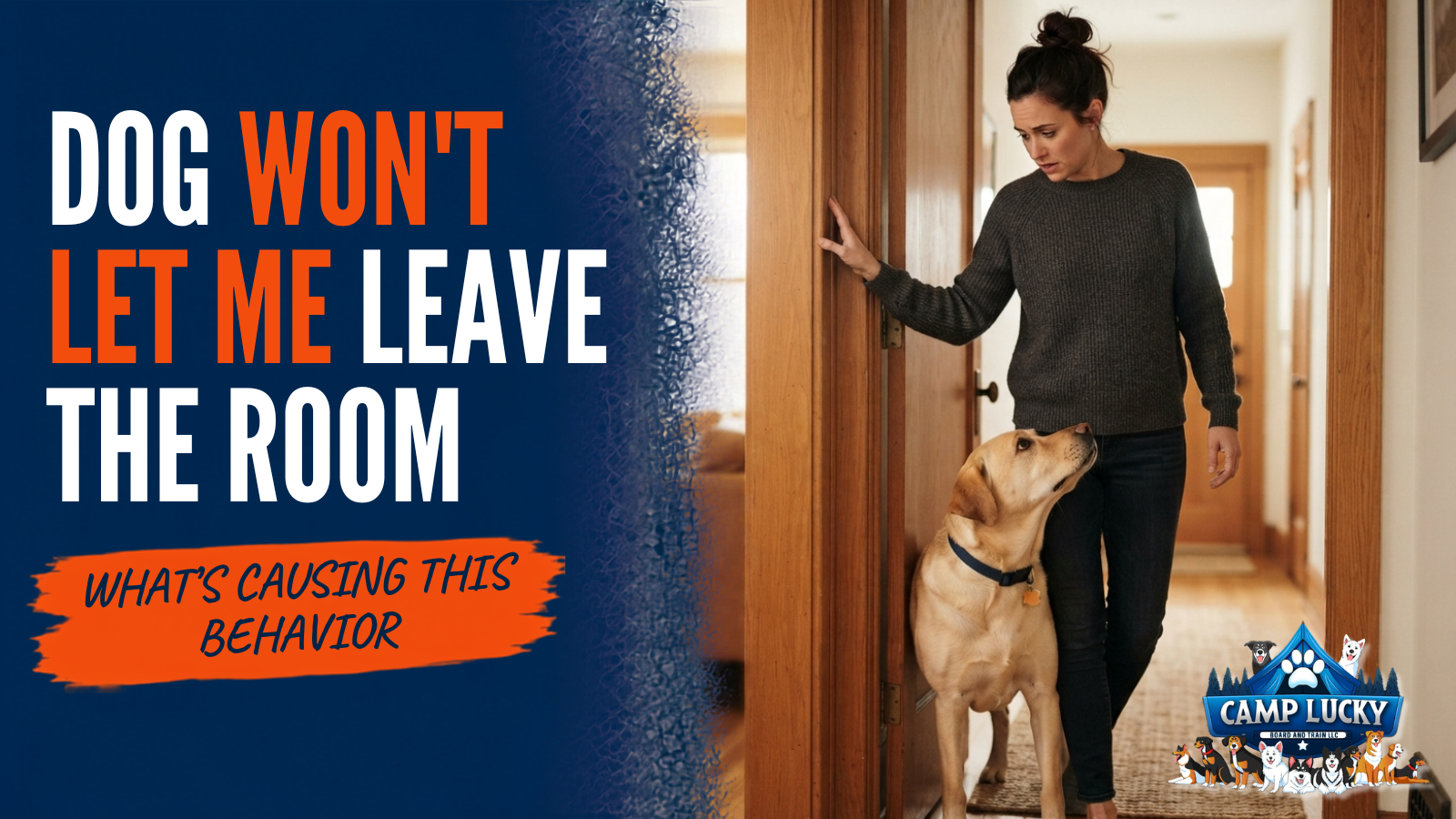
When a dog blocks the exit, scratches at a closed door, or follows so closely it’s impossible to take three steps without a collision, the easy explanation is that the dog is being difficult. The accurate explanation is that the dog is frightened.
Veterinary behaviorists consistently point out that this kind of clinginess isn’t about dominance or a power struggle. It’s about anxiety, attachment, and a nervous system that has learned to treat any increase in distance as a genuine threat. Dogs who shadow their owners through every room — often called “velcro dogs” — may not always meet the clinical definition of separation anxiety, but they’re operating from the same emotional place: proximity feels safe, distance does not.
For some dogs, the threshold is the front door. For others, it’s any doorway in the house. What’s happening internally is anticipatory anxiety — the dog isn’t reacting to the absence itself, but to the prediction of absence. Over time, ordinary pre-departure cues like picking up keys, putting on shoes, or simply standing up from the couch become conditioned triggers. The dog starts spiraling before the owner has even moved toward the door.
Stress chemistry interferes with learning. A dog in high arousal around doorways literally cannot absorb a “sit” or “stay” cue in those moments — the emotional alarm system overrides everything else. That’s why obedience commands alone don’t fix the problem. The anxiety itself has to be addressed first.
What Doorway Desensitization Actually Does
Teaching the Doorway to Mean Nothing
The goal of doorway desensitization is deceptively simple: make the doorway boring. A door that currently predicts abandonment needs to become just a door. Trainers accomplish this through carefully controlled, repeated exposure — showing the dog, again and again, that an owner can approach a threshold, cross it, and return without anything alarming happening.
This works because of how conditioned emotional responses are built and dismantled. The dog has learned, through repetition, that “owner near the door = something bad is coming.” Desensitization reverses that learning through a different kind of repetition — one where the predicted disaster never arrives. With enough successful, calm exposures, the doorway loses its power as a trigger.
This technique applies to any exit in the home, not just the front door. Trainers often work across multiple thresholds — bedroom doors, bathroom doors, baby gates — because a dog with separation distress can develop anxiety around any perceived departure point.
Why Tiny Exits Beat Long Absences
One of the most counterintuitive things about this process is that short departures are more valuable than long ones — especially early on. A one-second exit that the dog handles calmly does more training work than a ten-minute absence that ends in a meltdown.
The reason comes down to what the dog’s nervous system is actually learning. A calm return teaches the brain: “Owner left. Nothing bad happened. Owner came back.” A distressed absence teaches the opposite — it rehearses panic, reinforces the fear response, and makes the next absence harder to manage. Every time a dog spirals while alone, that neural pathway gets stronger.
This is why flooding — suddenly leaving for an hour to “see how the dog does” — tends to make separation anxiety worse, not better. Tiny, successful exits accumulate into genuine tolerance. Long, overwhelming ones do the opposite.
How Trainers Run Micro-Departures Step by Step
1. Start With Seconds, Not Minutes
The first stage of a micro-departure protocol looks almost laughably small. A trainer or owner steps out of sight — behind a door, around a corner — for one to five seconds, then returns before the dog shows any sign of distress. That’s it. No fanfare, no big reunion, just a quiet return.
The brevity is intentional. The dog needs to experience the full arc — owner leaves, owner comes back, nothing bad happened — while staying under the emotional threshold where panic kicks in. One calm second is a successful repetition. One panicked minute is a setback.
At this stage, giving the dog something positive to occupy them — a stuffed Kong, a long-lasting chew, a puzzle feeder — can reduce the intensity of the initial reaction and create a competing emotional association with the departure.
2. Return Before Distress Begins
The timing of the return is everything. Trainers watch closely for early stress signals: ears pinning back, pacing, whining, fixating on the door. The goal is to return before any of those signals escalate into full distress. Coming back after the dog has already started spiraling doesn’t teach calm — it teaches that panicking eventually brings the owner back.
Many trainers recommend recording the dog’s behavior during practice absences, even with a phone propped on a shelf. Watching the footage often reveals stress signals owners didn’t notice in the moment — and it gives an accurate read on how long the dog can truly stay under threshold, which is usually shorter than owners assume.
3. Stretch Duration Only When Calm Is Consistent
Duration increases only when the previous level is consistently calm — not occasionally calm, consistently calm. That means several successful repetitions at one duration before nudging the next rep slightly longer. The progression might go from one second to three seconds to ten seconds to thirty seconds over the course of days, not a single afternoon.
If a dog starts showing distress at a new duration, the right move is to step back to the previous level that worked — not push through. This isn’t regression; it’s accurate calibration. The dog is providing data about where their real threshold sits, and that information is useful.
4. Generalize Calm Across Rooms, Gates, and Scenarios
Once a dog can handle short absences through one doorway, the training isn’t finished — it’s just ready to expand. Calm behavior needs to be practiced across different thresholds, different times of day, and different departure setups. A dog who handles the bedroom door fine might still struggle at the front door, or at a baby gate in a new part of the house.
Generalization is what turns a fragile new behavior into a reliable one. Trainers cycle through different rooms, different durations, and different departure scenarios until calm becomes the dog’s consistent default response — not just a lucky outcome in one specific setup.
Counter-Conditioning: Making Departures Feel Good
Pairing Exits With High-Value Rewards
Desensitization reduces the fear. Counter-conditioning flips it into something positive. The technique involves pairing the moment of departure — or the preparation for departure — with something the dog genuinely loves: a high-value treat, a favorite toy, a stuffed Kong that only appears at this moment.
The mechanics are straightforward: as the owner moves toward the door, the dog gets something wonderful. The timing matters. The reward needs to arrive as the departure cue happens, not after the dog has already started to panic. Done consistently, the dog starts to associate the owner leaving with the arrival of something good — and the emotional charge around departures begins to shift.
The ASPCA supports desensitization and counter-conditioning as humane and effective approaches to separation anxiety. These methods are widely recognized by veterinary behaviorists and professional trainers for their effectiveness in reducing separation-related distress through systematic protocols.
Defusing Pre-Departure Cues Like Keys and Shoes
By the time most dogs with separation anxiety are in distress, they aren’t just reacting to the owner leaving — they’re reacting to the signs that leaving is about to happen. The jingle of keys. The sound of shoes on hardwood. A jacket being grabbed off the hook. These pre-departure cues can trigger anxiety before the owner has even touched the door.
Trainers address this by decoupling the cue from the departure. Pick up the keys, then sit back down. Put on shoes, then make a cup of coffee. Repeat until those actions stop predicting anything at all. Once the cues are defused, layering them into actual micro-departure practice becomes much less volatile — the dog’s alarm system has fewer triggers to set it off.
The Threshold Rule Trainers Never Break
Every component of this process — micro-departures, duration stretching, counter-conditioning, cue defusing — operates under one non-negotiable principle: never push the dog past its anxiety threshold.
Threshold is the point at which the dog shifts from calm (or mildly alert) into active distress. Below it, learning happens. Above it, fear gets practiced and reinforced. A dog that crosses into panic during a training session isn’t getting desensitized — it’s getting more sensitized. The fear pathway strengthens every time it fires without a successful resolution.
This is why the process can’t be rushed. An owner who is frustrated with slow progress and decides to “just leave for twenty minutes and see what happens” isn’t testing their dog — they’re setting the training back. The threshold rule isn’t about being overly cautious; it’s about understanding how fear learning actually works. Staying under threshold consistently, over time, is the only reliable path to genuine change.
Trainers also use this principle to monitor progress. If a dog who previously handled five-second departures calmly suddenly starts showing distress at two seconds, something has changed — a new stressor, a schedule disruption, a stretch of inconsistent practice. Recognizing that and scaling back is a professional move, not a failure.
When Professional Help Accelerates Results
What Board and Train Adds That DIY Can’t
For many dog owners, the DIY version of this process stalls — not because the techniques are wrong, but because the execution is inconsistent. Life gets in the way. Reps don’t happen daily. The dog has a bad day and the owner skips practice. Weeks pass with little measurable progress.
A structured board and train program solves this by compressing the repetition into a focused, consistent environment. Instead of a few practice reps scattered through a busy week, a dog in a professional program experiences the right kind of exposure many times a day, every day, with a trained eye monitoring for threshold violations and adjusting the protocol in real time.
Some home-based board and train programs emphasize building foundational calm and door manners, with dogs practicing proper threshold behavior during actual household routines, which can provide a level of repetition within authentic domestic contexts that is difficult to replicate on a DIY schedule. Camp Lucky Board and Train is one such program, built around training inside a real household rather than a commercial facility.
Why Home-Based Training Environments Matter
The setting of a board and train program isn’t a minor detail — it’s central to how well the skills transfer back to the owner’s home. A dog trained exclusively in a kennel facility spends the majority of its time in an environment that looks nothing like a real home: no foot traffic, no mealtimes, no one walking past doorways throughout the day.
When training happens inside a trainer’s personal home, the dog practices door manners during actual comings and goings, learns calm behavior around real household routines, and experiences the kind of low-level ambient activity that a domestic environment naturally provides. The result is a dog whose trained behaviors are built on a foundation that closely matches where those behaviors will actually be needed.
Equally important is what happens at the end of the program. Professional trainers don’t just hand back a trained dog — they coach owners on how to maintain the structure at home, including how to run micro-departures correctly, how to respond to anxious behavior, and how to avoid inadvertently rebuilding the clingy patterns that caused the problem in the first place.
Months of Consistency Build Lasting Calm — The Right Place to Start Is Small
Separation anxiety doesn’t resolve in a weekend. Evidence-based behavioral resources are consistent on this point: meaningful, lasting improvement takes weeks to months of patient, structured work. Progress is measured in small benchmarks — a dog that can stay relaxed on its bed while an owner moves around the room, then handle five minutes behind a closed door, then manage a short trip outside without spiraling.
Setbacks are part of the process, not proof it isn’t working. A schedule change, a move, or even a stretch of inconsistent practice can cause regression. The appropriate response isn’t to abandon the plan — it’s to scale back to the last level that worked and build forward again from there.
The cumulative effect of many small, successful reps — departures that resolve calmly, cues that no longer predict disaster, durations that stretch gradually without triggering panic — is a dog that has genuinely learned that being alone is safe. That’s not a temporary fix. It’s a real behavioral shift built on repetition, patience, and a clear understanding of how fear learning works.
Starting small isn’t a compromise. It’s the strategy. A one-second calm exit today is the foundation for a one-hour calm absence six months from now — and that transformation begins at the doorway.
For dog owners ready to move beyond the daily cycle of distress, Camp Lucky Board and Train offers structured, home-based programs designed to build the kind of lasting calm that separation anxiety makes feel impossible.