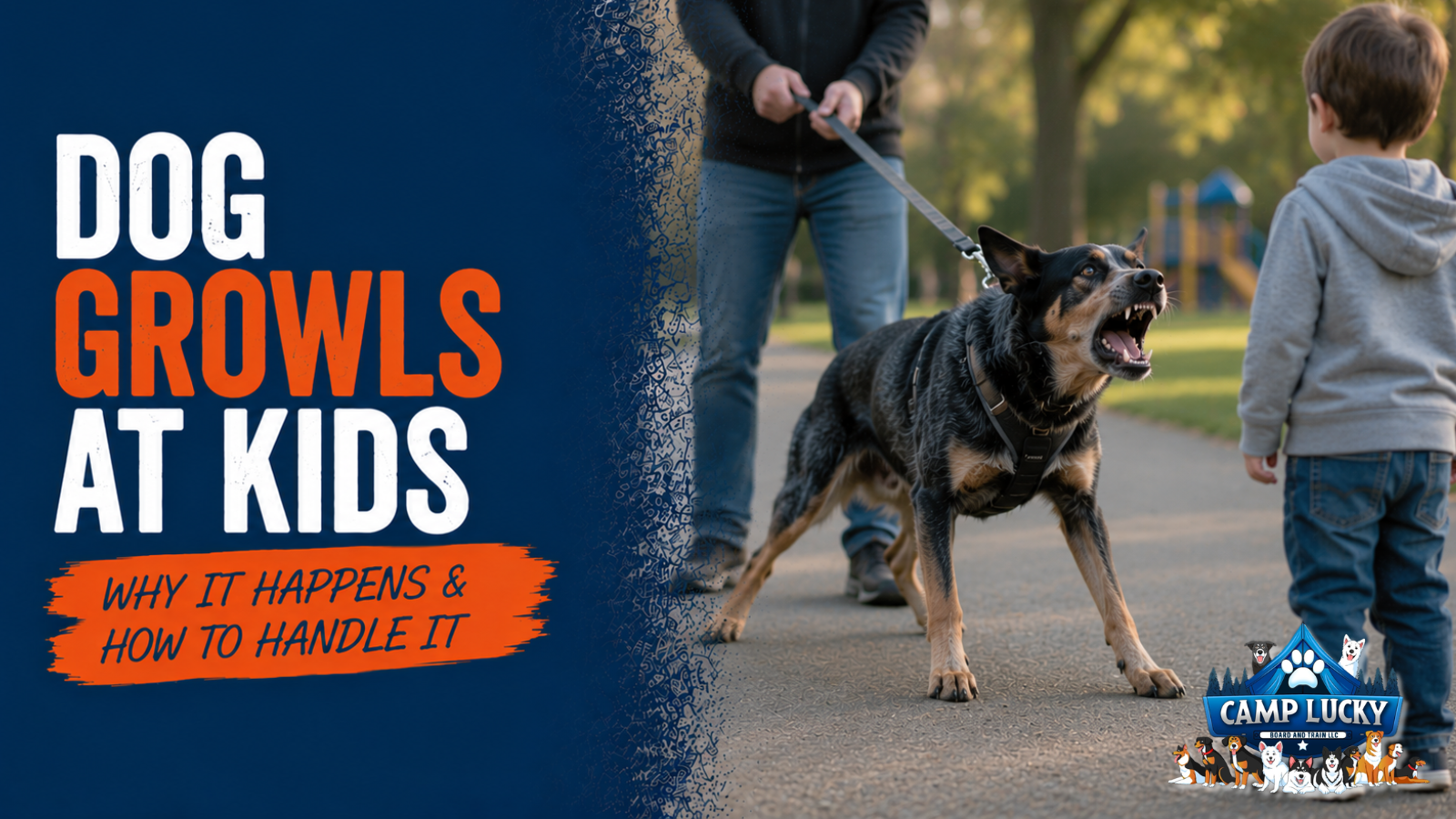
If your dog has growled at your child, your first instinct might be to punish them, but that could be the most dangerous decision you make.
Discover why trainers call punished dogs “silent biters” and what you should do instead to protect your family.
Key Takeaways:
- A dog’s growl at children is a safety warning signal indicating stress, fear, or discomfort, not aggression or dominance
- Punishing a growling dog creates dangerous “silent biters” who skip warning signals and attack without notice
- The Canine Ladder of Communication shows dogs escalate through subtle warning signs before growling becomes their last resort
- Professional desensitization and counter-conditioning techniques can safely change a dog’s emotional response to children
- Immediate separation without punishment, followed by expert guidance, prevents escalation to biting incidents
When a beloved family dog first growls at a child, parents experience a flood of panic, confusion, and guilt.
That split-second sound transforms a trusted companion into a perceived threat, leaving families wondering if their dog has suddenly turned dangerous.
The reality is far more complex, and far more hopeful, than most parents realize.
Why Your Dog’s Growl Is Actually a Safety Warning, Not Aggression
A growl represents one of the most important communications a dog can make.
Far from being an act of aggression, growling serves as a distance-increasing signal, the dog’s way of asking whatever is causing stress to move away.
Think of it as your dog’s version of saying “I’m uncomfortable, please give me space.”
This communication sits near the top of what behavioral scientists call the Canine Ladder of Communication, a sequential escalation model that begins with subtle stress signals.
Before a dog ever growls, they typically communicate discomfort through yawning, lip licking, turning their head away, showing “whale eye” (seeing the whites of their eyes), and freezing in place.
By the time growling occurs, multiple earlier warning signs have likely been missed or ignored.
Understanding this progression is vital for families because it reveals that growling rarely happens “out of nowhere.”
Professional dog trainers like those at Camp Lucky Board and Train emphasize that most dog-child incidents can be prevented by recognizing these earlier warning signals and addressing the underlying stress before it escalates to growling.
The Dangerous Truth About Punishing a Dog’s Growl
The most dangerous mistake parents can make when their dog growls at a child is to punish the behavior.
While the instinct to scold or correct might feel natural, this response creates a far more serious safety risk for children.
How Punishment Creates Silent Biters
When dogs are punished for growling, they don’t become safer, they become less predictable.
The dog learns that warning signals result in negative consequences, so in future stressful situations, they skip the warning entirely and go directly to biting.
This creates what trainers call “silent biters,” dogs who attack without any prior indication of distress.
Veterinary behaviorists and certified trainers widely agree that suppressing a growl without addressing the underlying cause dramatically increases bite risk.
The dog’s stress, fear, or discomfort remains unchanged, but their ability to communicate that distress has been eliminated through punishment.
The Smoke Detector Analogy Every Parent Should Know
Dog trainer Yamei Ross perfectly captures this concept: “Punishing a dog for growling is like taking the batteries out of your smoke detector.”
The warning system stops functioning, but the danger remains completely intact.
Parents who punish growling may temporarily stop the sound, but they haven’t addressed the fire, they’ve simply removed their early warning system.
This suppression also damages the trust between dog and owner.
The dog begins to view their family as a source of fear rather than security, further increasing their overall stress level and likelihood of reactive behavior.
Understanding the Canine Ladder of Communication
Dogs communicate their stress through a predictable sequence of signals, each becoming more obvious as their discomfort increases.
Recognizing this progression helps parents intervene before growling becomes necessary.
1. Subtle Warning Signs Parents Miss
The earliest stress signals are often subtle and easily overlooked in busy households.
Dogs may yawn when not tired, lick their lips when not hungry, or turn their head away from approaching children.
They might show “whale eye,” a sideways glance that reveals the whites of their eyes, or freeze completely in place.
These behaviors aren’t random quirks; they’re deliberate communications that the dog feels uncomfortable and needs space.
Children under 5 years old are developmentally unable to recognize these signals, making adult supervision and intervention necessary during this stage.
2. When Dogs Escalate to Growling
By the time a dog growls, they’ve typically exhausted their repertoire of subtle signals.
Growling represents their last clear attempt to communicate distress before physical intervention becomes their only perceived option.
This is why growls should always be taken seriously, regardless of the dog’s size or previous behavior.
The growl itself carries important information about the dog’s emotional state.
Dogs experiencing fear, resource anxiety, territorial stress, or accumulated overwhelm will use growling as their final diplomatic effort to resolve the situation without physical contact.
3. Air Snapping: The Final Warning Before Contact
If growling fails to create the necessary space, dogs may escalate to air snapping, a deliberate bite toward the perceived threat that doesn’t make contact.
This behavior demonstrates remarkable restraint from the dog, as they’re choosing to warn rather than bite despite feeling that all other options have been exhausted.
Air snapping should be considered an emergency signal that immediate intervention is required.
The next step in the escalation sequence is physical contact, making this the last opportunity to prevent an actual bite incident.
What Really Triggers Dogs to Growl at Children
Understanding why dogs growl at children helps parents address the root cause rather than just managing symptoms.
The underlying triggers are often more complex than they initially appear.
Fear and Anxiety Responses
Children present unique challenges for dogs due to their unpredictable movements, high energy levels, and different physical proportions.
Kids under 4 years old are at highest risk for dog bites to the head and neck area simply due to their height and tendency to approach dogs face-first.
Many dogs haven’t been adequately socialized to children during their critical developmental window (8-16 weeks of age).
For these dogs, children represent genuinely novel and potentially threatening stimuli.
Rescue dogs with unknown histories may carry fear conditioning from previous negative experiences with children that families will never fully understand.
The fear often intensifies because children’s natural behaviors, running, screaming, falling, making direct eye contact, and approaching dogs while they’re eating or resting, trigger defensive responses in dogs who lack the behavioral tools to process these interactions safely.
Trigger Stacking: When Stress Accumulates
“Trigger stacking” explains why dogs sometimes seem to “snap out of nowhere.”
This occurs when multiple minor stressors accumulate within a short period, pushing the dog past their behavioral threshold.
A dog might handle one stressor, a child running past, without incident.
But if that same dog was already stressed by loud noises, disrupted sleep, missed meals, or earlier handling, that child’s movement becomes the final trigger that produces a growl or worse.
Busy family households with irregular schedules, multiple children, and constant activity create environments where trigger stacking becomes the norm rather than the exception.
Dogs need quiet decompression time to regulate their nervous systems, and when this doesn’t occur, their stress accumulates throughout the day.
Immediate Action Steps When Your Dog Growls at Your Child
The moments immediately following a growling incident determine whether the situation improves or escalates.
Parents need a clear protocol that prioritizes safety while avoiding actions that worsen the underlying problem.
1. Separate Without Punishment
The first response must be environmental, not punitive.
Use baby gates, closed doors, crates, or leashes to create immediate physical distance between the dog and child.
Avoid scolding, yelling at, or physically correcting the dog, as these responses increase fear and make future incidents more likely.
Do not attempt to “try again” immediately.
The stress event has occurred, and both the dog and child need time to decompress before any re-introduction is considered.
Forcing immediate interaction while emotions and arousal levels remain elevated increases the risk of escalation.
2. Document the Trigger
Once safety is established, record the specific circumstances surrounding the incident.
Note what the child was doing, where the dog was positioned, what the dog was doing immediately beforehand, and any potential stressors that occurred earlier that day.
This documentation becomes necessary for identifying patterns and developing an effective training plan.
Many seemingly random growling incidents reveal clear triggers when multiple incidents are analyzed together.
Common triggers include children approaching while the dog is eating, resting, or possessing a valued item.
3. Rule Out Medical Causes
Schedule a veterinary examination, especially if the growling behavior represents a change from the dog’s previous temperament.
Pain dramatically lowers behavioral thresholds, and dogs experiencing discomfort from ear infections, dental issues, or orthopedic problems may become reactive to touch or sudden movements from children.
Medical causes are particularly suspected when previously tolerant dogs suddenly begin growling at children, or when the growling is associated with physical contact or specific body positions.
A thorough vet check eliminates pain as a contributing factor before behavioral modification begins.
Long-Term Solutions That Actually Work
Effective resolution of dog-child growling requires changing the dog’s underlying emotional response to children, not just managing their behavior.
This process demands consistency, patience, and often professional expertise to execute safely.
Desensitization and Counter-Conditioning Explained
The gold-standard approach for fear-based dog reactivity toward children combines two proven techniques.
Desensitization involves systematically exposing the dog to weakened versions of their trigger, such as a child at a distance, remaining still and quiet, at an intensity that produces alertness without reactivity.
Counter-conditioning pairs each sub-threshold exposure with something the dog values highly, such as high-value treats or play.
This creates a new, positive emotional association with the presence of children.
Over time, the dog’s conditioned response changes from “children mean danger” to “children predict good things.”
The process requires gradual intensity increases, with distance decreasing and child movement or noise slowly increasing only after the dog consistently shows relaxed, anticipatory responses to each prior level.
Rushing this progression or working above the dog’s threshold can worsen the fear response rather than improving it.
Why Expert Guidance Is Often Necessary
Owner-led desensitization programs frequently fail because families cannot reliably maintain the controlled conditions required for success.
Children are naturally unpredictable and mobile, making it difficult to maintain sub-threshold exposures consistently.
Additionally, the emotional reactivity of family members, including children’s responses to the dog’s behavior, becomes an uncontrolled variable that can sabotage progress.
Professional trainers provide the structured environment and expertise necessary to execute these protocols effectively while keeping everyone safe during the process.
Professional Training Can Restore Safety and Peace in Your Home
Behavioral modification for dogs who growl at children often requires intensive, professional intervention to create lasting change.
Board and train programs offer particular advantages for this complex behavioral challenge.
Residential training provides the controlled environment necessary for systematic desensitization and counter-conditioning work.
Professional facilities can precisely control the distance, movement, noise level, and frequency of child-stimulus exposure that family households cannot replicate consistently.
The immersive format accelerates progress through daily repetition and expert timing that would take months to achieve through weekly sessions at home.
Dogs also benefit from learning in a neutral environment free from the household stressors that may have contributed to the original problem.
Equally important is the owner education component that teaches families how to read early stress signals, maintain appropriate protocols, and continue reinforcing positive associations after the dog returns home.
Without this transfer of knowledge, even the most successful residential training may not produce lasting results.
The goal isn’t just managing a dangerous situation, it’s creating genuine emotional change that allows dogs and children to coexist safely and happily in the same home.