Is your dog’s aggressive behavior toward strangers actually a sign of fear, not dominance?
Most owners misread this crucial difference and accidentally make the problem worse with well-meaning responses that deepen anxiety instead of resolving it.
- Fear, not dominance, is the real driver behind most dogs’ negative reactions to strangers, and misreading this distinction often makes the problem significantly worse.
- The socialization window between 3 and 16 weeks is one of the most powerful predictors of how a dog will handle unfamiliar people for the rest of its life.
- Suppressing a dog’s growl through punishment doesn’t reduce fear — it removes the warning signal while the underlying anxiety stays fully intact, creating a more dangerous dog.
- Common owner responses like forcing greetings or flooding the dog with exposure can deepen fear rather than resolve it — keep reading to understand what actually works.
- Structured, immersive training environments — like those offered by board and train programs — can accelerate meaningful progress in ways that daily home management rarely achieves.
A dog that barks, lunges, or freezes when a stranger approaches isn’t trying to take charge of the situation.
It’s scared.
That distinction, fear versus dominance, changes everything about how the behavior should be understood and addressed.
Yet it’s one of the most consistently misread dynamics in dog ownership, and the confusion costs dogs and their owners months or even years of unnecessary struggle.
More Dogs Fear Strangers Than Most Owners Realize
Stranger fear is far more common in dogs than most people expect.
Research suggests that somewhere between 20 and 25 percent of dogs show some form of social fearfulness, and one large survey found that 22.3 percent of dogs studied were reported by their owners to show fear specifically toward unfamiliar people.
Some behavioral tracking data suggests the real number may be even higher in certain populations.
What makes this especially difficult is that the behavior doesn’t always look like fear.
A dog that barks at every guest who walks through the front door, growls when someone reaches out to pet it, or strains against the leash toward a stranger on the sidewalk can easily be read as bold, aggressive, or dominant.
Owners often describe these dogs as “protective” or “reactive” without recognizing that the root cause is anxiety, not attitude.
This misreading matters enormously, because the response a dominant dog needs and the response a fearful dog needs are almost complete opposites.
Treating a scared dog like it’s acting out of rank leads to interventions that make the fear worse, not better.
Understanding the real picture is the first step toward actually helping the dog.
Fear, Not Dominance, Drives the Behavior
When a dog reacts to a stranger, the question isn’t how it’s reacting, it’s why.
Two dogs can produce nearly identical behavior on the surface: barking, stiffening, pulling toward or away from a person.
But one may be operating from insecurity and perceived threat, while the other may be motivated by something else entirely.
Getting that distinction right changes the entire approach to training.
Why the Dominance Theory Is Scientifically Discredited
The idea that dogs misbehave because they’re trying to assert dominance over their owners or establish social rank over strangers has been widely rejected by the scientific and veterinary behavioral community.
The American Veterinary Society of Animal Behavior (AVSAB) has explicitly stated that dominance theory, as commonly applied to explain problematic dog behavior, is outdated and not supported by current evidence.
The dominance framework gained cultural traction largely through popular media, but it was never an accurate description of how dogs actually process social situations, especially with humans.
Dogs don’t lunge at the mail carrier because they’ve decided they outrank him.
They lunge because something about his arrival triggers a threat response in their nervous system.
Applying a dominance lens to that reaction leads owners toward confrontational responses, corrections, alpha rolls, forced submission, that address none of the underlying emotional state driving the behavior.
The result is often a dog that appears temporarily “fixed” but has simply been suppressed.
The fear is still there.
It just has fewer ways to express itself, until it finds a bigger one.
What Fear Aggression Actually Looks Like vs. True Dominance
True dominance aggression, where a dog attempts to control access to resources or social hierarchy, is actually quite rare. Far more common is fear aggression, which is characterized by defensive behavior aimed at creating distance from a perceived threat.
The dog isn’t trying to win.
It’s trying to escape.
Here’s a practical comparison owners often find clarifying:
- Growling at a stranger — commonly mistaken for aggression or disobedience; actually a warning signal and a request for more distance
- Backing away from a guest — commonly mistaken for stubbornness; actually fear-driven avoidance
- Barking at strangers on walks — commonly labeled territorial or dominant; actually alert barking rooted in anxiety or insecurity
- Snapping when cornered — commonly labeled unpredictable aggression; actually a defensive bite triggered when escape wasn’t available
- Hiding behind the owner — commonly mistaken for clinginess; actually a fear response and a search for security from a trusted person
Fear-based bites tend to be fast, sharp, and followed by retreat, because the dog’s goal was never to injure.
It wanted distance.
When every other signal it sent was ignored, biting became the only option that worked.
That’s a pattern created by misreading the behavior, not by the dog being fundamentally dangerous.
The Body Language Owners Miss
Most owners don’t realize their dog was communicating long before things escalated.
Fear doesn’t start with a growl.
It starts with signals so subtle that, without specific knowledge of dog body language, they’re nearly invisible, or easily misread as something else entirely.
Early Stress Signals: Lip Licking, Whale Eye, and Looking Away
Dogs communicate distress in layers.
The early signals are quiet and easy to miss, especially for owners who aren’t specifically watching for them.
These include:
- Lip licking — a rapid tongue flick over the nose or lips, unrelated to food
- Whale eye — the whites of the eyes become visible as the dog turns its head while keeping its gaze fixed on a perceived threat
- Yawning — not from tiredness, but as a self-calming signal in a stressful moment
- Looking away — a deliberate avoidance of eye contact that signals discomfort, not disinterest
- Panting when not hot — stress panting looks similar to heat panting but occurs in cool environments during tense encounters
If these early signals are missed or ignored, by the owner or by the approaching stranger, the dog has no choice but to escalate.
Displacement behaviors follow, then avoidance, then appeasement, and eventually growling, barking, and in some cases snapping.
The escalation isn’t random.
It’s a communication ladder, and every rung below a bite is the dog’s attempt to resolve a situation without using its teeth.
Why Suppressing Growling Creates a More Dangerous Dog
One of the most dangerous training mistakes an owner can make is punishing a dog for growling.
It’s understandable, growling is alarming, especially in front of guests or children, but correcting it doesn’t resolve the fear behind it.
It removes the warning.
Veterinary behavior literature documents this clearly: dogs that have been consistently punished for growling may appear calmer around strangers for a period, but they’ve simply lost the ability, or willingness, to signal before biting.
The underlying anxiety is unchanged.
What’s changed is that it now surfaces without the warnings that used to precede it.
A dog that used to growl before snapping now just snaps.
That’s not progress.
That’s a more dangerous dog with a less readable behavioral profile.
Growling is information.
It means the dog is over threshold and needs relief, more distance, less pressure, a way out.
The right response is to give it that relief, not eliminate the signal.
What Actually Causes Stranger Fear in Dogs
Stranger fear rarely has a single cause.
In most cases, it’s the result of multiple factors stacking together, developmental, genetic, and environmental.
Understanding which factors are at play matters, because it shapes both what progress is realistic and what training approach is appropriate.
The Socialization Window: 3-16 Weeks Is Everything
The research on this is striking and consistent: the primary socialization period, roughly 3 to 16 weeks of age, is the single most powerful developmental window in a dog’s life.
During this phase, puppies are neurologically primed to form associations with the world around them.
Positive exposure to diverse people, environments, sounds, and experiences during this time builds a nervous system that can handle novelty without fear.
The absence of that exposure leaves gaps that are genuinely difficult to fill later.
One of the largest survey-based studies on canine social fear found that inadequate socialization between 7 and 16 weeks was the biggest single predictor of fear toward strangers in adult dogs.
Research has also found that puppies weaned later, at or after 8 weeks, were more likely to develop stranger fear, a finding that highlights just how sensitive this developmental window is.
Once the window closes, new learning is absolutely still possible, but it takes considerably more time, more repetition, and more behavioral expertise to produce lasting change.
This is why dogs who missed early socialization typically benefit from professional intervention rather than informal exposure alone.
Genetics: Some Dogs Are Wired to Be More Fearful
Not every stranger-fearful dog had a difficult puppyhood.
Genetics play a measurable role.
Research has identified breed-level patterns in social fearfulness, with herding breeds in particular showing heightened sensitivity to environmental cues, a trait linked to genetic variants that overlap with fear responses and hyper-vigilance.
Some dogs carry a biological predisposition toward fear that socialization alone cannot fully override.
Breed patterns are worth noting.
Spanish Water Dogs, Shetland Sheepdogs, and certain mixed breeds tend to show higher rates of social fearfulness, while Labrador Retrievers tend to rank among the lowest.
For owners of more fear-prone breeds, adjusting expectations matters. The goal may be functional calm around strangers, not enthusiastic friendliness, and that’s a completely valid and meaningful outcome.
Trigger Stacking: Why Good Days Can Go Bad Fast
Owners of stranger-fearful dogs often describe their dog as “unpredictable,” fine one day, completely falling apart the next, even in situations that seemed manageable before.
This is almost always explained by trigger stacking.
Trigger stacking occurs when multiple stressors accumulate throughout a day without sufficient recovery time in between.
Each stressor adds to what behavioral scientists sometimes describe as a “cortisol bucket.”
Once that bucket overflows, the dog responds to stimuli it would normally handle with a disproportionate reaction, because it was already close to threshold before the final trigger even appeared.
A common stacking pattern might look like this: the dog heard a loud noise on the morning walk, then encountered an unfamiliar person at the park, then a delivery driver rang the doorbell, and then a guest arrived for dinner.
Any one of those events might have been manageable in isolation.
Together, they pushed the dog past its coping limit, and the guest got the full reaction of a dog that had been on edge all day.
Understanding trigger stacking is essential for owners who manage a stranger-fearful dog at home.
It reframes “bad days” from mysterious unpredictability into something logical and, importantly, something that can be managed proactively.
Common Owner Responses That Make It Worse
Most owners who make these mistakes aren’t being careless.
They’re trying to help.
The problem is that the natural, empathetic human response to a frightened dog is often the exact opposite of what the dog needs behaviorally.
Two specific patterns come up repeatedly.
Forcing the Greeting
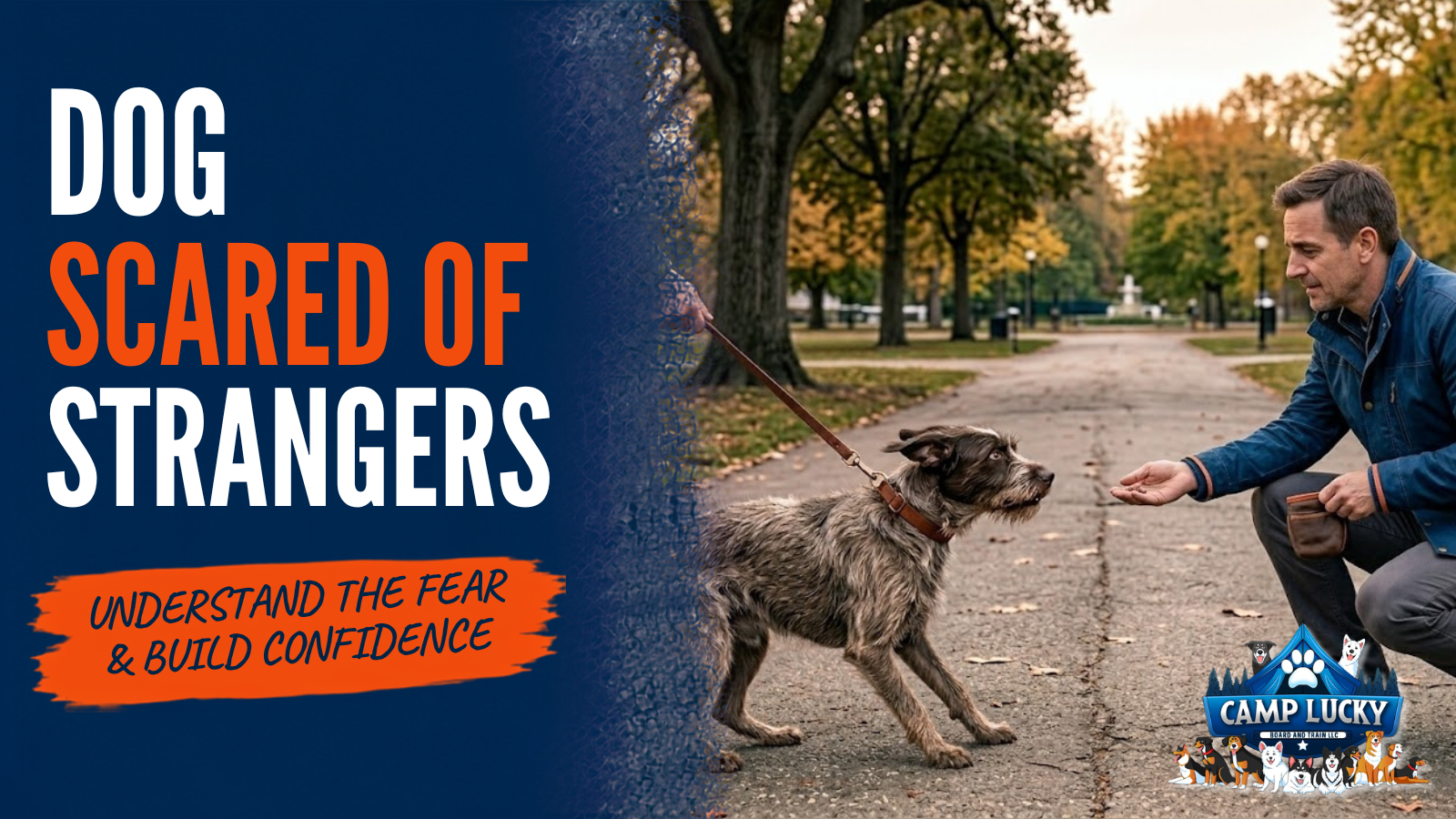
The instinct to help a scared dog “get used to” strangers by holding it still while someone pets it, or walking it directly toward the person it’s reacting to, is one of the most common and most damaging responses owners try.
The ASPCA has cautioned against forcing fearful dogs into interactions with strangers, as it can worsen fear and increase the risk of adverse reactions.
When a dog is restrained during an encounter it finds threatening, it learns something very specific: escape is not possible.
That lesson drives anxiety higher, not lower.
It also erodes the dog’s trust in the owner, the person who was supposed to be a source of safety is now the reason the scary thing keeps getting closer.
Over time, this pattern makes the dog more reactive, not less, and can accelerate the escalation ladder toward biting.
Punishing Fear-Based Reactions
Verbal corrections, leash pops, or any form of aversive response applied when a dog growls, barks, or reacts to a stranger does not address the emotional state driving the behavior.
It adds an additional threat, the owner’s correction, to an already overwhelming experience, which actively deepens the fear-stranger association in the dog’s brain.
The ASPCA and the American Veterinary Society of Animal Behavior (AVSAB) have explicitly advised against punishment for fear-based behavior for exactly this reason.
What owners sometimes interpret as improvement after punishment is usually suppression, the warning signals have been removed, not the fear behind them.
The risk is a dog that has lost its ability to communicate distress before reaching a bite.
What Evidence-Based Training Actually Involves
Effective treatment for stranger fear isn’t about flooding the dog with exposure or hoping it adjusts over time.
It’s a structured process built on three interconnected principles, none of which can be skipped without undermining the others.
1. Threshold Management: Never Train Above the Fear Line
Threshold is the distance at which a dog notices a stranger but hasn’t yet entered a fear response.
Training only works below that line, where the dog can still take food, maintain some focus, and process information.
Once a dog is over threshold, its amygdala is running the show, and learning stops.
A practical test: if the dog refuses high-value treats in the presence of a stranger, it’s already over threshold.
The right move is to increase distance immediately, not push through, not try a different treat, not wait it out.
Every over-threshold encounter reinforces the fear association.
Every sub-threshold encounter provides an opportunity to replace it.
This is why the common advice to “just expose them to more people” backfires without structure.
Frequency without threshold management isn’t desensitization.
It’s flooding, and it makes things worse.
2. Desensitization and Counterconditioning Done Right
Desensitization and counterconditioning (DS/CC) is the evidence-based gold standard for fear-based behavior.
The mechanics are specific:
- The stranger appears at or just beyond the dog’s threshold distance
- The stranger ignores the dog completely: no eye contact, no reaching, no vocal engagement
- Over time, strangers may toss treats to the side without approaching
The goal is to change the dog’s emotional association with strangers from “threat signal” to “predictor of good things.”
This isn’t simply rewarding a dog near a stranger.
Timing, distance, treat value, and pace of progression all determine whether the protocol works or stalls.
Done carelessly, it can actually confirm fear rather than undo it.
3. Giving the Dog Choice and Control
Dogs that are allowed to approach or retreat from strangers at their own pace build confidence faster and more durably than dogs that are pushed into encounters.
This isn’t permissiveness, it’s behavioral strategy.
An animal that retains agency in a scary situation learns that it can manage the situation.
An animal that has no choice learns helplessness instead.
Structural obedience training, sit, stay, place, heel, plays a supporting role here.
“Learn to Earn” approaches, where dogs earn access to food, walks, and attention through calm compliance, are well-supported in behavioral science as a way to reduce ambient anxiety by making the dog’s world more predictable and comprehensible.
Structure isn’t the same as pressure.
Delivered calmly and consistently through reward-based systems, it gives fearful dogs something to do with their arousal, and a reason to trust the outcome.
Why Professional Help Accelerates Progress
The science behind treating stranger fear is well-established.
The challenge has never been the theory.
It’s the execution, and executing DS/CC correctly in a real household, with real life happening around it, is genuinely difficult.
The DIY Breakdown: Why Consistency Is So Hard at Home
Successful desensitization requires things that everyday home life rarely provides:
- A controlled environment — strangers who will follow specific protocols: maintain distance, avoid eye contact, toss treats without reaching. Most real-world strangers do the opposite instinctively.
- Consistent threshold management — a single over-threshold encounter can undo days or weeks of progress. Busy households, sidewalk encounters, and well-meaning family members collapse this consistency regularly.
- Calm handler energy — when an owner is anxious about how the dog will react, that tension travels down the leash. Dogs read their handlers constantly, and owner anxiety actively cues fear and reactivity.
- Time and repetition — structured sessions multiple times per week, sustained over months. For most working adults or parents managing a household, this cadence is simply not sustainable.
Urban environments compound every one of these challenges.
High foot traffic, elevator encounters, crowded sidewalks, and unpredictable stimuli make threshold management nearly impossible without a professional framework guiding the process.
What a Board and Train Offers That Home Training Cannot
For dogs with stranger fear, immersive residential training offers something a weekly lesson or a self-guided protocol never can: controlled, repeated exposure across many different strangers, environments, and social contexts, consistently managed below threshold, every single day.
At Camp Lucky Board and Train, dogs live inside a trainer’s personal home rather than a kennel facility, which means they’re practicing real-world household behaviors around real foot traffic, mealtimes, door entries, and daily routines.
That context matters enormously for a stranger-fearful dog.
The training isn’t happening in a sterile arena, it’s happening in the kind of environment the dog actually needs to handle.
The built-in variety of people a dog encounters during a residential program, trainers, staff, other clients, and visitors of different appearances and movement patterns, provides the breadth of sub-threshold exposure that a single owner simply cannot manufacture at home.
Handler calm is also a constant rather than a variable: trainers working with fearful dogs aren’t emotionally invested in the outcome the way an owner is, which fundamentally changes how the dog experiences proximity to unfamiliar people.
Obedience training within the program plays a supporting role too.
Structured commands, sit, place, heel, stay, give an anxious dog a behavioral framework that reduces ambient stress.
When a dog knows what’s expected of it and that compliance produces predictable, positive outcomes, the world becomes less overwhelming.
That predictability itself is calming for a dog that has spent months reading every stranger as an unpredictable threat.
The transfer session at the end of a board and train program is where the owner’s role begins in earnest.
Skills built in a structured environment need to be maintained and generalized at home, and quality programs invest real time in coaching owners through that transition, because without it, regression is likely.
Fear Won’t Fix Itself — But It Can Get Better With the Right Approach
Stranger fear doesn’t resolve on its own with age, and repeated exposure without structure doesn’t wear it down, it usually deepens it.
But with the right approach, real progress is possible for most dogs, regardless of where the fear came from.
Progress timelines vary significantly.
Mild, recently developed fear with a motivated owner following a structured protocol can show measurable improvement within four to eight weeks.
Moderate fear rooted in incomplete socialization may take several months of consistent work before reliable calm generalizes to new strangers.
Deep fear, shaped by genetics, long reinforcement history, or a history of punishment, may take six months to two years of sustained effort, and for some dogs, the realistic goal is functional neutrality rather than enthusiastic friendliness.
That reframe matters.
A dog that no longer reacts badly to strangers, even if it never becomes the type to solicit petting from every person it meets, has achieved something meaningful and life-improving.
Owners who understand that as a valid outcome make more consistent, sustainable progress than those pursuing a transformation that was never realistic to begin with.
The tools are well understood.
The path is clear.
What it takes is accurate information, realistic expectations, and training that actually addresses the emotional state driving the behavior, not just the surface reaction.
If a dog in your life is struggling with stranger fear, we at Camp Lucky Board and Train work with dogs of any breed, age, and behavior level, including fear and reactivity cases, through structured residential programs designed to build real, lasting change.