If you are searching for dog training in Kansas City, chances are your dog is doing something that feels impossible to fix on your own.
Maybe it is pulling and lunging on the leash, maybe it is jumping on every guest, maybe it is barking at the mail carrier, or melting down every time you leave the house.
None of these behaviors are a life sentence, and understanding what is happening inside your dog’s brain is the first step toward changing them for good.
Key Takeaways
- Problem behaviors like leash reactivity, jumping, barking, and separation anxiety are not defiance. They are neurological stress responses driven by the amygdala, cortisol, and neurotransmitter imbalances.
- Once a dog crosses its arousal threshold, the thinking brain shuts down, which is why in the moment corrections rarely work without the right setup.
- Adolescent dogs, roughly six to eighteen months old, go through brain rewiring that can turn a calm puppy into a dog with sudden behavior problems. This is biology, not bad behavior.
- DIY dog training often fails because owners unknowingly practice the unwanted behavior over and over, reinforcing the very pattern they are trying to stop.
- Our board and train and in-home dog training programs in Kansas City are built around controlling thresholds and repeating calm exposures, which is how the brain actually builds new defaults.
Every Kansas City dog owner who has been yanked across a sidewalk, pulled off the couch by a jumping puppy, or convinced their house feels like chaos knows the same sinking feeling.
What am I doing wrong?
The short answer is probably nothing.
The longer answer has everything to do with what is happening inside the dog’s brain, and it is exactly what our dog training programs are built to address.
Your Dog Isn’t Misbehaving, Their Brain Is Hijacked
When a dog spots a trigger, whether that is another dog on a leash, a jogger, a doorbell, or food left on the counter, and launches into barking, lunging, jumping, or grabbing, that reaction is not a choice.
A neurological alarm fires faster than any conscious thought can form, and for a few critical seconds the dog’s higher brain functions are essentially offline.
Scolding a dog mid reaction, or yanking a leash or pulling a dog off the counter hoping to snap them out of it, targets a rational process that simply is not happening in that moment.
The behavior is not stubbornness. It is a system doing exactly what evolution designed it to do: protect the animal from a perceived threat or capture an easy reward.
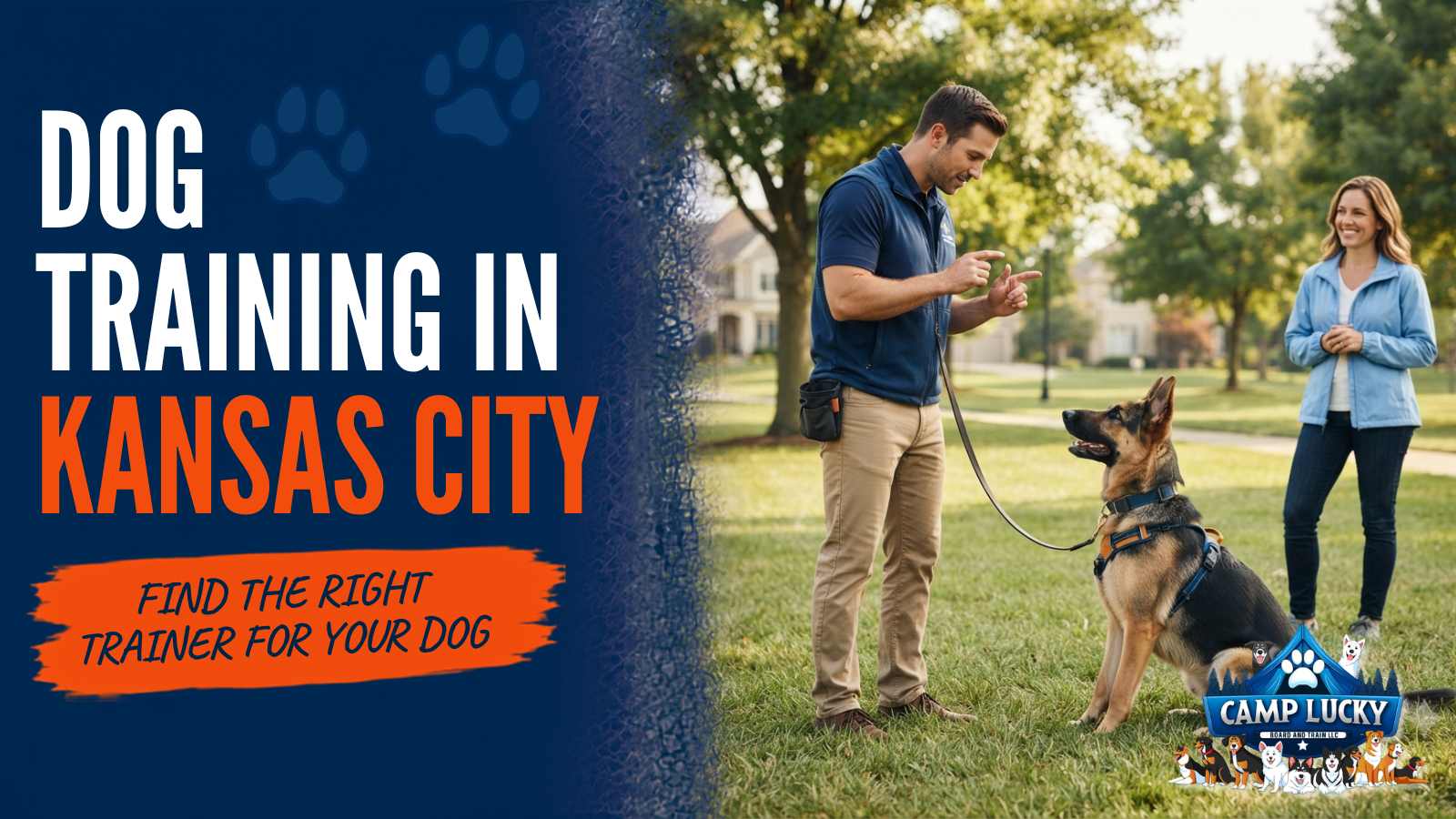
We are Camp Lucky Board and Train, a Kansas City dog training program founded by veteran military K9 handler Aaron Rustici, and every program we run is built around this biology, addressing the neurological root rather than just the surface behavior.
The Amygdala: The Brain’s Alarm System
At the center of nearly every problem behavior is a small, almond shaped brain structure called the amygdala.
Its job is to scan the environment for threats or opportunities and trigger an immediate response before the thinking brain has a chance to weigh in.
In dogs with reactivity, anxiety, or impulse control issues, research on fear related behavior suggests the amygdala fires with heightened sensitivity, producing automatic reactions to stimuli that a calmer dog might barely notice.
Fight-or-Flight Before Thought
The amygdala bypasses rational processing entirely and sends the body into a fight or flight state within milliseconds.
Heart rate spikes, muscles tense, and the dog is already mid lunge, mid jump, or mid bark before any training cue has a chance to register.
These episodes feel sudden because they are. The dog is not building up to the reaction, the reaction is the first event.
Why Cortisol Makes Training Harder
The fight or flight response floods the body with cortisol, the primary stress hormone.
During and after a stressful episode, elevated cortisol can linger in the bloodstream for up to 72 hours, a period sometimes called a cortisol hangover.
During this window the dog is more sensitive, more reactive, and significantly less capable of learning.
Training attempted while cortisol is still elevated largely will not stick, which is exactly why repeated stressful episodes do not just maintain a problem. They compound it.
Neurotransmitters Behind Problem Behaviors
Cortisol is not the only chemistry at play.
The broader neurotransmitter environment shapes how prone a dog is to reactivity, anxiety, and impulsive behavior in the first place.
Serotonin, Dopamine, and Anxiety
Research into canine behavior has linked imbalances in serotonin and dopamine to heightened aggression, anxiety, and reactive responses.
Serotonin plays a calming, regulatory role, and low levels are associated with increased fear based aggression.
Dopamine drives arousal and motivation, and too much activation in stressful contexts can accelerate a behavioral spiral rather than slow it.
These are not personality flaws. They are chemical realities that no amount of better owner advice is going to fix on its own.
Adolescence Rewires Behavior
One of the most misunderstood triggers for problem behavior is completely normal: adolescence.
Between roughly six and eighteen months, a dog’s brain undergoes significant neurological pruning, a restructuring process comparable to human puberty.
Neural pathways that seemed solid suddenly weaken, recall vanishes, and impulse control regresses.
Dogs that walked politely at five months begin lunging at ten, and puppies that greeted guests calmly start jumping, mouthing, or barking without warning.
Kansas City’s active rescue culture adds another layer to this pattern.
Wayside Waifs, the area’s largest no kill shelter, places more than 5,400 animals every year, and many adopters bring home dogs with unknown histories and missed socialization windows.
Many dog owners across the metro are seeing this pattern play out firsthand. Dogs adopted during peak adoption years are now in their adolescent phase, with behavior that has escalated unexpectedly.
This is not the dog forgetting its training. It is a brain in active reorganization that is temporarily less capable of the impulse regulation it had just started building, and it calls for structured intensification, not frustration.
Why DIY Dog Training Often Fails in Kansas City
Armed with online tutorials, a new harness, and genuine commitment, many Kansas City owners pour weeks into working with a dog on leash pulling, jumping, barking, or counter surfing, and get nowhere.
The brain science explains why.
Why Many Owners Miss the Threshold Problem
Every dog has an arousal threshold, a line between aware of a trigger and consumed by it.
Once over threshold, the amygdala is running the show and learning stops entirely.
Walking a reactive dog through a busy park, or letting an overexcited dog greet every guest at the door, is not training, it is rehearsal, and the dog gets better at the very behavior you are trying to stop.
Timing compounds the problem, since owners often mark or correct a behavior a beat too late, which means they end up reinforcing the recovery from the behavior rather than the behavior itself.
Inconsistency Teaches the Wrong Lesson
In households with multiple people, dogs often receive completely different rules from different family members.
One person allows jumping, another tries to correct it, one lets the dog greet every visitor, another tries to redirect, and dogs do not generalize rules the way people expect.
Accidental reinforcement compounds the problem further, since a dog that jumps and gets pushed away is still getting touched, and a dog that barks and watches the mail carrier walk away has just been rewarded for barking.
How Our Dog Training Approach Rewires the Brain
The brain that learned a problem behavior can learn something different, and that is not optimism, it is neuroscience.
Counter-Conditioning and Neural Pathways
Counter-conditioning works by repeatedly pairing a trigger with something positive, not to distract the dog, but to literally change the emotional association stored in the brain.
Over many consistent repetitions below threshold, new neural connections form and strengthen through a process neuroscientists call long-term potentiation.
The trigger stops predicting danger or excitement and starts predicting something neutral or good, and the amygdala’s alarm quiets.
How E-Collars Interrupt Problem Behavior Loops
In our balanced training programs, tools like the e-collar serve a specific neurological function, pattern interruption.
When a dog begins escalating toward threshold, whether that is barking at the door, lunging at another dog, or bolting after a squirrel, a precise, low level stimulus from a remote collar can break the arousal loop before it peaks.
We use the ET300 by E-Collar Technologies, applied at the minimum level needed to get a response, and every program is built on a foundation of positive reinforcement first.
The goal is communication, not discomfort, a clear signal in a moment when the dog’s brain is otherwise too flooded to process verbal cues.
Board and Train in Kansas City: What Our Program Looks Like
Knowing the neuroscience is one thing, applying it consistently enough to produce real change is another, and that is the argument for an immersive dog training program over a few YouTube videos.
Controlled Thresholds Build New Defaults
A professional trainer controls what an owner cannot: the environment.
Dogs in our board and train program are never placed in situations where they are over threshold and practicing the unwanted behavior.
Exposure is carefully calibrated, close enough to the trigger to engage the dog’s awareness, far enough to keep the thinking brain online, and done hundreds of times across days and weeks.
The dog does not just learn to suppress the reaction, it genuinely stops experiencing the trigger as a threat.
Life Inside the Program
At Camp Lucky, dogs live inside a trainer’s personal home rather than a kennel facility.
Training happens in a realistic domestic environment, with real foot traffic, actual mealtimes, and genuine door activity, the same contexts where most problem behavior shows up at home.
Our programs typically run one to four weeks depending on the dog, and we identify each dog’s specific trigger profile, whether that is leash reactivity, jumping, resource guarding, or separation related anxiety, before targeting it directly.
We also offer in-home lessons for owners who want hands-on coaching without a residential stay, and payment plans are available to make the program accessible.
Every day of board and train, we send a report card so owners can see the progress as it happens instead of waiting until pickup.
Answering the Biggest Fear: Will My Dog Forget Me?
The most common fear we hear from Kansas City owners considering board and train is that their dog will forget them or bond with someone else.
That fear is understandable, but it is not how attachment works, dogs do not transfer years of bonding in a few weeks.
What actually happens is the opposite, owners tell us the relationship improves because the dog finally has clear rules and the owner finally has a dog who can listen.
At pickup, we walk owners through the training their dog learned so the skills transfer home instead of staying with us.
Dog Training Kansas City: Let’s Build Your Dog’s New Foundation
Leash reactivity, jumping, counter surfing, door bolting, and separation anxiety are not character flaws, and none of them are permanent.
They are learned neurological patterns, built through repetition and stress chemistry, and the same mechanisms that created them are the mechanisms that can change them.
For Kansas City dog owners exhausted by walks that feel like battles or a house that feels like chaos, the path forward is not more willpower or another online video, it is the right training environment.
That is what we built Camp Lucky to provide, and it is why our board and train and in-home dog training programs exist.
Learn more about our dog training programs in Kansas City at campluckytraining.com/kansas-city.