If your dog transforms into a completely different animal the second they spot a squirrel, you’re not dealing with disobedience, you’re dealing with neuroscience.
Understanding what’s actually happening in their brain changes everything about what training can accomplish.
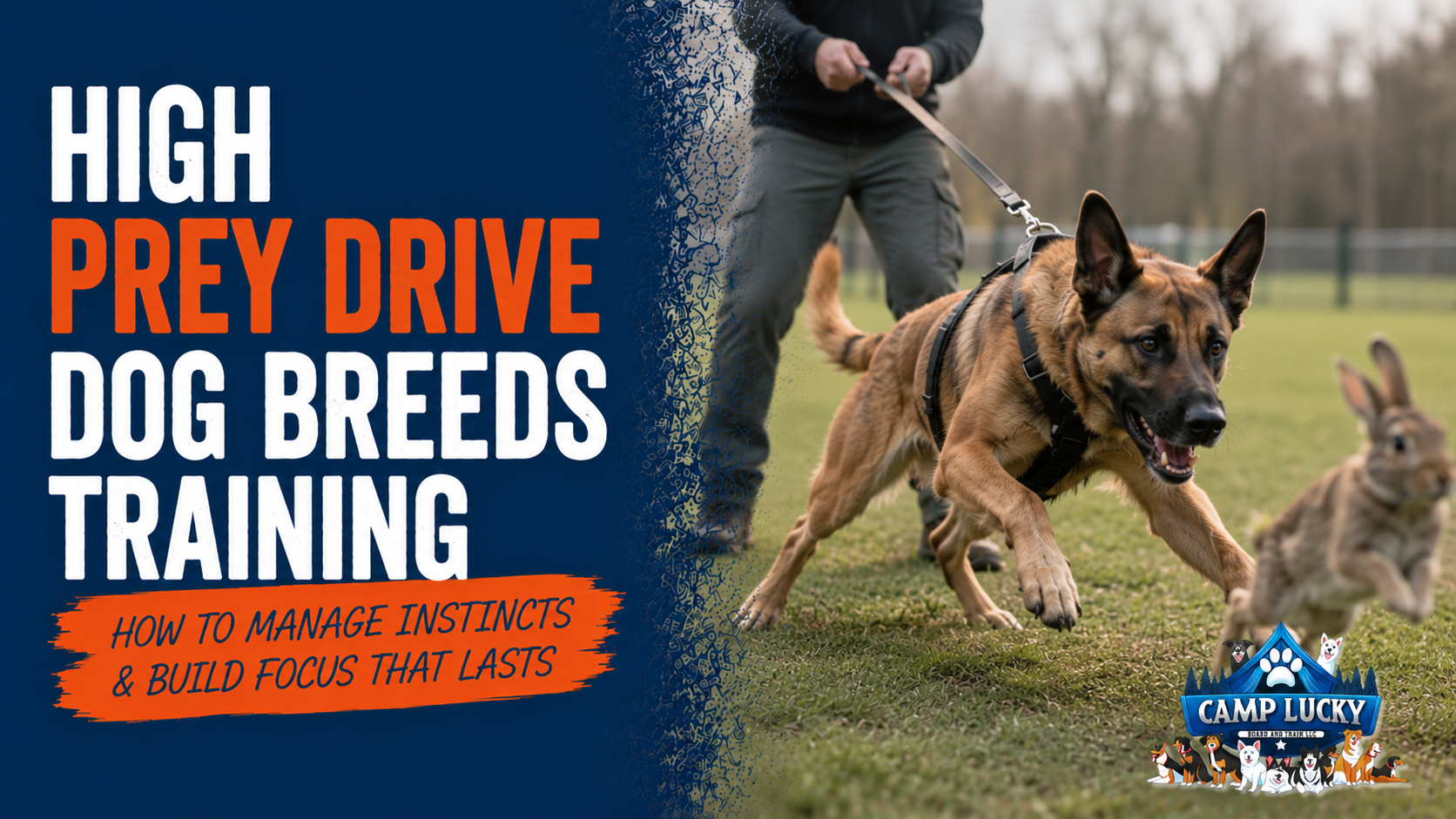
- High prey drive is not disobedience — it’s a hardwired neurological state triggered by movement, and understanding that distinction changes everything about how training should work.
- The most common advice, more exercise, high-value treats, better socialization, fails these dogs because it doesn’t address the actual neurobiology driving the behavior.
- Effective training works from the predatory sequence itself, using impulse control and threshold management as the two non-negotiables before any reliable off-leash control becomes possible.
- Board and train programs can deliver a volume and consistency of training that owners simply can’t replicate on their own, but the owner’s role after the program is just as critical as the training itself.
- Keep reading to understand exactly what’s happening in your dog’s brain during a prey drive episode, and what a real training framework actually looks like from the inside.
If you own a Belgian Malinois, Siberian Husky, Border Collie, Jack Russell Terrier, or any other breed with serious prey drive, you’ve probably had a version of the same experience: your dog is calm, sweet, and responsive at home, then a squirrel appears, and it’s like you don’t exist.
No amount of treat-waving, voice commands, or leash corrections seems to matter.
That’s not a training failure on your part.
That’s neuroscience.
Your Dog Isn’t Disobedient — Their Brain Is Hijacked
When a high prey drive dog locks onto a moving target, the brain shifts into a distinct operational mode.
Reward and arousal systems flood with dopamine and norepinephrine.
At that point, the dog isn’t ignoring commands, the dog is physiologically incapable of processing them the way it would in a calm state.
This is the Predatory Motor Sequence (PMS) at full activation: Orient, Eye, Stalk, Chase, Grab-Bite, Kill-Bite, Dissect, Consume.
It’s not one behavior, it’s a chain of behaviors, each one releasing its own neurochemical reward.
The mesolimbic dopamine system, the same reward pathway that drives hunger and thirst, fires at each phase.
That’s why a dog in full chase will run past a dropped piece of steak without blinking.
The dopamine system is already running at capacity.
No external food reward can compete.
This is also why the common framing of stubborn or dominant falls apart under scrutiny.
A dog ignoring a recall during an active chase isn’t asserting social hierarchy.
The dog is in a neurologically altered state where the recall command is competing against an instinct that evolution has been refining for tens of thousands of years.
Treating it as a dominance problem, and responding with punishment, escalates arousal, erodes trust, and makes the behavior more unpredictable over time.
Understanding this distinction is the foundation that dog trainers like us at Camp Lucky Board and Train build everything else on.
Before any method makes sense, the owner has to understand what they’re actually working with.
Why Common Advice Fails These Dogs
The advice most owners receive is well-intentioned, and almost entirely ineffective for high prey drive breeds.
Not because the advice is wrong in general, but because it doesn’t account for the specific neurobiology at play.
Three pieces of advice come up constantly, and all three miss the mark in the same fundamental way.
High-Value Treats Can’t Compete with Dopamine
Food rewards work when the dog’s motivational system is accessible to external input.
During active prey arousal, it isn’t.
The mesolimbic dopamine system is already engaged at maximum capacity, the behavior itself is the reward.
This is what researchers call intrinsic reinforcement: the predatory sequence doesn’t need anything added to it to feel rewarding to the dog.
Every chase, even one where the dog never catches anything, strengthens the neural pathway.
Trying to redirect a dog mid-sequence with a piece of chicken isn’t just ineffective, it’s the wrong tool for the neurological problem in front of you.
More Exercise Rehearses the Drive, Not Resolves It
Physical exhaustion and neurochemical resolution are not the same thing.
A two-hour run that ends with the dog lunging at three cyclists hasn’t reduced the drive, it may have rehearsed it.
What matters isn’t whether the dog is tired.
What matters is whether the predatory sequence was completed in a healthy, structured way, or whether excess arousal accumulated through repeated partial activations with no resolution.
A controlled 15-minute flirt pole session that allows the dog to orient, stalk, chase, grab, and possess a toy will produce noticeably deeper calm than an hour of unstructured running.
The difference is neurochemical completion, not caloric expenditure.
Socialization Doesn’t Touch a Hardwired Instinct
Socialization is genuinely valuable, for reducing fear-based reactivity.
But prey drive and reactivity are neurologically distinct.
A reactive dog relaxes when the perceived threat disappears.
A high prey drive dog escalates as the prey object retreats, because the chase sequence has been triggered but not completed.
Socialization addresses familiarity and emotional security.
It has minimal effect on a dog whose predatory instinct fires in response to visual motion, regardless of how familiar the target is.
These require fundamentally different training frameworks, and conflating the two is one of the most common reasons owners cycle through trainers without results.
The Predatory Sequence Trainers Actually Work From
Every effective training approach for prey drive dogs starts from the same place: a working understanding of the predatory motor sequence and where in that sequence a specific dog operates most intensely.
The sequence is the blueprint.
Ignoring it, or trying to suppress it wholesale, is why so many training attempts fail.
Each Breed Has a Different Phase Amplified by Genetics
Selective breeding didn’t just increase prey drive in general, it amplified specific phases of the sequence in specific breeds.
Sighthounds like Greyhounds and Whippets were bred primarily for the chase phase: visual motion triggers instant arousal, and the sequence fires fast.
Terriers like Jack Russells were selectively bred for the grab-bite and kill-bite phases, which is why they’re relentless once engaged and difficult to interrupt mid-sequence.
Herding breeds like Border Collies have the eye-stalk phase amplified while the kill sequence is largely inhibited, which is why they fixate and herd rather than attack.
This distinction isn’t academic.
A Border Collie obsessively circling children is expressing stalk-chase drive, not predatory aggression.
A Jack Russell that has killed a rabbit has completed the full neurological sequence and received the full chemical reward that drives the behavior to repeat.
These dogs cannot be trained the same way, with the same tools, at the same pace.
The breed-specific phase profile determines which substitutes and outlets are neurologically satisfying, and which ones leave the dog more aroused, not less.
An Incomplete Sequence Leaves the Dog More Aroused, Not Less
This is one of the most practically important insights in prey drive training, and one of the least understood by owners.
The completion of the predatory sequence matters deeply to a dog’s emotional regulation.
The grab-bite and kill-bite phases, along with possessing prey, produce endorphin release that begins the downward slope of the arousal curve.
The dissect and consume phases flood the system with hormones that counteract the adrenaline used during the chase, returning the dog to neurological homeostasis.
When a prey sequence is interrupted, a leash jerk mid-chase, a distraction that breaks the stalk, without a structured substitute outlet, the arousal curve has been opened but not closed.
The dog is left in a frustrated, escalated state.
Over time, repeated incomplete sequences can actually lower a dog’s trigger threshold, making them more reactive with each exposure.
This is why trainers structure sessions around completion, not interruption, and why identifying the right substitute for each breed’s dominant phase is the foundation of the work.
Impulse Control and Threshold: The Two Non-Negotiables
Before reliable off-leash control, before real-world distraction work, before any of the advanced skills become possible, two foundational elements have to be in place.
Trainers who work with high prey drive dogs consistently identify the same two non-negotiables: threshold management and impulse control.
They address different parts of the problem, and both are required.
Threshold Management: Intervene at the Lock, Not the Chase
Threshold is the point at which a dog’s arousal escalates past the level where they can process and respond to handler input.
Below threshold, the dog is cognitively accessible, they can hear commands, make choices, and respond to reinforcement.
Above threshold, the predatory sequence has taken over, and no cue short of a significant physical interrupt will break through.
The critical skill for owners, and the one that takes the most practice, is learning to identify and intervene at the very first moment of orientation toward a stimulus, before arousal has escalated through stalk and chase.
That initial lock of attention, where the dog’s ears rotate and the body lowers slightly, is the window.
By the time full chase has begun, roughly 90% of the recall opportunity has already closed.
Threshold management means structuring every walk and exposure so the dog encounters stimuli at a distance where they can still disengage, then building that distance down systematically over time.
Impulse Control: Inserting a Trainable Gap Between Stimulus and Action
Impulse control is the capacity to pause between perceiving a stimulus and acting on it.
In a high prey drive dog, that gap is essentially zero at full arousal, the sequence fires and the body follows.
The goal of impulse control training is not to suppress the drive, but to build a consistent, trainable pause that the handler can work within.
This gets built through structured repetition in low-stakes contexts first: sit before the food bowl goes down, wait at doorways, hold a down-stay while a toy is dropped nearby.
Structured tug games are particularly effective, the dog must sit before the game begins and drop on command to restart it.
Each of these exercises teaches the same thing: controlled behavior unlocks access to what the dog wants. Drive isn’t punished, it’s governed.
That distinction is what makes the training stick.
How Board and Train Accelerates What Owners Can’t
There’s a structural reality to training a high prey drive dog that no amount of owner effort fully overcomes: the volume of repetition required to rewire deeply reinforced behavioral patterns is higher than most owners can realistically deliver.
This isn’t a criticism, it’s just math.
A professional trainer working with a dog full-time in an immersive environment can deliver 10 to 20 times the daily training repetitions that the average owner manages around work, family, and everything else.
That volume gap is where board and train programs earn their place.
Repetition Volume No Owner Can Realistically Match
Behavioral change in dogs, especially in deeply wired instinctive patterns, is built through repetition under the right conditions.
Impulse control around a moving trigger needs to be practiced dozens of times per day during the critical formation period, not a few times per week.
In a board and train environment, every interaction with the dog is a training opportunity: mealtime, doorways, walks, rest periods.
The consistency across a full day compounds in ways that weekly lessons simply can’t replicate.
Controlled Prey Stimulus Exposure at Precise Threshold Distances
Managing prey stimulus exposure at sub-threshold distances requires a level of environmental control that most owners can’t engineer on a standard walk.
Professional trainers can stage specific triggers at known distances, systematically decrease that distance as the dog demonstrates reliable disengagement, and retreat immediately if arousal starts to escalate.
This kind of graduated, precision exposure, repeated dozens of times per session, is what produces real threshold expansion.
Dogs live inside a trainer’s personal home during the program, not in a kennel, which means training is embedded in realistic daily routines: mealtimes, door manners, foot traffic, and unpredictable household activity all become part of the curriculum.
In-Home Boarding Builds Real-World Habits — But Owners Must Maintain Them
The most important truth about board and train outcomes, and the one most under-communicated, is that the dog’s behavior at the facility will always be better than their behavior at home immediately after return.
That’s not a failure of the program.
It’s how behavioral generalization works.
The dog has built new habits in the trainer’s context, with the trainer’s handling cues and environment.
Transfer to the owner’s home requires deliberate, structured repetition by the owner.
Programs that invest heavily in owner handover coaching, real-world practice sessions with the owner present, clear maintenance protocols, and ongoing follow-up support, produce substantially better long-term outcomes.
The board and train is an accelerant.
The owner’s consistent follow-through is what makes it permanent.
Where Balanced Training and E-Collars Fit In
The tools used in high prey drive training generate more debate than almost any other topic in professional dog training.
Most of that debate focuses on electronic collars, and the question isn’t really whether they work, but whether they’re being used correctly and for the right reasons.
The nuance matters significantly.
Why Food Rewards Alone Fall Short During Active Arousal
Positive reinforcement using food rewards is a legitimate and effective foundation tool, particularly in the early stages of training, when the dog is learning new commands in low-distraction environments.
The problem isn’t the method.
The problem is what happens when that dog is at or near threshold in a real-world environment.
During active prey arousal, the intrinsic reward of the predatory sequence overwhelms any external food-based reinforcement.
The motivational system that food rewards access is simply not competitive with a brain flooded with dopamine from a live trigger.
This is why balanced training, a framework that combines positive reinforcement with fair, well-timed corrections, tends to produce more reliable real-world results for high drive breeds.
E-Collars as Communication Tools, Not Punishment
When used correctly by experienced trainers, electronic collars function as a remote communication tool, not a pain delivery device.
At low stimulation levels (often below what a human can detectably feel), the collar delivers a tactile cue that can reach through arousal states where verbal commands cannot.
The guiding principle is straightforward: if the dog yelps or shows distress, the application is wrong.
A 2024 study by Johnson and Wynne found that when e-collars were used by expert trainers, dogs stopped chasing a lure within one to two sessions, with no significant cortisol spikes observed during the study period.
It’s worth noting that other researchers have raised questions about the generalizability of these results to novel situations and whether standard welfare measurements fully capture long-term stress effects, which is precisely why e-collar training belongs in professional hands during the formation period, with owners trained on maintenance use before handover.
The key variable in every credible study on the subject is the same: handler knowledge and timing.
In untrained hands, the same tool can create fear associations and worsen reactivity dramatically.
Reliable Off-Leash Control Is Possible — With the Right Framework
For owners who have spent months white-knuckling a leash through every walk, the idea of reliable off-leash control can feel like fantasy.
It’s not, but it requires realistic expectations about what the process involves and how long it takes.
Recall in a high prey drive dog is not a basic obedience command.
It is an advanced behavior that asks the dog to voluntarily interrupt a neurologically rewarding sequence and return to the handler instead.
Building that behavior to the level where it holds under real-world conditions requires a specific sequence: a solid recall trained in zero-distraction environments first, then graduated exposure to stimuli at sub-threshold distances, then reinforcement that’s actually competitive with the drive reward, often a tug toy, a chase game, or movement rather than food.
The recall cue also needs to be protected: never call the dog from a situation where recall is guaranteed to fail.
Every failed recall attempt dilutes the cue.
For some breeds, sighthounds especially, fully reliable recall in open environments may never be a realistic goal, and experienced trainers are honest about that.
Responsible ownership sometimes means accepting biological constraints rather than testing them.
But for the vast majority of high prey drive dogs, consistent application of threshold management, impulse control, drive-channeling outlets, and the right communication tools produces a dog that is genuinely manageable, reliably responsive, and noticeably safer in the real world.
That’s not a small thing, and for most owners, it changes the entire relationship with their dog.
To find out what a structured, professional approach looks like for your specific dog, we at Camp Lucky Board and Train offer free in-home consultations across multiple locations to help owners find the right starting point.