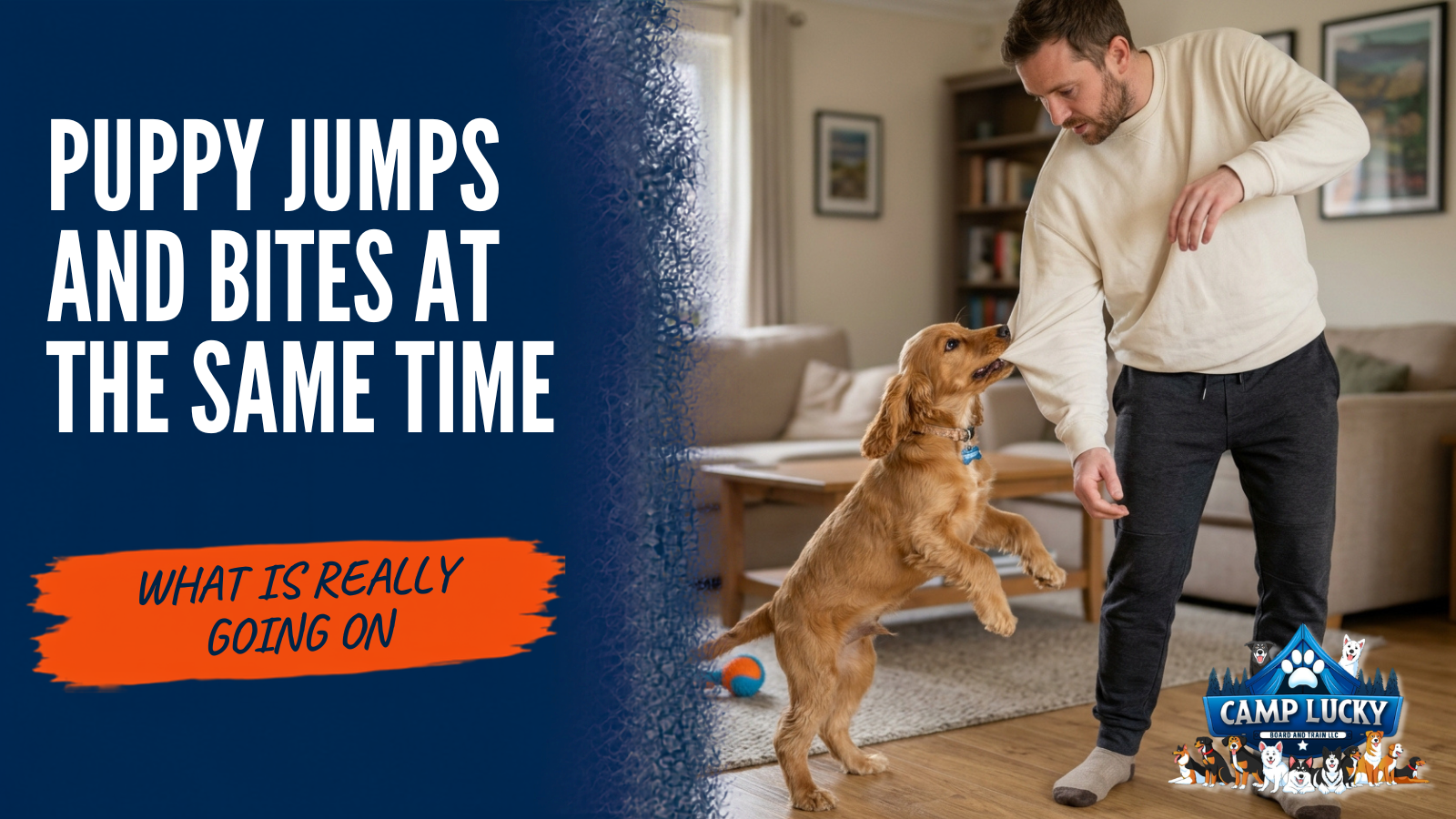
Your puppy jumps and bites at the same moment, and it feels like two problems.
A Lee’s Summit trainer says there’s actually one root cause, plus a few surprisingly common reactions that make things worse.
Key Takeaways
- Jumping and mouthing that happen together usually come from one burst of excitement, frustration, or tiredness rather than two separate behavior problems
- Scolding, pushing, or squealing can accidentally add attention and keep the cycle going instead of calming it down
- Rewarding four paws on the floor and offering a toy before a puppy gets too wound up are two simple ways to shape calmer greetings
- A one-week board and train program for puppies and newly adopted dogs is one option Lee’s Summit owners can look into for extra support with foundational manners
- Growling, stiffening, snapping, or a sudden change in biting intensity are signs it may be time to call a vet or a qualified trainer
A puppy that launches off the ground and grabs at hands the second someone walks in the door can feel like two bad habits happening at once.
In most cases, it is really just one.
A single wave of excitement rolls through the puppy’s body, and jumping and mouthing both become outlets for the same overloaded feeling.
Why Jumping and Biting Are One Problem
Jumping and mouthing often show up together because they come from the same source: a puppy that is too excited, too tired, or too frustrated to manage its own body.
Both behaviors are attempts to reach a person’s face, hands, or attention, and both tend to spike during greetings, play sessions, or the restless evening hours when a young dog has run out of self-control for the day.
Treating jumping and biting as one event rather than two separate training problems makes the whole situation easier to handle.
Owners can focus on lowering the puppy’s arousal level and rewarding calmer choices, which naturally brings both behaviors down together.
We at Camp Lucky Board and Train work with puppies on this kind of foundational manners work, building routines that help a young dog settle into calmer greetings and gentler play from the start.
Most puppies grow out of the worst of this phase as they mature and their teeth finish coming in, but the months in between call for a consistent approach.
Understanding the shared root cause is the first step toward a plan that actually works.
What’s Really Driving the Behavior
Excitement, Frustration, or Fatigue
A puppy that jumps and mouths at the same moment is rarely being defiant.
The behavior tends to trace back to one of a few familiar triggers that build up faster than a young dog can regulate.
- Excitement during greetings, play, or anything new happening nearby
- Frustration when a puppy wants something, like reaching a person or another dog, and cannot get to it
- Fatigue, since an overtired puppy often behaves like an overtired toddler, with less control over impulses and more mouthing
Play itself is a normal part of how puppies learn to use their mouths.
The goal is not to stop all mouthing overnight, since that is part of how a puppy develops a softer mouth over time.
Instead, the aim is to teach gentler pressure and redirect the behavior toward toys instead of skin or clothing.
Why Pushing, Scolding, or Squealing Backfires
It can feel natural to push a jumping puppy away or yelp when teeth land on skin, but these reactions often add fuel to the fire.
A puppy does not read a push the way a person would.
Physical contact and a raised voice both register as attention, and attention is often exactly what an excited puppy is looking for.
Scolding carries a similar risk.
A sharp word or a stern tone can come across as part of the game rather than a correction, especially to a puppy that is already keyed up.
For some dogs, a loud or high-pitched reaction actually ramps up the excitement and leads to more jumping and mouthing.
Calmly withdrawing attention tends to work far better than any dramatic response.
A Practical Plan for Calmer Greetings
Reward Four Paws on the Floor
One of the simplest rules a household can adopt is giving attention only when a puppy’s paws are on the ground.
The moment all four feet touch down, praise, petting, or a calm greeting can follow.
The instant a puppy jumps, attention stops, and the person calmly steps back or turns away until the puppy settles again.
This approach teaches a puppy that calm behavior, rather than jumping, is what earns the attention it wants.
Consistency matters here more than almost anything else.
Every person who greets the puppy, from family members to visitors, needs to follow the same rule, or the puppy will keep testing which behavior works on which person.
Offer a Toy Before Excitement Peaks
Timing matters just as much as consistency.
A toy offered before a puppy reaches full excitement gives those busy teeth something appropriate to land on instead of hands, sleeves, or pant legs.
Waiting until mouthing has already started makes redirection much harder, since a puppy in the middle of an arousal spike has a harder time changing course.
Keeping a toy within reach during greetings, playtime, or any moment likely to trigger excitement makes this strategy easy to use in the moment.
Rope toys, chew toys, or anything the puppy already enjoys can work well as that appropriate target.
Use a Gate or Leash to Prevent Rehearsal
Every time a puppy jumps and gets away with it, the behavior gets a little more practice and a little more reinforced.
A baby gate at the door or a leash during greetings limits how much space a puppy has to launch into visitors, which gives the household a chance to reward calm paws-down behavior before jumping even becomes possible.
This kind of physical management is not a long-term fix on its own, but it buys time for the four-paws rule to take hold.
Over time, as the puppy learns that calm greetings earn the reward it wants, the gate or leash can be phased out.
Build In Quiet Breaks and Rest
A puppy that becomes harder and harder to redirect is often simply worn out.
Scheduling quiet breaks and regular rest throughout the day can prevent the kind of overtired meltdown that fuels extra jumping and biting.
When a puppy starts escalating despite best efforts at redirection, a short toilet break followed by quiet time in a crate or pen often settles things faster than continued play ever could.
Building rest into the daily routine, rather than waiting for a puppy to crash, helps keep the whole household calmer.
A tired puppy with no outlet for that fatigue is far more likely to turn into a mouthy, jumpy puppy by evening.
Keeping Kids Safe Around a Mouthy Puppy
Children and mouthy puppies can be a tricky combination, since kids tend to run, squeal, and react in ways that can accidentally rev a puppy up even more.
Active adult supervision is essential any time children and a young, mouthy puppy are together.
An adult should be ready to step in, redirect the puppy toward a toy, and end the interaction if things start to escalate.
Teaching children to stay calm and still if a puppy starts jumping or mouthing can also help, since sudden movement or high-pitched noise often reads as an invitation to keep playing rough.
A predictable, calm response from everyone in the house, adults and kids alike, goes a long way toward helping a puppy learn where the line is.
When to Call a Vet or Trainer
Most jumping and mouthing is a normal part of puppyhood, but certain signs call for professional input rather than more home management.
Stiff body language, growling, snapping, or signs of fear are all worth taking seriously, as is biting that seems unusually hard during routine handling like nail trims or grooming.
A sudden change in biting behavior, especially in a puppy that was previously gentle, is another reason to check in with a veterinarian or a qualified trainer rather than waiting it out.
These situations differ from ordinary puppy exuberance, and getting an expert opinion early can prevent a lot of guesswork down the road.
Lasting Calm Starts With Consistency
Jumping and mouthing rarely disappear overnight, and that is normal.
What makes the biggest difference is a household that responds the same way every time, rewarding calm greetings, offering toys before excitement peaks, and giving a puppy enough rest to keep its impulse control intact.
Families in Lee’s Summit working through this phase can expect steady progress with patience and a clear, shared plan.
For owners who want extra structure and hands-on help building those habits, a one-week board and train program built around foundational manners can give a young puppy a strong head start on calmer greetings and gentler play.