Think your dog is just being stubborn? That chewed cushion and midnight barking might actually be signs of a frustrated brain with nowhere productive to direct its energy—and why your usual corrections keep failing to stick.
Key Takeaways:
- Most “bad” dog behavior isn’t defiance — it’s a frustrated brain with nowhere productive to direct its energy.
- Boredom and anxiety look nearly identical on the surface, but they require completely different fixes — mislabeling the problem keeps owners stuck.
- Common corrections like “just exercise more” often fall short, and sometimes, without mental engagement, can leave dogs physically tired but mentally still restless or even more excitable.
- Mental stimulation and structured obedience are more powerful boredom antidotes than physical exercise alone — and the combination changes behavior faster than either approach on its own.
- Keep reading to find out why the same behaviors keep coming back even after correction, and what actually breaks the cycle for good.
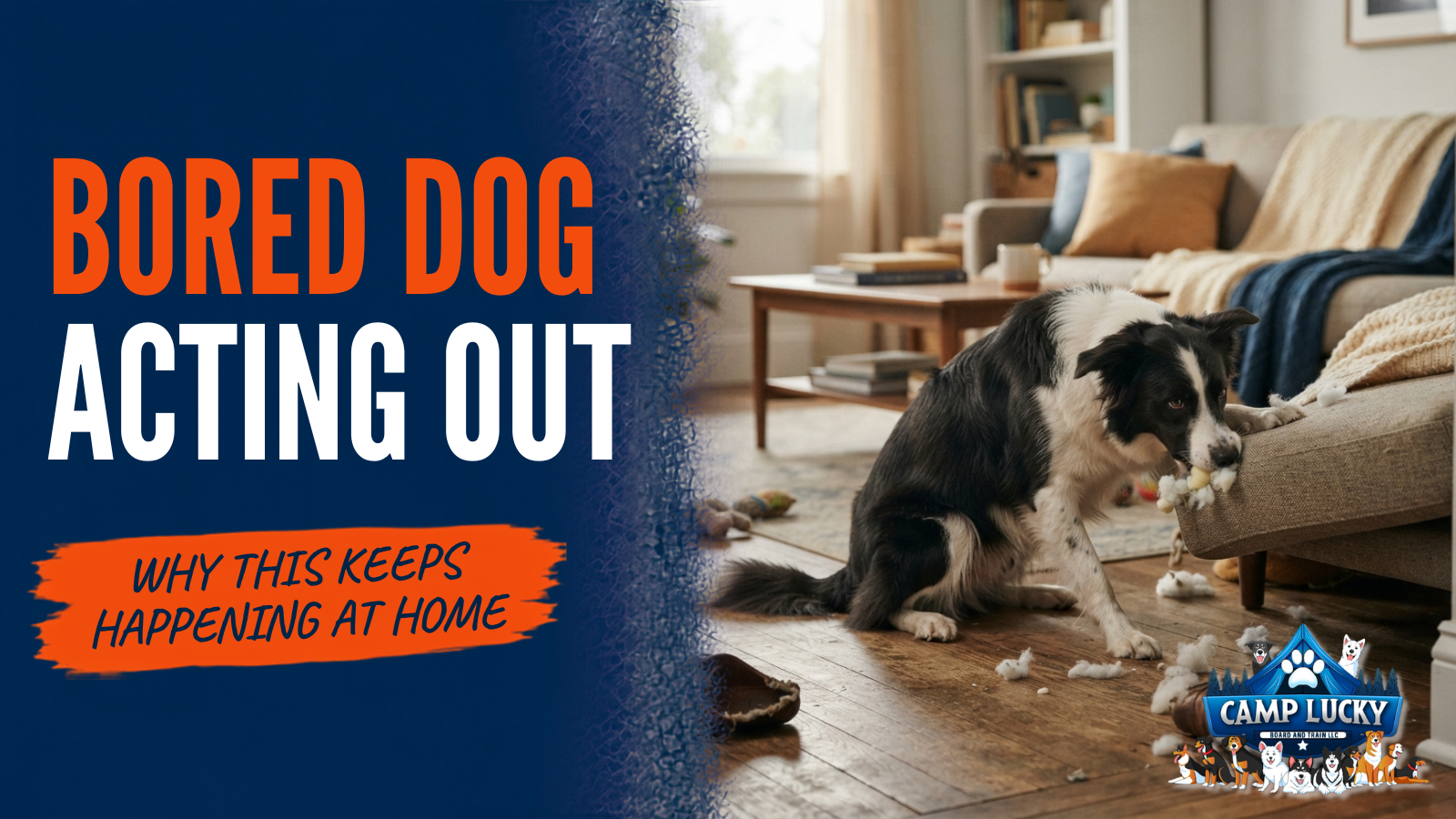
A chewed-up couch cushion. Barking at the wall at 11 PM. A dog that won’t stop following you into every room. Most owners see these behaviors and assume their dog is being difficult — testing boundaries, acting out, or just plain stubborn. That framing leads to frustration on both sides and fixes that don’t stick.
It’s Not Defiance — It’s a Frustrated Brain With Nowhere to Go
Here’s what’s actually happening: when a dog’s behavioral needs go unmet — movement, sniffing, chewing, social interaction, mental engagement — the nervous system doesn’t just sit quietly. It builds pressure. And that pressure has to go somewhere.
At a behavioral level, what looks like disobedience is usually a combination of under-stimulation, excess arousal, and frustration. The dog isn’t plotting against anyone. It’s a problem-solver and a predator by nature, and when the environment is flat and boring, the brain starts generating its own entertainment — usually the kind owners really don’t want.
Destructive behaviors are also self-reinforcing. Shredding a pillow, stealing a sock, barking at the mail carrier — these all feel genuinely satisfying to the dog in the moment and successfully drain some of that built-up arousal. That’s why the behavior repeats even when the dog has been corrected for it before. The reward isn’t coming from the owner. It’s coming from the act itself.
Our dog trainers at Camp Lucky Board and Train work with dogs exactly like this every day — cases that owners have already tried to address through correction alone, only to see the same behaviors resurface within days. The pattern is consistent: treating acting out as a behavior problem, when it’s actually a lifestyle, emotional, and communication problem, almost always leads to escalation — not resolution.
What “Acting Out” Actually Looks Like
Under-stimulation doesn’t look the same in every dog. The way frustration leaks out depends on the individual animal — its breed, age, and environment. But several patterns show up repeatedly, and recognizing them is the first step toward fixing the right problem.
Destructive Chewing, Digging, and Raiding Trash
Chewing is a natural, species-appropriate behavior. When a dog has no appropriate outlet for it, furniture, shoes, door frames, and trash cans become fair game. Digging serves a similar release-valve function — it’s not spite, it’s a dog creating its own job when no job has been provided. These behaviors spike when dogs spend long hours alone without structured mental work or physical engagement, and they’re particularly common in adolescent dogs whose drive has outpaced their impulse control.
Excessive Barking and Vocalization
Barking at “nothing,” whining when nothing is wrong, howling at every sound outside — excessive vocalization is one of the clearest signs of a dog seeking stimulation. In the absence of real things to engage with, some dogs turn window-watching and sound-monitoring into a full-time job. Every bark at a passerby, every howl that gets a response, feeds the loop. The dog found something to do — and it worked.
Restlessness, Pacing, and Late-Night Zoomies
An inability to settle is a hallmark of unspent energy colliding with a lack of mental structure. Pacing, constantly checking windows and doors, frantic bursts of running late at night — these aren’t random quirks. They’re a nervous system with nowhere to discharge. Without structured rest and calm-state practice built into daily routines, dogs default to motion as their only regulation tool.
Clinginess and Relentless Pestering
When the home environment offers nothing interesting and the owner is the only source of stimulation, many dogs make the human their full-time entertainment. Shadowing from room to room, nudging arms, dropping toys insistently, escalating demands — these behaviors look like affection but are actually a symptom of an under-enriched environment. The dog has one outlet, and it’s you.
Why Dogs Repeat Behaviors Owners Have Corrected
This is the part that baffles most owners: the dog knows it’s not supposed to do the thing. The correction happened. And yet, the same behavior is back within a day or two. Understanding why reveals exactly why correction-only approaches stall out.
Misbehavior Self-Reinforces in the Moment
The dog isn’t recycling the behavior to defy the owner. It’s recycling it because the behavior itself paid off. Chewing something releases tension. Barking at the mailman actually makes the mailman leave — from the dog’s perspective, every single time. Stealing a sock launches an exciting chase game.
These intrinsic rewards are immediate, reliable, and powerful. A correction that happens after the fact — even seconds later — is competing against a payoff the dog already received. That’s a losing battle without also changing what the dog can do instead and how satisfying that alternative is.
Accidental Attention Rewards the Exact Problem
Here’s the reinforcement trap most owners fall into without realizing it: a dog that barks, pesters, or steals something to get attention — and gets it — just learned that the behavior works. Eye contact, talking (even in a sharp tone), physically engaging, chasing — to a bored dog, any response is stimulation. The behavior got a result. It will be tried again.
Owners caught in this loop often describe feeling like “nothing works” — because the corrective response is inadvertently functioning as the reward. Breaking that cycle requires changing the environment and the dog’s behavior pattern, not just increasing the firmness of the correction.
Boredom vs. Anxiety: Why the Mislabel Matters
Boredom and anxiety are not the same thing — but they overlap enough in how they look that owners (and even some trainers) regularly confuse them. Both can produce destructive chewing, pacing, vocalization, and an inability to settle. Getting the label wrong doesn’t just lead to the wrong solution — it can actively make the problem worse.
Boredom is driven by a lack of stimulation. The dog’s environment isn’t giving the brain enough to work with, so the nervous system self-generates activity. The fix involves enrichment, structure, and mental engagement.
Anxiety is driven by fear or stress — an emotional state where the dog is responding to a perceived threat, whether real or imagined. The fix involves desensitization, building confidence, and often addressing the specific triggers involved.
Treating boredom like anxiety — adding calming supplements, reducing stimulation, tiptoeing around triggers — can actually deepen the problem by removing what the dog actually needs. And treating anxiety like boredom — just adding more activity and exercise — misses the emotional root entirely and can raise arousal without providing relief. Identifying which problem is actually driving the behavior is the most important diagnostic step most owners skip.
Why “Just Exercise More” Keeps Failing
Exercise advice is the most common response to a dog acting out — and it’s not wrong, exactly. Movement matters. But applied without structure, it’s often not enough, and in some cases it actively makes things worse.
Over-Arousal Without Mental Structure Makes Things Worse
A long run or a high-energy fetch session raises arousal. Without mental engagement or calm-down work built around it, the dog comes home physically tired but mentally still running. Owners describe this as the dog seeming “more wired” after exercise — that’s not an exaggeration. A dog that has been amped up through cardio, without any structured decompression or mental engagement, can absolutely come home and chew the couch.
Walks that include sniffing opportunities, obedience cues, and engagement work the brain alongside the body. That combination produces genuine tiredness — the kind that comes with a settled nervous system, not just depleted legs.
Breed Drive and Adolescence Raise the Stakes
Not every dog has the same threshold. High-drive breeds — herding dogs, working breeds, terriers — were developed to sustain effort and mental focus for hours. A 30-minute walk doesn’t touch their behavioral ceiling. Similarly, adolescent dogs between roughly 8 and 24 months are going through a period where their physical capability has dramatically increased while their impulse control is still catching up. Owners of adolescents frequently describe a sudden spike in “naughty” behaviors right around this window, and it’s not coincidence — it’s a neurological and developmental reality.
For these dogs, the answer isn’t just more exercise. It’s better-structured exercise combined with mental work, obedience, and deliberate calm-state training that teaches the dog how to regulate itself.
What Actually Fixes It
Changing a bored, frustrated dog’s behavior isn’t about finding the one right toy or the perfect punishment. It’s about stacking several consistent changes that work together to reduce the need for misbehavior in the first place.
1. Targeted Enrichment: Chewing, Foraging, and Scent Work
Species-appropriate mental outlets make a measurable difference in frustration-driven behavior. Long-lasting chews and food-based puzzles aren’t just distractions — research on canine enrichment shows they produce genuinely positive emotional states and reduce the drive toward destructive outlets when used consistently. Nose work, hiding food, and foraging games give dogs a “job” that drains mental energy in a way that’s deeply satisfying to them neurologically. A dog that has already worked its brain is far less likely to invent its own entertainment.
2. Obedience Training as a Boredom Antidote
Structured obedience is one of the most underused tools for managing frustration. Short, focused training sessions before periods of alone time or historically “naughty” windows pre-empt the acting out by giving the dog a sense of having worked. Commands like place, heel, down, and off aren’t just manners — they build communication, mental engagement, and a habit of following direction that carries through the day. Dogs that are mentally occupied through training are dramatically easier to live with.
3. Calm-State Practice to Lower the Arousal Baseline
Teaching a dog to settle isn’t passive — it’s an active skill that has to be practiced. Place training, extended down-stays, and relaxation work with low-level distractions in the background teach the dog how to turn its own arousal dial down. Dogs that default to chaos do so partly because no one has ever shown them what calmness feels like or reinforced it consistently. Building calm as a trained behavior changes the dog’s baseline over time — not overnight, but reliably.
4. Environmental Management to Block Self-Rewarding Triggers
While training builds new habits, management prevents the old ones from getting more practice. Limiting access to high-value destruction zones, blocking certain window views that trigger compulsive barking, rotating available toys to maintain novelty, and pre-loading safe chews during known high-risk times all reduce the opportunities for the dog to rehearse and reinforce unwanted behavior. Management isn’t a permanent fix — but it prevents backsliding while better habits are being built.
When a Board and Train Makes More Sense Than DIY
Many owners arrive at this information already burned out. They’ve tried the puzzle feeders. They’ve done extra walks. They’ve watched the videos. The gap usually isn’t knowledge — it’s execution. Delivering consistent, structured mental and physical engagement day after day, on top of a full life, is genuinely hard.
Consistency Owners Can’t Realistically Deliver
Behavioral change in dogs is built through repetition. A lot of it. Dozens or hundreds of repetitions of a single command, in varied situations, over a sustained period. For most working adults — especially those with kids, demanding jobs, or high-drive adolescent dogs — that volume of consistent structured work isn’t realistic. When training happens in sporadic bursts, progress stalls. The dog never gets enough repetitions to form the new habit before life interrupts and the old behavior reasserts itself.
What Professional Repetition Achieves Faster
A residential board and train environment delivers what busy owners simply can’t: structured training sessions built into every part of the day, in a real home environment where the dog practices door manners, mealtime behavior, crate settling, and obedience in context — not just in scheduled sessions. Professional handlers can work through dozens of repetitions daily, and dogs experience clear rules and consistent expectations from the moment they wake up to when they go to sleep. That density of repetition compresses the timeline dramatically.
Why Owner Coaching at Handoff Determines Lasting Results
A well-trained dog that goes back to an unchanged home environment will gradually revert. This is the piece most owners don’t anticipate — and what separates programs worth enrolling in from those that aren’t. The dog’s new behavior is only as durable as the owner’s ability to maintain it. Ethical programs invest seriously in the handoff: teaching owners the commands, the handling techniques, the timing, and the daily routines that keep the training alive after the dog comes home. Without that transfer of skills, the work done during the program has a short shelf life.
Your Dog Isn’t Broken — The Lifestyle Setup Is
The most important reframe most overwhelmed dog owners need is this: the dog acting out isn’t a broken dog. It’s a dog whose environment hasn’t been built to meet its actual needs. That’s a fixable problem.
Boredom-driven destruction, incessant barking, late-night chaos, and relentless pestering are all communication. The dog isn’t doing any of it to be difficult — it’s doing it because something isn’t working in how its day is structured, and this is the only language it has.
The solution isn’t harsher corrections. It’s building a lifestyle that gives the dog’s brain a productive place to put its energy — through targeted enrichment, structured obedience, consistent calm-state practice, and smarter management. For some dogs and owners, getting that structure in place on their own is entirely achievable. For others, especially those dealing with high-drive breeds, adolescent dogs, or deeply entrenched patterns, the most practical path forward is professional help.
Either way, the starting point is the same: stop asking “why is my dog so bad?” and start asking “what does this dog actually need — and how do I build a day that delivers it?” That shift in framing is where real change begins.
For families ready to stop guessing and start making real progress, we at Camp Lucky Board and Train offer free in-home consultations and residential training programs designed to address the root of frustration-based behavior — and equip owners with the skills to keep it going long after training ends.