If your dog cowers or growls at men, your instinct to comfort or correct might be making things worse.
A trainer breaks down the subtle warning signs owners miss and the exact mistakes that deepen fear instead of fixing it.
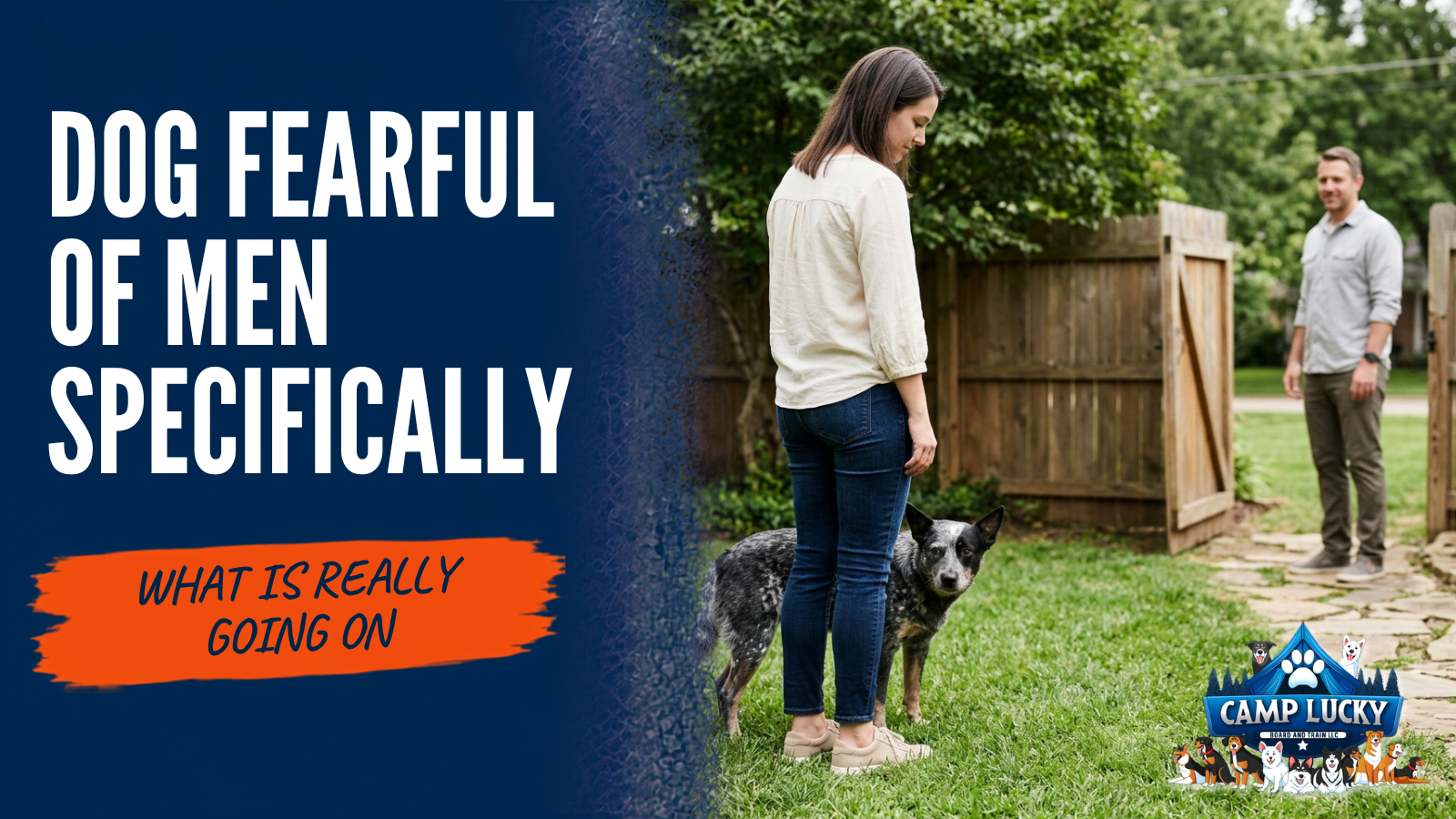
Key Takeaways
- A dog that cowers, growls, or backs away from men is showing a fear response, not defiance, so the first step is reading the warning signs rather than assuming disobedience
- Fear of men does not automatically mean a dog was abused; genetics, limited early exposure, and the way people approach can all shape the reaction
- Forcing a greeting, punishing a growl, or letting a man loom and reach over the dog are among the fastest ways to make the fear worse
- Progress comes from distance, patience, and letting the dog choose to approach, something Camp Lucky Board and Train’s programs build through gradual, structured exposure
- What should happen the moment a fearful dog stops taking treats or shows signs of real stress is worth knowing before it happens
A dog who freezes, backs into a corner, or growls at the sight of a man is not being stubborn or disrespectful.
Something deeper is happening, and understanding it changes everything about how to help.
What follows breaks down what fear of men actually looks like, the mistakes that make it worse, and the slow, steady approach that actually builds trust.
Fear Is a Response, Not Defiance
When a dog avoids a man, hides behind furniture, or snaps when a male visitor reaches down to pet them, it is tempting to label that as bad behavior.
The more accurate read is that the dog’s nervous system has decided this situation is unsafe, and the dog is reacting the only way it knows how.
Fear responses are automatic.
A dog does not choose to tremble or tuck its tail any more than a person chooses to flinch at a loud noise.
This distinction changes the entire training approach.
A disobedience problem calls for clearer commands and consistency.
A fear problem calls for patience, management, and a very different kind of groundwork.
Treating a frightened dog like a defiant one, by forcing eye contact or insisting on a greeting, almost always deepens the fear instead of resolving it.
It also helps to drop the assumption that fear of men proves past abuse.
Genetics, how much variety a dog experienced during early puppyhood, and even the specific way certain people move and approach can all shape this kind of reaction.
A dog raised mostly around women, for example, may simply have less early exposure to deeper voices, taller frames, or facial hair, and that unfamiliarity alone can trigger caution.
Patience and structure, rather than assumptions about a dog’s past, are what tend to move the needle with fear-based behavior.
What Your Dog Is Actually Afraid Of
Few dogs are afraid of every man they meet.
Most are reacting to specific traits or situations that happen to be more common among men, which is why the fear can look broader than it really is.
Specific Triggers, Not Every Man
A dog might tense up around tall people, deep voices, beards, hoods, hats, or sunglasses rather than men as a category.
Some dogs react most strongly to posture and movement, such as someone walking directly toward them with a confident stride, leaning over them, or reaching out fast.
Pinpointing the actual trigger takes some observation.
Watching when the fear shows up, whether it is with every man or only certain ones, helps identify whether the issue is about appearance, movement, voice, or something more specific like a hat or a hood.
Reading the Warning Signs
Fear rarely shows up as an obvious growl right away.
It usually builds through smaller, quieter signals first, and catching those early signs can prevent a situation from escalating.
Common warning signs include:
- Hiding behind a person, piece of furniture, or in another room
- A tucked tail or lowered body posture
- Lip licking or yawning when nothing is tired or hungry about the moment
- Freezing in place rather than moving away
- Growling, which is a dog’s way of asking for space
- Snapping, which typically happens only when the dog feels cornered and has no other way to escape
A growl or snap is rarely the first sign of distress.
It usually arrives after quieter signals went unnoticed or ignored.
Mistakes That Make Fear Worse
Most well-meaning attempts to help a fearful dog actually backfire, because they come from a human instinct to comfort through closeness rather than the dog’s actual need for space and control.
Forcing a Greeting
Holding a dog still so a visitor can pet it, or carrying a dog over to meet someone new, removes the one thing a frightened dog needs most: the ability to choose.
Taking away a dog’s sense of control over the situation tends to deepen the fear rather than resolve it.
A dog who is dragged toward a man it is scared of learns that its own signals do not matter, which can make the next interaction even harder.
Punishing the Growl or Retreat
Scolding a dog for growling, barking, or trying to back away removes one of the few communication tools the dog has left.
A growl is information, not an attack.
Suppressing it without addressing the underlying fear does not make a dog less afraid; it just removes the warning system, which can make a bite more likely later because there was no growl to signal it was coming.
Correcting fear-based behavior, rather than working to change the emotion behind it, tends to make the fear and the defensive response worse over time.
Looming, Reaching, and Direct Eye Contact
Well-meaning men often crouch down, lean in, reach a hand toward the dog’s face, and stare directly at the dog, thinking this looks friendly.
From a fearful dog’s perspective, that combination can look like a threat closing in.
A better approach involves sitting down, turning slightly to the side instead of facing the dog head-on, and avoiding direct eye contact until the dog relaxes.
Letting a dog approach on its own terms, rather than reaching toward it, tends to feel far less threatening.
Building Calm Around Men
Once the mistakes are off the table, the real work is building new, calmer associations one small step at a time.
Start at a Distance the Dog Can Handle
Progress begins with distance, not proximity.
A dog should be able to see a man far enough away that there is no shaking, freezing, or refusal to take treats.
That distance is then paired with something the dog values, such as a favorite treat, so the sight of a man slowly starts to predict something good rather than something scary.
Only once the dog stays relaxed at that distance should the gap begin to close, and even then, gradually.
Let the Dog Choose to Approach
Rather than a man walking toward the dog, the dog should be given the chance to walk toward the man, if and when it feels ready.
Having a new person toss a treat to the side rather than offering it by hand avoids requiring the dog to get close before it is ready.
If a dog ever refuses food during one of these exposures, that is a clear sign the situation is too close or too intense, and backing off to an easier distance is the right call.
Give the Dog a Safe Retreat
A dog needs somewhere to go when things feel like too much.
Setting up a bed, mat, or crate in a quiet area, and making sure visitors understand that space is off-limits, gives a fearful dog a reliable place to decompress.
Knowing an escape route exists, even if it is never used, can lower a dog’s overall stress level during visits.
When to Stop and Get Help
Some signs mean it is time to pause the exercise and bring in extra support rather than keep pushing forward.
A dog that stops taking even high-value treats, trembles persistently, tries to flee, or shows any sign of aggression such as a snap or a bite attempt needs the interaction stopped immediately and calmly.
Creating distance first, without punishment or a raised voice, keeps everyone safer in the moment.
Bite risk should always be taken seriously, even from a dog that has never bitten before.
If fear responses are intensifying rather than improving, or if there is any aggression involved, reaching out to a veterinarian or a qualified dog behavior professional is the responsible next step.
These situations call for an experienced eye that can evaluate the dog’s specific history and body language in person.
Taking the Skills Home
Progress made during structured sessions only sticks if it transfers into daily life.
A dog that stays calm around a stranger in a quiet backyard still needs practice with the specific people it lives with and the visitors who come through the front door regularly.
This is where go-home instruction becomes valuable, since it gives an owner a clear plan for handling real situations like a male houseguest arriving or a partner coming home from work.
Our programs at Camp Lucky Board and Train include a private go-home session and ongoing trainer support so the techniques used during a dog’s stay carry over once the dog is back in its usual environment.
That continuity matters, because fear-based behavior can resurface quickly if the structure built during training is not reinforced at home.
Patience Protects Progress, Not Pressure
Fear around men rarely disappears overnight, and expecting a fast fix often leads straight back to the mistakes already covered: forcing contact, rushing distance, or punishing a dog’s honest warning signs.
Slow, consistent exposure paired with good associations protects the progress already made and keeps building on it.
Every small win counts, whether it is a dog taking a treat at a slightly closer distance or choosing to sniff toward a calm, seated stranger for the first time.
Respecting the pace a dog sets, rather than the pace an owner wishes for, is what turns a fearful dog into a dog that can relax, even around the people it once found frightening.
For anyone working through this at home, starting with structured, consistent training can make those small wins easier to recognize and build on.