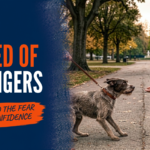
If your dog explodes at the sight of other dogs on walks, you’re likely treating the wrong problem.
Most owners can’t tell the difference between fear and frustration reactivity, and using the wrong training approach actually makes the behavior worse.

Key Takeaways
- Leash reactivity in dogs is almost always driven by one of two emotional states — fear or frustration — and treating them the same way leads to slower progress or makes things worse.
- A dog’s body language is the clearest clue: fearful dogs try to create distance, while frustrated dogs strain toward the other dog with intense, forward energy.
- On-leash greetings are unnatural in dog social language — head-on approaches and leash tension both amplify the emotional overload dogs feel during encounters.
- Training must match the root cause: fear reactivity calls for building safety and confidence, while frustration reactivity requires impulse control work.
- When home training stalls, structured board and train programs can provide the repetition and controlled exposure that most owners simply cannot replicate on daily walks.
Every dog owner who has been yanked down the sidewalk while their dog erupts at another passing dog knows that sinking feeling, the embarrassment, the helplessness, the wondering if something is fundamentally wrong. The good news is that leash reactivity is one of the most misunderstood but genuinely improvable behavior challenges in dogs. The key is figuring out why it’s happening before trying to fix it.
Your Dog Isn’t ‘Bad’ — They’re Overwhelmed
That explosive barking, lunging, or spinning at the sight of another dog on a walk isn’t a personality flaw, and it isn’t dominance.
It’s emotional overload.
Dogs that react when another dog approaches on leash are experiencing what’s called leash reactivity, an exaggerated emotional response that appears specifically when the dog is restrained by a leash, fence, or other barrier.
The word restrained matters here.
Many leash-reactive dogs are completely relaxed and social off-leash.
The leash itself changes everything about how they feel in that moment.
It removes their ability to move naturally, to curve away, to disengage, and without those options, emotions spike fast.
This is also why scolding the outburst rarely works.
When a dog is operating from survival or emotional circuitry, they aren’t choosing to misbehave.
The thinking part of their brain has taken a back seat.
“He knows better” and “he’s just being stubborn” are understandable conclusions, but what’s actually happening is closer to a nervous system flood, the dog genuinely cannot process information clearly at that level of arousal.
Recognizing this distinction changes everything about how training should be approached.
What Leash Reactivity Actually Is
Leash reactivity is defined as an exaggerated response to a trigger, most often another dog, that appears specifically when the dog is on leash or behind a barrier.
The behaviors can look dramatically different from dog to dog: some bark and lunge, some whine and spin, some go completely silent and rigid before exploding.
But they share a common thread, the dog’s emotional state has overwhelmed their ability to respond normally.
There’s an important line between reactivity and aggression.
Most leash-reactive dogs are not dangerous in the traditional sense.
They’re overwhelmed.
The behavior looks intense, but the emotional engine driving it is usually fear or frustration, not predatory intent.
That distinction matters because it points directly toward what training needs to accomplish.
The Unique Dynamics of On-Leash Reactivity
On-leash encounters between dogs are, by design, set up to go badly.
In natural canine social behavior, dogs approach each other in wide arcs, use lateral body movement, pause frequently, sniff, and always retain the option to disengage and walk away.
Distance and angle are the tools dogs use to manage their own arousal and keep interactions from escalating.
On a sidewalk, none of that is available.
Two dogs get walked straight toward each other in a narrow corridor, head-on, which is actually a threat signal in dog body language.
The leash prevents the dog from curving away, fleeing, or creating the distance they need.
And when a handler tightens the leash in anticipation of a reaction, that physical tension travels straight to the dog as confirmation: yes, there is something to be worried about here.
The Reinforcement Loop Owners Accidentally Create
Here’s the part that makes leash reactivity so stubborn over time.
When a dog barks, lunges, or makes itself look enormous, the other dog moves away.
From the reactive dog’s perspective, the threat disappeared because of what they did. That’s a powerful lesson, and the brain files it away immediately: exploding works.
Every walk that follows rehearses this loop.
The dog sees another dog, emotional arousal spikes, the dog reacts, the other dog passes and disappears, and the reactive behavior gets reinforced one more time.
Even when owners correct the outburst, yelling, leash yanks, or sharp verbal reprimands, the fundamental loop doesn’t break.
The threat still goes away.
The behavior still gets rewarded by the outcome, even if there’s a punishment layered on top of it.
Understanding this loop is the first step toward actually interrupting it.
Fear vs. Frustration: Two Very Different Problems
Reactivity is not a single thing.
It’s a label applied to a range of behaviors that can be driven by completely different emotional states.
The two most common are fear and frustration, and while they can look similar from a distance, they require different training approaches.
Misreading one for the other doesn’t just slow progress; it can actively make things worse.
Signs Your Dog Is Fear-Reactive
Fear reactivity is fundamentally about distance.
A fear-reactive dog perceives other dogs as a threat and reacts in order to make that threat go away.
The behavior, barking, lunging, growling, is defensive. It’s a dog communicating, loudly: get away from me.
The body language tells the real story.
Fear-reactive dogs typically show:
- A lowered body posture, crouching, or weight shifting backward
- Tail tucked or held low
- Ears pinned back against the head
- Whites of the eyes visible (sometimes called “whale eye”)
- Attempts to back away or move behind the handler before the reaction escalates
- Growling or air-snapping as a warning before a full lunge
These dogs aren’t looking for a fight.
They’re trying to survive an encounter that feels threatening, and the reactive display is the tool they’ve learned to use.
The American Veterinary Society of Animal Behavior (AVSAB) emphasizes that training for these dogs must address the underlying fear and anxiety, not just suppress the visible symptoms.
Signs Your Dog Is Frustration-Reactive
Frustration reactivity looks completely different at its core, even if the barking and lunging appear similar on the surface.
A frustration-reactive dog isn’t afraid of the approaching dog. They want to get to the other dog.
The leash is the problem, it’s blocking something they desperately want, and that blockage builds into an explosive release.
Body language here tends to be forward and intense rather than defensive:
- Weight shifted forward, straining toward the other dog
- Tail held high, possibly wagging rapidly
- Ears up and forward, hyper-focused gaze
- Whining, yelping, or frantic barking mixed with intense pulling
- Sometimes spinning or jumping in place
- Behavior that stops or dramatically reduces once the other dog is gone
These dogs are often described as “overly social” or “just excited” early on, which is exactly why the behavior gets dismissed until it becomes unmanageable.
The frustration builds over time, especially if the dog learns that exploding is the only outlet available.
Why Misreading the Emotion Makes Training Worse
Imagine a fear-reactive dog being pushed into close proximity with other dogs to “socialize” the fear away.
Each forced encounter confirms the dog’s belief that other dogs are a threat, and now they can’t escape.
The fear deepens, the reactivity intensifies, and trust in the handler erodes.
Flip it around: a frustration-reactive dog placed on a heavy management program that avoids all dog contact doesn’t learn impulse control.
The frustration has no outlet, the arousal builds, and the next encounter hits even harder.
Getting the emotional root cause right isn’t just helpful, it’s the entire foundation of an effective training plan.
Training that works for one type can actively harm the other.
Why On-Leash Greetings Set Dogs Up to Fail
Even well-meaning owners often make reactivity worse by allowing, or encouraging, on-leash greetings between dogs.
The logic seems sound: let them meet, let them sniff, they’ll learn the other dog is friendly.
But the way most on-leash greetings happen is fundamentally at odds with how dogs communicate safety to each other.
Head-On Approaches Are a Threat Signal in Dog Language
In the canine social world, a direct, head-on approach between two unfamiliar dogs is a challenge.
Dogs that are fluent in their own language curve toward each other, approach at angles, pause, and offer side-body presentations.
These movements signal non-threat and keep arousal manageable.
On a sidewalk, two handlers walking their dogs toward each other eliminates all of that natural communication.
The dogs are locked into a direct approach with no ability to adjust speed, angle, or distance.
For a dog already sensitive to social pressure, this setup is almost guaranteed to push them over threshold before the two dogs are even within sniffing range.
How Leash Tension Confirms the Threat
Leash tension significantly worsens reactive behavior by restricting a dog’s natural coping mechanisms and increasing the perception of threat.
When a handler tightens the leash as another dog approaches, a completely natural reaction when bracing for a potential incident, the dog feels that tension and interprets it as a signal: something is wrong, be ready.
This creates a feedback loop that’s hard to break without deliberate training.
The handler’s anxiety transfers through the leash.
The dog’s arousal rises.
The handler tightens more.
The dog reacts.
Neither party comes out of the encounter with anything useful learned.
The solution isn’t to let every leash go slack, it’s to understand that leash handling is an active part of the training, not just a safety tool.
Training Looks Different for Each Type
Once the emotional root cause is identified, training has a clear direction.
Fear reactivity and frustration reactivity share some foundational needs, but the core strategies are genuinely different, and trying to use a one-size-fits-all approach is one of the most common reasons DIY training stalls out.
For Fear Reactivity: Build Safety First
The goal with a fear-reactive dog is to change the emotional association with other dogs, from “threat” to “neutral” or even “good thing.”
This is accomplished through desensitization and counter-conditioning: gradually exposing the dog to other dogs at distances where they can still think and remain calm, while pairing that exposure with high-value rewards and calm handler energy.
Key principles for fear reactivity training:
- Distance is everything. Work far enough away from other dogs that the reactive dog notices but doesn’t react. This is called staying “under threshold.”
- Never force the approach. Pushing a fearful dog into closer proximity before they’re ready deepens the fear, not the tolerance.
- Mark calm observation. Techniques like “Look at That” (LAT) reinforce curiosity and neutrality, the dog sees another dog, gets marked and rewarded, and begins building a new association.
- Progress is measured in weeks and months, not days. Setbacks are normal, especially when triggers appear suddenly in unpredictable environments.
For Frustration Reactivity: Teach Impulse Control
Frustration-reactive dogs need a different foundation.
Because the core issue is an inability to tolerate the leash blocking what they want, training focuses on impulse control and alternative behaviors, teaching the dog that checking in with the handler is more rewarding than straining toward every dog they see.
Effective strategies include:
- “Look at me” / “Watch me” cues — building strong eye contact on cue so the dog has a clear, rewarded alternative to fixating on the trigger.
- Heel work around distractions — practicing precise positioning so the dog has a structured job to do when another dog appears.
- Appropriate social outlets — frustration-reactive dogs often genuinely need dog-dog interaction. Structured off-leash play with compatible dogs provides an appropriate outlet for that social drive, reducing the emotional charge during leash encounters.
- Pattern games and engagement exercises — building habits that automatically redirect the dog’s focus toward the handler when a trigger appears.
What Both Types Require: Threshold Management
Regardless of the root cause, threshold management is the non-negotiable first step in any reactivity program.
Consistently preventing the dog from going over threshold stops the daily rehearsal of the reactive loop.
Every over-threshold reaction is another rep of the wrong behavior being reinforced.
Practically, this means route planning, off-peak walk times, and having a rehearsed escape plan ready for surprise encounters.
An emergency U-turn cue, practiced at home until it’s automatic, can be the difference between a controlled redirect and a full meltdown on a narrow sidewalk.
The concept of trigger stacking is also worth understanding here, multiple stressors accumulating throughout the day cause a dog to hit threshold much faster than they would in isolation.
A dog that already had a stressful morning, heard loud noises, and was cooped up all afternoon is going to have a much shorter fuse on the evening walk.
Managing the whole day matters, not just the moments when other dogs appear.
When DIY Training Isn’t Enough
For many owners, the gap isn’t information.
There’s no shortage of advice available, books, videos, online forums.
The gap is consistent, correctly-timed implementation in the messy, unpredictable real world.
Narrow sidewalks, off-leash neighborhood dogs, juggling kids and bags and work stress, all of it makes maintaining the controlled training environment that reactivity work requires genuinely hard to pull off alone.
DIY attempts also have a common failure pattern.
Leash corrections applied at the moment of explosion add stress or pain to an already overwhelming situation, sometimes deepening the fear-dog association rather than breaking it.
Treats offered too late in the arousal spiral function as distraction bribes rather than actual counter-conditioning.
And without a helper dog or controlled setup, there’s no way to get the kind of graduated, repeated exposures that actually shift emotional patterning over time.
How Board and Train Accelerates Reactive Dog Progress
A structured board and train program changes the math on reactive dog training.
Instead of one or two brief training moments per day sandwiched between everything else in a busy life, a dog in a residential program gets hundreds of correctly-timed, properly-spaced repetitions with neutral helper dogs in real-world environments, every single day.
We at Camp Lucky Board and Train, a veteran-owned training company founded by former Air Force K9 handler Aaron Rustici, address reactivity through structured multi-week residential programs.
Dogs live inside a trainer’s personal home, not a kennel facility, which means training happens throughout the day in realistic domestic settings.
By the third week of their program, trainers have a detailed picture of each dog’s specific triggers and emotional profile, and design focused work around those individual challenges.
The core advantage of this format for reactive dogs is immersion and repetition.
A dog can be placed in triggering scenarios over and over, in a structured and controlled way, until the new calm response starts to become the default.
That level of repetition takes weeks or months to replicate through weekly lessons alone.
Effective programs also include thorough owner education at handoff, because lasting progress depends on what happens once the dog is back home.
Identify the Root Cause — Then You Can Fix It
Leash reactivity is fixable.
But fixing it requires starting with the right question: is this dog afraid, or is this dog frustrated?
The answer shapes every decision that follows, what training methods to use, how to structure exposures, what to reinforce, and how quickly to progress.
A fear-reactive dog lunging to create distance needs safety built first.
A frustration-reactive dog lunging to close distance needs impulse control built first.
Using the wrong approach doesn’t just slow things down, it can actively reinforce the problem, or create new ones.
Watch the body language closely.
Note whether the dog moves toward or away from the trigger when there’s slack in the leash.
Look at posture, tail position, and what the dog does once the other dog passes.
These details are the most reliable map to what’s actually happening emotionally, and that map is where effective training begins.
Progress takes time, consistency, and a training environment structured to create wins rather than repeat the same reactive loop.
With the right approach matched to the right emotional root cause, most dogs can make meaningful, lasting improvement, whether through a carefully designed home training plan or a structured program that does the foundational heavy lifting first.
Families dealing with a reactive dog and looking for a structured path forward can reach out to us at Camp Lucky Board and Train for a free in-home consultation to find the right program for their dog’s specific needs.