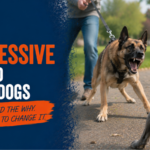
Your dog isn’t “high energy,” they might be trapped in chronic overarousal, a stress loop where their nervous system never shuts off.
And that two-hour walk you’re doing? It’s probably making everything worse.

Here’s what’s actually happening in their body.
- What looks like ‘high energy’ is often chronic overarousal — a state where the dog’s nervous system is stuck in a stress loop, not simply undertired.
- More exercise is one of the most common responses to a restless dog — and for overaroused dogs, it frequently makes the problem worse by spiking cortisol further.
- Calmness is a trainable skill, not a personality trait. Dogs that never settle usually have not been taught how — and owners often reinforce the chaos without realizing it.
- The adolescent window (6 to 24 months) is one of the most misunderstood contributors to a dog that seems to have flipped from manageable to uncontrollable overnight.
- Keep reading to understand what is actually happening in your dog’s body — and why addressing the nervous system changes everything.
If you have been walking your dog two hours a day and they are still bouncing off the walls at 10pm, this one is for you.
That gut-punch feeling, equal parts exhausted, confused, and quietly guilty, is something a lot of dog owners know but rarely say out loud.
The dog is not bad.
You are not failing.
But the framework most people are using to understand the problem is almost certainly wrong, and that is why nothing is working.
‘High Energy’ Is Often a Misdiagnosis
When a dog cannot stop moving, will not settle, and seems to run on some kind of internal combustion engine that never shuts off, most people reach for the same label: high energy.
It is an easy explanation that points toward an equally easy solution, more exercise.
The problem is that “high energy” is actually an umbrella term covering several very different behavioral situations that require completely different responses.
A genuinely high-energy dog, think a working-line Border Collie or a Hungarian Vizsla, has an above-average genetic drive and exercise requirement. When those needs are actually met, these dogs do settle.
They are responsive, trainable, and capable of rest.
The dog that “never settles” is a different animal entirely.
That dog is not just energetic.
Something else is running underneath the behavior, something physiological, and that distinction matters more than most owners realize.
There is also a third category worth knowing: learned non-settling, where the dog has been accidentally trained by its owner’s responses to stay active, demanding, and alert.
And on the rare far end of the spectrum, true hyperkinesis, a medically diagnosable condition sometimes compared to ADHD, exists, but it is far less common than most people assume.
Misidentifying any of these as simple “high energy” leads directly to solutions that do not just fail, they backfire.
What’s Actually Happening in the Dog’s Body
The Sympathetic Nervous System Stays Stuck On
Every dog’s nervous system has two operating modes.
The sympathetic nervous system (SNS) handles arousal, the “fight or flight” response that floods the body with adrenaline when something exciting or threatening shows up.
The parasympathetic nervous system is the counterbalance, the “rest and digest” side that brings the dog back down to baseline after the trigger is gone.
In a healthy, regulated dog, these two systems work like a seesaw.
A stimulus arrives, the SNS activates, the stimulus passes, and the parasympathetic system takes over so the dog can settle.
In a chronically overaroused dog, that second half of the cycle is broken or severely delayed.
The SNS gets activated, by a doorbell, a thrown ball, a visitor walking in, and it simply stays on.
The dog remains in a heightened state long after the original trigger has disappeared.
What makes this especially difficult to spot is that it looks exactly like excitement.
The dog is jumping, pacing, vocalizing, seeking attention, all behaviors owners associate with a happy, energetic dog.
But underneath that surface-level expression is a nervous system under genuine strain.
The dog is not “full of life.”
It is full of stress hormones, and it does not know how to get out of the loop.
Why Cortisol Accumulation Prevents Settling
When the SNS activates, cortisol, the primary stress hormone, follows.
Cortisol typically begins to rise shortly after a significant arousal event and can peak within 20 to 60 minutes, though this varies depending on the stressor and the individual dog.
Under normal conditions, cortisol clears and the dog returns to baseline.
But cortisol recovery after significant arousal can take anywhere from 30 minutes to several days depending on the intensity of the event and the individual dog.
Now consider the typical day of a “high energy” dog: a stimulating morning walk, a midday play session, an afternoon trip to the dog park, an evening of household activity with kids and noise.
Each one of those events spikes cortisol.
If the dog never has enough uninterrupted calm time to fully clear it, the stress hormones accumulate.
Researchers describe this total burden as allostatic load, the body’s running tab of stress adaptation.
A dog living at high allostatic load is primed to overreact to everything.
It struggles to learn, because elevated cortisol impairs the hippocampus and memory consolidation.
It cannot settle.
And it appears to have “infinite energy” because that is exactly what a chronically revved nervous system looks like from the outside.
The key diagnostic question is simple but clarifying: does the dog eventually settle, or never?
A truly high-energy dog will eventually rest when needs are genuinely met.
A dog in chronic overarousal will not, because the driver is not physical.
It is neurological.
Why More Exercise Makes It Worse
The Exercise Paradox Explained
“Tire them out” is the most universally repeated advice in dog ownership.
It is not wrong for every dog, but for an overaroused dog, it is one of the most reliably counterproductive things an owner can do.
The reason comes down to basic exercise physiology and how cortisol actually responds to intense physical activity.
Intense exercise does not immediately reduce arousal.
It maintains or temporarily spikes cortisol, and only begins to reduce SNS sensitivity after adequate recovery time. A dog taken from an already-stimulating home environment and run hard at a dog park comes back physically tired, but neurologically more reactive, not less.
Research published in Applied Animal Behaviour Science found that dogs in group play at parks showed significantly elevated cortisol compared to one-on-one play, with those cortisol effects lingering for hours afterward.
There is also a fitness conditioning problem layered on top of this.
Owners who consistently respond to a restless dog with more intense exercise are, over time, building a more athletic dog with a higher fitness baseline.
The same amount of exercise produces less tiredness as the dog gets fitter.
The owner works harder, the dog needs more, and the cycle tightens.
How Owners Accidentally Condition a More Reactive Dog
Beyond the cortisol issue, the type of environment matters enormously.
High-stimulation outlets, dog parks, off-leash group play, fetch in busy areas, do not just fail to calm overaroused dogs.
They actively practice and reinforce a heightened arousal state.
Every trip to the dog park, every frenzied game of fetch, every excited greeting with strangers is teaching the dog’s nervous system that this is the normal operating level.
Over time, specific cues, the leash appearing, the car door opening, a visitor arriving, become powerful triggers for SNS activation before the event even starts.
The dog begins arousal-ramping in anticipation.
The owner has, without knowing it, conditioned a more reactive animal through the very activities intended to help.
This is not a character flaw in the dog.
It is operant conditioning working exactly as designed, just pointed in the wrong direction.
Overarousal vs. True High Energy: How to Tell the Difference
The Behavioral and Physical Signs of Chronic Overarousal
Chronic overarousal has a recognizable signature once you know what to look for.
It is not just “a lot of energy.” The behaviors cluster around an inability to regulate, to turn the volume down, regardless of circumstances.
Common signs include:
- Hypervigilance — constantly scanning the environment, startling easily, unable to fully relax even in familiar, quiet spaces
- Restlessness that does not resolve — pacing, circling, inability to hold a down-stay even after extended exercise
- Demand behaviors — persistent attention-seeking, nudging, barking, jumping that escalates rather than stops when ignored
- Overreaction to minor stimuli — a distant noise, a neighbor walking by, or a leaf blowing past the window triggers a disproportionate response
- Difficulty learning in stimulating environments — the dog knows a command at home but loses access to it completely outside
The clearest differentiator between true high energy and chronic overarousal is the settling question.
A high-energy dog that has been genuinely worked, mentally and physically, will eventually lie down and rest.
The chronically overaroused dog stays activated.
It may collapse from physical exhaustion, but even then there is a quality of tension in the body, vigilant, not relaxed.
The Adolescent Factor Owners Overlook
A significant portion of owners dealing with a dog that “never settles” are living with an adolescent, a dog between roughly 6 and 24 months old.
This age range is not coincidental.
Canine adolescence involves dramatic neurological restructuring, including major changes to the prefrontal cortex (PFC), the brain region responsible for impulse control and executive regulation.
During this window, the PFC is literally incomplete.
The hardware for consistent self-regulation is not fully built yet.
Adolescent hormones flood an immature regulatory system, and behaviors that seemed manageable at 10 weeks can intensify sharply at 8 or 10 months.
Many medium-energy breeds may show signs of settling between 18 and 30 months, while high-drive working breeds and some larger breeds may not reach genuine behavioral maturity until 24 to 36 months or even beyond.
This is a biological timeline, not a training failure.
But it is a window that responds well to structured support, and one that, left without intervention, tends to entrench patterns deeper into the nervous system the longer it goes on.
Calmness Is a Skill You Have to Teach
Why Many Dogs Never Develop Effective Self-Settling
One of the most important, and least intuitive, insights from modern behavioral science is that the ability to settle is a learned behavior, not a default state.
Dogs are not born knowing how to turn themselves off.
They learn it, through experience and reinforcement history, or they do not.
Dogs Trust describes a “settle” not as a physical position but as an emotional state, a specific state of mind that can be cued, shaped, and rewarded.
The physiological signals of genuine relaxation are specific and observable: weight shifting to one hip, a sigh, the head dropping, lying on one side rather than in a tense sphinx position.
These signals can be captured and reinforced, building a strong learning history around calm.
But that only happens if someone deliberately teaches it.
Dogs that never receive this training tend to become overstimulated in new environments, show increased anxiety and reactivity over time, have reduced capacity to absorb new training, and simply never experience real rest.
They are not choosing to be difficult.
They have never been shown that calm is an option, let alone a rewarding one.
How Owners Reinforce the Chaos Without Realizing It
Most owners of never-settling dogs have inadvertently built a powerful reinforcement history for exactly the behaviors they want to stop.
It works like this: the dog is restless and demanding, so the owner engages, even if that engagement is frustration, pushing the dog away, or a verbal correction. To the dog, any response is attention.
And attention is what the dog was seeking.
Over time, the dog learns that demanding, arousal-seeking behavior works.
It produces interaction.
And because that response is inconsistent, sometimes the owner engages, sometimes they do not, the behavior gets locked in by intermittent variable reinforcement, the most powerful reinforcement schedule known in behavioral science.
The same mechanism that makes slot machines addictive makes a dog that occasionally gets rewarded for demand barking nearly impossible to extinguish through willpower alone.
Meanwhile, calm behavior goes completely unremarked.
The dog lies quietly for 30 seconds, and the owner, relieved, does not make a sound.
From the dog’s perspective, calm has never paid off.
Chaos has.
That is not a character flaw.
That is a very logical learning outcome.
What Actually Lowers Arousal
1. Decompression Over High-Intensity Exercise
For chronically overaroused dogs, the prescription is counterintuitive: less intense exercise, more decompression.
Decompression is any activity that activates the parasympathetic nervous system, the “rest and digest” side, rather than continuing to fuel the SNS.
The most research-supported decompression activities include:
- Slow sniff walks — where the dog sets the pace and sniffs freely, rather than walking at heel in a structured way. Sniffing has been shown to lower heart rate and cortisol and activate the parasympathetic system.
- Lick mats and frozen food toys — the repetitive licking behavior engages a naturally self-soothing mechanism that helps reduce stress hormones.
- Long-lasting chews — sustained chewing produces a similar calming effect through rhythmic jaw movement.
- Scatter feeding — spreading kibble in grass or a snuffle mat engages foraging instincts in a low-arousal, nose-led way.
The goal is not to stop exercising the dog. It is to restructure how the dog’s activity time is spent, moving away from high-stimulation outlets and toward activities that build parasympathetic tone over time.
This is a gradual recalibration of the nervous system’s baseline, not a quick fix.
2. Place Training as a Calm Anchor
“Place” training, teaching a dog to go to a specific mat or platform and remain there with growing duration, is one of the most operationally powerful tools available for a dog that never settles.
The mat becomes a spatial anchor for a specific emotional state.
Over repeated sessions, the dog begins to associate that physical location with the experience of being calm, still, and rewarded for it.
This matters because it gives the dog something concrete to do instead of the demand behaviors, a clear alternative that carries its own reinforcement history.
Consistent place training also builds impulse control and self-regulation, which are the exact neurological capacities the overaroused dog is lacking.
The training starts in a very low-distraction environment and is gradually proofed across increasing levels of stimulation, which is why it requires real patience and repetition before it holds under pressure.
3. Impulse Control as the Foundation
A dog that cannot settle is ultimately a dog that cannot choose calm over the pull of a stimulus. That capacity, the ability to pause, override the impulse, and wait, is impulse control, and it underpins everything else.
Impulse control training looks like waiting before a food bowl is released, pausing at doorways before being allowed through, and holding a sit while a trigger passes by rather than exploding toward it.
These are not just obedience exercises.
They are building the actual neural circuitry that “settle” depends on.
Each repetition, pause, wait, choose calm, lays down a new behavioral default.
Without this foundation, settle training and place work compete against an existing, powerful reinforcement history for chaos.
With it, calm behaviors start to become the dog’s natural first response rather than something coaxed or commanded.
When Board and Train Resets What Home Training Can’t
The Nervous System Needs an Environmental Break
Even owners who fully understand what needs to change often find that implementing it at home produces minimal results.
Part of that comes down to the environment itself.
A dog living in the same household where all the arousal patterns were learned is surrounded by the same triggers, the same cues, the same learned associations.
The leash by the door, the sound of the owner’s car, the family’s daily routines, all of it is pre-loaded with conditioned arousal.
Trying to lower that dog’s nervous system baseline in the same environment is like trying to study for an exam in the middle of a loud party.
A professional board and train setting offers something home training genuinely cannot: a complete environmental reset.
Removing the dog from its existing home, and all the learned arousal cues woven into it, gives the nervous system a real opportunity to recalibrate.
At Camp Lucky Board and Train, dogs live inside a trainer’s personal home for the duration of their stay rather than in a kennel facility, meaning they practice real-world behaviors, door manners, mealtimes, household activity, in an environment that consistently reinforces calm responses rather than accidentally reinforcing chaos.
The density of repetition that a structured daily program delivers is also something home training simply cannot replicate, short, frequent settle sessions distributed throughout the day, precisely when they matter most.
Why Consistency at Home Keeps Failing
Even the most motivated owners run into structural problems at home that quietly undermine progress.
Households with multiple adults, children, or regular visitors create inconsistent rule enforcement.
The dog learns the behavior works sometimes, and intermittent reinforcement, as established earlier, is the most powerful schedule for maintaining behavior.
One family member who engages with the demand barking “just this once” can undo a week of consistent work by everyone else.
There is also the emotional depletion factor.
Owners who have been managing a never-settling dog for months, or years, are often running on empty by the time they seek help.
Emotionally depleted owners make reactive decisions.
They give in.
They engage with the restless dog because ignoring it feels cruel, even when they know engagement is the wrong call.
Research has found that owners of dogs with behavior problems score in the clinically meaningful range for caregiver burden at rates that would alarm most people familiar with the data.
The board and train period does not just help the dog, it gives the owner genuine respite and the chance to receive structured coaching before the dog returns home.
That owner-transfer component is not a bonus.
It is what determines whether the progress holds long-term.
Your Dog Isn’t Broken — The Approach Was Wrong
A dog that will not settle is not a bad dog.
It is almost always a dog whose nervous system got stuck in a loop that no one recognized, and that standard advice made worse.
The “tire them out” instinct comes from a genuinely caring place.
It just misidentifies the problem.
An overaroused dog does not need more stimulation.
It needs a nervous system that has been taught how to come down.
That reframe changes everything.
It means the problem is not about the dog’s personality, the owner’s failure, or some fundamental incompatibility.
There is a specific mechanism driving the behavior, chronic physiological overarousal, and that mechanism responds to a specific set of interventions: decompression over intensity, place training as a calm anchor, impulse control as the foundation, and a consistent environment that stops accidentally rewarding chaos.
Owners who have tried everything and found nothing works are not failing because they lack dedication.
They were handed the wrong map.
Understanding the difference between high energy and chronic overarousal is not just an academic distinction, it is the fork in the road between solutions that compound the problem and ones that actually resolve it.
The dog has not run out of chances.
The approach just needed to change.
For families ready to stop spinning their wheels, we at Camp Lucky Board and Train offer professional residential training programs built to address deep-rooted arousal and behavioral patterns, and give both dogs and their owners a genuine path forward.