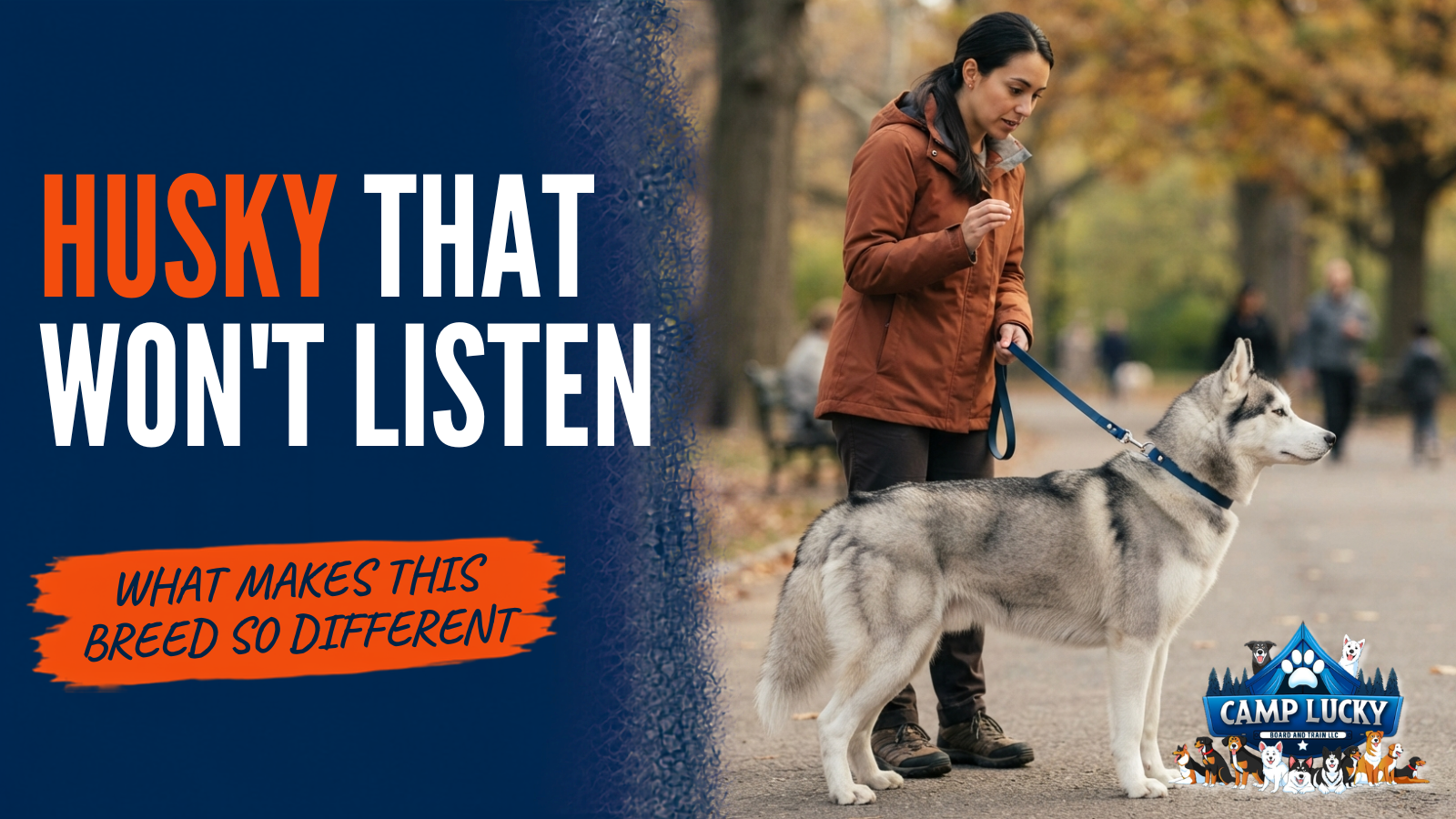
If your Husky ignores commands outdoors but listens perfectly inside, the problem isn’t stubbornness—it’s genetics. Their independence was bred for survival, and standard training advice completely misses why food rewards stop working the moment real distractions appear.
Key Takeaways:
- Huskies aren’t stubborn by choice — their genetics wire them to make independent decisions, a survival trait bred over centuries of sled work in harsh Arctic conditions.
- “Not listening” and “stubborn” are the wrong frames — understanding what’s actually driving the behavior is the first step to fixing it, and the real triggers might surprise you.
- Generic training advice routinely fails this breed — Huskies have low biddability, meaning human approval alone rarely motivates them the way it does other dogs.
- Positive reinforcement, consistent structure, and clear communication form the foundation — programs like we offer at Camp Lucky Board and Train are built around the reality of high-drive, independent breeds rather than one-size-fits-all obedience.
- A well-trained Husky is actually a freer Husky — structure and reliability open up experiences that an untrained dog never gets to have safely.
If living with a Husky sometimes feels like negotiating with a very fast, very loud coworker who doesn’t respect your authority — that’s not just a “you” problem. It’s one of the most common experiences Husky owners across the U.S. share, and it has very little to do with how much the dog loves you or how hard you’ve tried.
Your Husky Isn’t Stubborn — They’re Genetically Wired Differently
Here’s something that should reframe everything: when a Husky ignores a command, it’s usually not defiance. It’s decision-making. Siberian Huskies were selectively bred over generations to pull sleds across hundreds of miles of frozen wilderness — often with minimal direction from a handler. The lead dog didn’t wait to be told there was a crack in the ice. It assessed, decided, and acted. That independence wasn’t a bug. It was the whole point.
Fast forward to a suburban backyard in Kansas City or San Antonio, and that same genetic programming is still very much active. The Husky in your living room carries the instincts of a working dog designed to trust its own judgment over yours. Calling that “stubbornness” misses the point entirely — and it leads owners toward the wrong solutions.
Reframing the problem matters. Most “Husky that won’t listen” cases aren’t about a bad dog or a lazy owner. They’re about a high-drive, independence-bred working dog living in a human environment that never gave it clear, compelling reasons to cooperate.
Why ‘Won’t Listen’ Means Something Different in Huskies
Bred to Think, Not to Obey
From a behavioral science standpoint, Huskies are described as having low biddability — a term that refers to how eager a dog is to please its handler simply because the handler asked. Golden Retrievers and Border Collies score high here; they’re practically hardwired to want human approval. Huskies sit near the opposite end of that scale.
That doesn’t mean they’re unintelligent. It’s nearly the reverse — Huskies are sharp, curious, and excellent problem-solvers. But their intelligence is built around self-directed thinking, not compliance. They understand commands far more often than owners realize. The issue is that they weigh the command against everything else available to them and make a choice. That squirrel? More biologically satisfying than any sit cue. That open gate? An irresistible invitation. Your voice? Background noise.
This also means Huskies are particularly prone to accidental reinforcement. When a dog ignores a recall and successfully chases the thing it wanted, ignoring the recall just got rewarded — powerfully, by the environment itself. Repeat that pattern enough times, and “come” stops meaning anything at all. The dog has simply learned that making its own call works out better.
The Real Triggers Behind Every ‘Not Listening’ Moment
Prey Drive and Roaming Override Your Recall
Two of the most significant genetic traits driving “not listening” moments in Huskies are their prey drive and their roaming instinct. These aren’t personality quirks — they’re deep biological drives that generate dopamine when acted on. The biological payoff of chasing something is simply more powerful than most treats, praise, or commands an owner can offer in the moment.
This is why Huskies often perform well indoors, then completely disconnect the moment they step outside. It’s not spite. It’s context-specific learning colliding with a far more stimulating environment. The living room doesn’t have squirrels. The park does.
The roaming instinct compounds this further. Huskies were bred to cover enormous distances, and that pull toward exploration doesn’t turn off in a fenced yard or on a 6-foot leash. Door-dashing, fence-testing, and escape artistry are all expressions of the same ancient drive — and they become deeply ingrained habits when the environment accidentally rewards them.
On top of this, consider what happens in many U.S. households: the command “come” gets repeated five times with no follow-through. “Heel” is said while the owner is already being dragged forward. Over time, the dog doesn’t learn disobedience — it learns that human words are suggestions with no predictable outcome, not reliable signals worth responding to. That’s command poisoning, and it’s one of the most common training failures with this breed.
Why Generic Training Advice Fails This Breed
Positive-Only Falls Short Outdoors
The most common training advice Husky owners find online — “be consistent, use positive reinforcement, reward good behavior” — isn’t wrong. It’s just incomplete. Positive reinforcement is the essential foundation for building any behavior with a Husky. But when a dog’s internal reward system is running on the thrill of a chase or the freedom of a wide-open field, a piece of kibble simply can’t compete.
Purely reward-based approaches often work reasonably well in low-distraction environments. The problem surfaces the moment the real world shows up: other dogs, wildlife, kids running, the smell of something interesting three blocks away. In those moments, the reinforcement history the owner built at home doesn’t hold up — because it was never tested against anything that actually challenged it.
On the other side of that coin, dominance-based or heavily punishment-based methods are equally ineffective with Huskies — and often actively harmful. This breed is notably sensitive to heavy-handed tactics. Rather than submitting, Huskies tend to shut down, resist, or develop avoidance behaviors. Veterinary and behavioral professionals widely discourage intimidation-based strategies for this reason, and experienced trainers consistently report that harsh methods damage the trust and engagement that Husky training fundamentally depends on.
The approach that actually fits this breed lives between those two extremes — which is where the real training conversation begins.
What Actually Works: Training Approaches for Independent Dogs
Positive reinforcement, consistent structure, and clear communication form the foundation that most experienced professionals recommend for high-drive, independent breeds like Huskies. Some professionals also advocate for a balanced approach that integrates positive reinforcement with fair, clear corrections — though given the Husky’s sensitivity, the emphasis is typically placed heavily on building trust and engagement first. The goal isn’t to overpower the dog or bribe it endlessly. It’s to build genuine communication, then make cooperation the most reliable and rewarding option available.
Here’s how that breaks down in practice:
1. Build Engagement Before Obedience
Before “sit” or “come” means anything in a high-distraction environment, the Husky has to learn that checking in with its handler is worth doing. Engagement training — teaching a dog to orient toward and focus on the handler — is the foundation everything else is built on. Without it, commands are just words competing against a world full of more compelling options.
2. Use High-Value, Breed-Appropriate Rewards
Standard treats won’t always cut it. Breed-appropriate rewards for Huskies include real food (not dry kibble), tug games, chase games, and — critically — access to the environment itself. Permission to sniff, permission to run, permission to roam: these are powerful currencies for a dog built to cover ground. Rotating reward types keeps motivation from collapsing when distractions spike.
3. Proof Commands Around Real-World Distractions
A command that only works at home isn’t a trained command — it’s a home-only trick. Systematic proofing means taking heel, recall, place, and down-stay into increasingly challenging real-world environments — parks, busy sidewalks, pet-friendly stores — and reinforcing correct responses with clear, consistent criteria. This is how behavior becomes genuinely reliable rather than situational.
4. Apply Fair, Clear Corrections as Part of a Structured Approach
Structure without boundaries isn’t structure. When corrections are part of the training plan, they should be delivered calmly, at the right moment, and proportionate to the dog. The key word is fair: corrections that are too harsh shut a Husky down; corrections that never come teach the dog that compliance is negotiable. Consistency, timing, and professional guidance are everything here.
A Note on E-Collars and Off-Leash Reliability
E-collars, when introduced responsibly and under professional guidance, can be a meaningful part of the picture for high-drive Huskies — particularly for building off-leash communication where food rewards lose their pull. Trainers who use them correctly apply minimal stimulation as a communication tool, not a punishment device. The ET300 by E-Collar Technologies, for example, operates at levels many humans can barely perceive, and is used to mark and redirect behavior rather than cause discomfort.
That said, it’s worth being honest: achieving fully reliable off-leash control in uncontrolled environments remains one of the hardest goals to reach with a Husky, even with advanced tools. Their roaming and prey instincts don’t disappear — they get managed. Many experienced trainers recommend that Huskies, even well-trained ones, should never be considered fully safe in unfenced public spaces. What good training provides is dramatically improved reliability, better communication, and real-world control that makes daily life genuinely safer and more enjoyable.
When Board and Train Resets the Pattern Faster
For many Husky owners, the challenge isn’t understanding what needs to happen — it’s finding the time, consistency, and controlled environment to actually make it happen. That’s where immersive board and train programs offer something that weekly lessons or video tutorials can’t replicate: professional repetition, every day, in realistic conditions, with no gaps in follow-through.
We at Camp Lucky Board and Train recommend four-week program for Huskies — noting that the breed’s combination of high drive, independence, and habit entrenchment typically requires the full arc of foundation work, distraction proofing, behavioral focus, and immersive repetition to produce lasting results. Our model places dogs inside a trainer’s personal home rather than a kennel — which means a Husky is practicing door manners when people actually walk through doors, and working through meal-time impulse control during actual mealtimes. That home environment is what makes the training transfer back into a family setting far more effectively.
Real-world outcomes support the approach. Many owners report significant improvements in obedience and day-to-day behavior after completing a board and train program — dogs returning home with reliable command foundations, improved leash manners, and a noticeably more harmonious household dynamic. These results reflect what becomes possible when a Husky’s training is designed around how the breed actually works — not how owners wish it would.
A Structured Husky Is a Happier, Freer Husky
There’s a version of this story that ends with a Husky who can go to a park without dragging their owner across the field. Who can be trusted near an open door. Who settles when asked and engages when invited. That version isn’t built on dominance or bribery — it’s built on clear communication, consistent structure, and training that respects what this breed actually is.
Obedience isn’t a restriction for a Husky. It’s what unlocks more of the world for them. A dog with reliable recall can safely go more places. A dog with solid leash manners gets more opportunities. A dog whose owner knows how to communicate clearly lives with less confusion and less anxiety — and so does the family around it.
The independence that makes Huskies challenging is also what makes them extraordinary. The goal of good training isn’t to suppress that quality. It’s to build a relationship where that intelligence has somewhere useful to go — and where cooperation feels more rewarding than going rogue.
For Husky owners ready to stop guessing and start seeing real change, we at Camp Lucky Board and Train offer breed-aware training programs designed for exactly this kind of dog.