Your dog suddenly plants its feet and won’t budge, and it’s tempting to call it stubbornness.
A trainer reveals what’s really happening in your dog’s nervous system during a freeze, and why pulling harder makes everything worse.
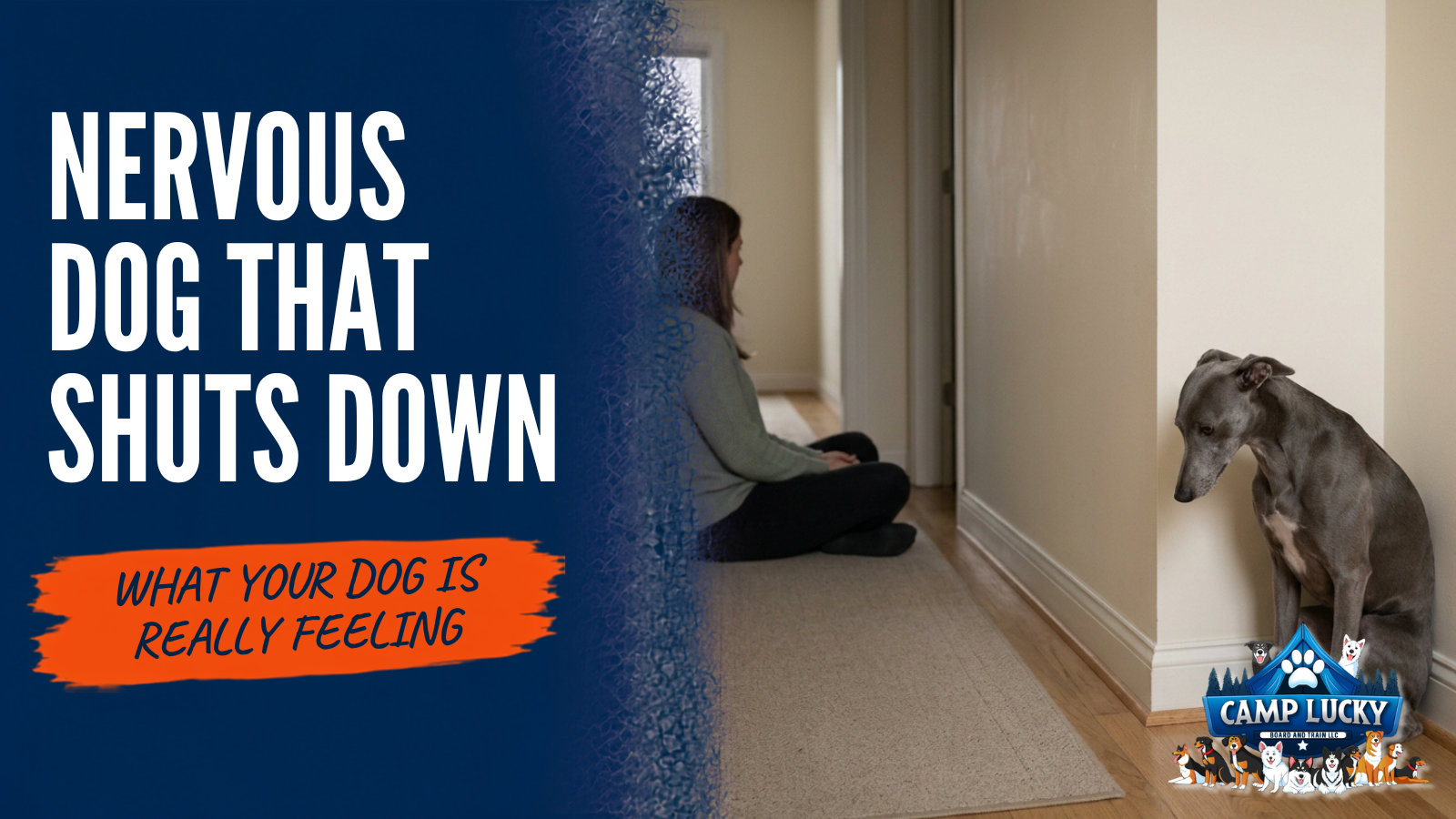
Key Takeaways
- A dog that freezes or refuses to walk is usually communicating fear, overwhelm, or a past negative experience rather than being stubborn
- A calm, motionless dog is not always a relaxed dog, since freezing is often a stress response, sometimes called a shut-down state
- Overstimulation, unfamiliar environments, leash pressure, and even hidden pain can all cause a dog to stop in its tracks
- Forcing or dragging a frozen dog forward tends to increase fear and can damage the dog’s trust in its handler
- Rebuilding confidence takes gradual exposure and repetition in real settings, a process that structured board and train programs are often built around
A walk should be one of the easiest parts of a dog’s day.
So when a dog plants its feet, lowers its body, or simply refuses to budge, it can leave an owner standing on the sidewalk feeling confused, embarrassed, and a little stuck.
Understanding what is actually happening in that moment changes how to respond.
The Walk Stops. The Dog Goes Still.
One second the leash is loose and the pace is normal.
The next, the dog has turned into a statue, eyes wide or oddly fixed, body rigid, refusing to take another step no matter how much coaxing or gentle tugging happens.
Owners often describe feeling baffled because nothing dramatic seemed to happen.
No loud noise, no obvious scare, just a dog that suddenly will not move.
That confusion is exactly the point where most people reach for the word “stubborn.”
It feels like the dog is making a choice to be difficult.
But trainers who work with fearful and anxious dogs every day see this pattern constantly, and the explanation almost never has anything to do with defiance.
Freezing is one of the clearest signals a dog can give that something in the moment feels unsafe, confusing, or like too much to process.
The good news is that freezing is information, not a dead end.
A dog going still on a walk is trying to cope with something, and figuring out what that something is opens the door to actually helping.
What Freezing Actually Means
Freezing is a survival response built into the dog’s nervous system.
When a dog feels unsure whether a situation is safe, stillness can be a way of gathering information before deciding what to do next.
Dogs often freeze or shut down as a reaction to stress, using that pause to assess the situation before committing to a next move.
The behavior reads less like refusal and more like a dog that needs a moment to process what’s happening.
Signs Owners Mistake for Stubbornness
Many of the behaviors that get labeled as stubborn are really fear in disguise.
A dog that digs in its heels, turns its head away, or suddenly becomes “deaf” to a familiar cue is often overwhelmed rather than defiant.
- Planting all four feet and refusing to move, even with treats offered
- Turning the body away from the direction of travel
- Suddenly ignoring commands the dog knows well at home
- Pulling hard toward home instead of forward
- Refusing treats that would normally be irresistible
A dog that freezes on a walk is communicating a feeling, and figuring out the reason behind the stop is the real key to helping the dog move forward calmly.
Reading these signals as defiance instead of distress usually leads owners to push harder, which tends to make things worse.
Why Calm Can Actually Mean Overwhelmed
A dog standing perfectly still might look like the picture of calm, yet that stillness can be the opposite.
A dog that has gone quiet, stopped sniffing, and become unresponsive may have reached a point where its nervous system has essentially paused rather than relaxed, waiting for a perceived threat to pass.
This matters because owners naturally read quiet as good behavior, so a genuinely shut-down dog can go unnoticed until the problem grows.
A dog in this state is not disobeying a cue.
It is struggling to function at all in that moment, which calls for a different kind of response.
The Real Triggers Behind the Freeze
Freezing rarely has one single cause.
Most of the time it is a combination of the environment, the dog’s history, and sometimes the dog’s physical condition all colliding at once.
Overstimulation and Unfamiliar Environments
Busy streets, unfamiliar smells, moving crowds, and constant noise can overload a dog’s senses fast.
Overstimulation from busy streets, strong smells, and constant movement can cause some dogs to shut down entirely rather than push through.
A dog that has limited experience outside its own neighborhood may simply lack the confidence to process so much new information at once, making even a routine walk feel like a lot to handle.
New routes matter too.
A change in surface, a new block, or an unfamiliar park can be enough to make a dog hesitate and freeze, even if nothing scary actually happens.
The unfamiliarity itself is the trigger.
Leash Pressure and Past Experience
Some dogs freeze the moment the leash comes out, long before the front door opens.
This can point to leash anxiety or a fear of restraint rooted in past trauma, rushed training, or discomfort from poorly fitted equipment.
A dog that associates the leash with tension, correction, or confusion may shut down as soon as that pressure appears on its neck or body.
Body language often tells the story before the freeze even happens.
Signs like a tucked tail, ears pinned back, lip licking, panting when it is not hot outside, or refusing a favorite treat can all signal rising stress well before a dog comes to a complete stop.
Catching these earlier signals gives an owner the chance to step in before the dog reaches a full freeze.
When It’s Actually Pain, Not Fear
Not every frozen walk is about emotion.
A dog that suddenly refuses to move may be dealing with a genuine physical problem, such as a sore paw pad, a torn nail, or a more serious injury that makes walking painful.
Joint issues like arthritis or hip dysplasia can also cause a dog to stop walking altogether simply because movement hurts.
A sudden change in walking behavior, especially in a dog that has never had this issue before, deserves a trip to the veterinarian before anything else.
Ruling out pain first protects the dog and makes sure any behavior plan that follows is actually addressing the right problem.
Why Forcing a Dog Forward Backfires
It is tempting to tug, scoop up, or cheerfully drag a frozen dog toward the direction everyone needs to go.
This almost always backfires.
Forcing a dog out of a freeze or pulling it through a scary situation can increase its fear and teach the dog that its handler is not a safe presence during stressful moments.
Punishing a scared dog for freezing compounds the problem further.
Pressuring or correcting a dog that is already afraid raises its stress level and can create lasting behavioral issues, including aggression.
The dog is not choosing to be difficult, so a punishment-based response teaches the wrong lesson entirely and can damage the trust that makes training possible in the first place.
The better first move is simple: pause.
Checking the environment and the dog’s body language helps determine whether the right next step is creating more space from whatever triggered the freeze, choosing a different path, or simply ending the walk early and trying again later.
A dog that is pushed past its limit over and over learns that walks are something to dread, which shrinks its world instead of expanding it.
Rebuilding Confidence Step by Step
Helping a dog move past freezing is less about forcing forward motion and more about changing how the dog feels about the situation in the first place.
Until that emotional state shifts, commands, pulling, or coaxing will not build real confidence.
Desensitization and Counterconditioning Explained
Two terms come up constantly in this kind of training: desensitization and counterconditioning.
Desensitization means gradually exposing a dog to whatever is triggering the fear in its mildest possible form, then slowly increasing the intensity only once the dog shows it can handle each step.
Counterconditioning works alongside that process by pairing the trigger with something positive, like a high-value treat, so the dog’s emotional response starts to shift from fear toward neutral or even positive.
Practical versions of this approach include:
- Starting with quiet, low-pressure walks far from known triggers
- Keeping distance from anything that causes stress rather than walking straight toward it
- Rewarding calm body language the moment it appears
Using a longer leash, such as a 15 or 30 foot line, to give the dog room to move around without constant pressure on its neck
- Building up slowly over many successful walks rather than expecting quick results
Why Repetition in Real Settings Matters
A single good walk does not undo months of fear.
Progress comes from repeated, successful exposure in the actual settings where a dog struggles, not just in a quiet backyard.
A dog that only practices calm behavior in one controlled spot may still freeze the moment it encounters a real sidewalk, a crowded parking lot, or an unfamiliar neighborhood.
Practicing in realistic environments, from front doors to busy public spaces, tends to produce results that hold up once the owner is back on their own.
Skills built only in artificial settings rarely transfer cleanly to everyday life.
Structured Programs for Lasting Change
Some dogs make steady progress with patient, owner-led work at home.
Others, especially those with deeper fear responses or a history of negative leash experiences, benefit from more intensive, structured support.
Camp Lucky Board and Train work with dogs through live-in programs where our trainers work each dog multiple times a day, practicing real-life skills like calm greetings and door manners in the very settings where those skills actually matter.
Matching Program Length to the Dog’s Needs
Not every dog needs the same amount of time to build confidence.
Our one week program tends to suit puppies or newly adopted dogs who just need foundational leash structure and basic obedience.
Our two week program expands into distraction work and off-leash reliability in busier, more distracting environments, which can be especially useful for dogs that freeze around unfamiliar stimuli.
Our three week program adds more time for proofing behaviors and building genuine confidence in dogs working through minor fear or anxiety-driven issues, while our four week program offers the most thorough option for dogs with significant behavioral needs, including more serious fear responses that take longer to unwind.
Matching the program length to what the dog is actually dealing with matters more than picking the longest or shortest option by default.
A dog that freezes occasionally in new places needs a different plan than one that shuts down on nearly every outing.
Handoff Support So Progress Holds at Home
Training that only exists during a program does not last once the dog goes home.
Our personalized go-home session at the end of each program helps translate what the dog has learned into instructions the owner can actually follow, so the dog’s new confidence does not disappear the moment it walks back through its own front door.
Our photo and video updates throughout a dog’s stay also give owners a window into how their dog is progressing, which can ease some of the worry that comes with sending a nervous dog away for training in the first place.
Understanding the Fear Is the First Step Forward
A dog that freezes on a walk is showing, in the clearest way it knows how, that something about that moment feels like too much.
Reading those signals correctly, ruling out pain, and responding with patience instead of pressure gives a dog the chance to build real confidence instead of just learning to tolerate fear in silence.
For owners ready to work through this pattern step by step, dog training programs built around gradual exposure and real-world repetition can offer a clear path forward.