Handing your dog to a stranger for weeks is risky if you skip the right questions.
With zero licensing requirements for U.S. dog trainers, one consultation moment could reveal whether a program is legit, or a red flag waiting to happen.
Key Takeaways
- A dog trainer consultation is meant to diagnose a dog’s behavior and build a personalized plan, not deliver instant obedience results.
- The dog training industry has no licensing or education requirements, so asking about credentials and methods before booking matters more than it would for a regulated profession.
- Owners should ask specific questions about where a dog will live, who trains it daily, and what happens after pickup before committing to any board and train program.
- A balanced training approach starts with positive reinforcement before introducing an e-collar as a communication tool.
- Guaranteed results, quick fixes, and talk of dominance or being ‘alpha’ over a dog are signals worth walking away from during a consultation.
Handing a dog over to a stranger for a week or more is a big decision, and the consultation is the only real chance to find out what that experience will actually look like.
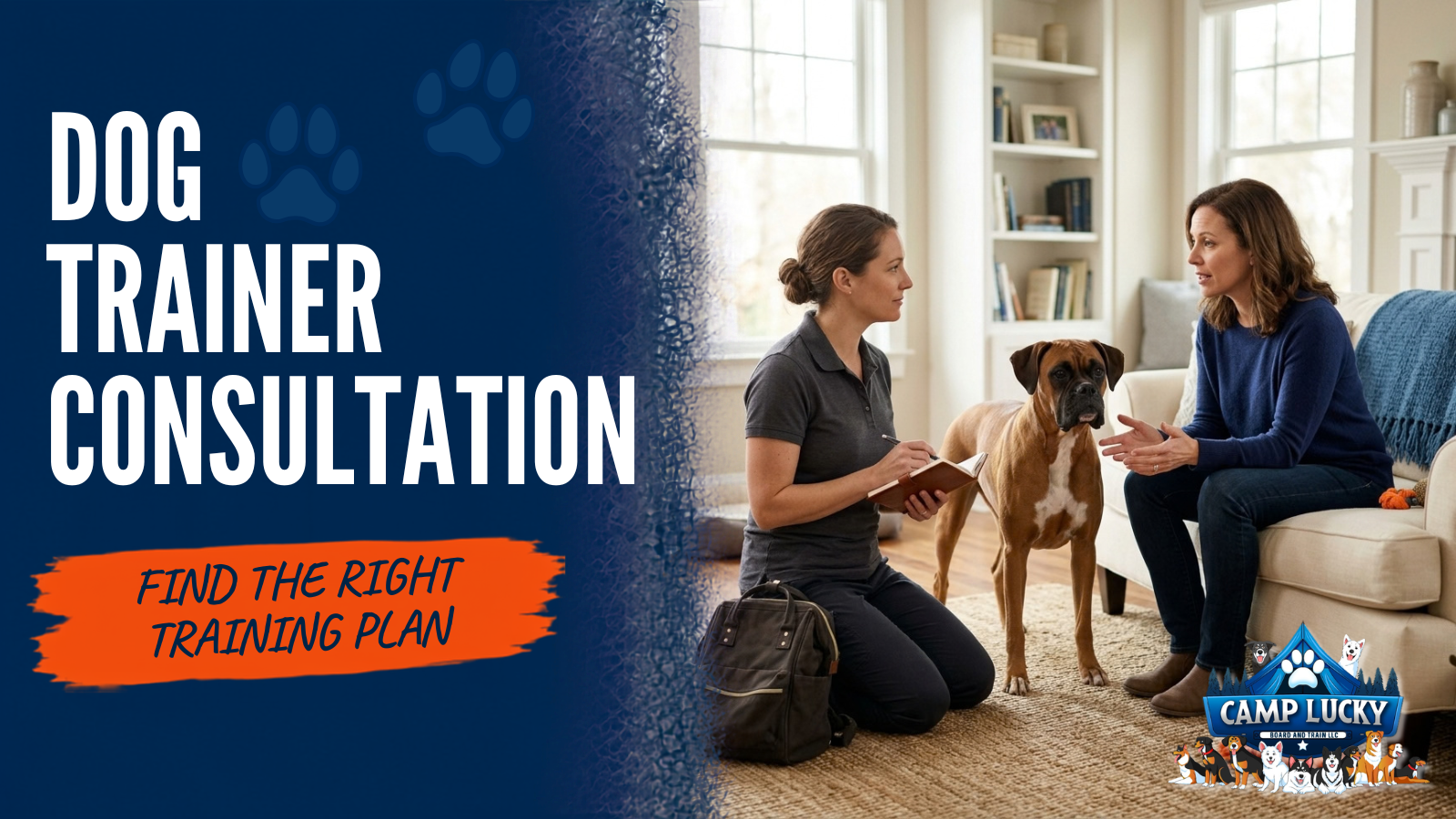
A good consultation is not a training session and it will not produce a perfectly behaved dog on the spot.
Instead, it should function as an honest evaluation of the dog’s behavior, the owner’s goals, and whether a particular program and trainer are the right fit.
What A Real Consultation Should Deliver
A consultation exists to gather information rather than perform tricks.
The trainer should be asking about the dog’s history, daily routine, health, and behavior in different situations well before any talk of program length or pricing comes up.
That order matters: a trainer who jumps straight to selling a package without asking questions first is skipping the diagnostic step that makes a training plan actually work for that specific dog.
The strongest consultations also explain the process in plain language, without dodging behind jargon.
Owners should walk away understanding what a typical day will look like for their dog, what role they will play once training starts, and how progress will be measured along the way.
A consultation should give owners a place to talk through a dog’s specific struggles and set expectations before any commitment is made, which reflects a broader standard worth expecting from any program under consideration.
Questions About Your Dog’s Specific Needs
Ask About Goals, Routine, And History
Before any conversation about board and train length or cost, a trainer should want to know what a typical day looks like for the dog.
That includes questions about feeding schedules, exercise habits, previous training attempts, health conditions, and what the owner ultimately wants to be different at home.
A dog with a bite history needs a different conversation than a bouncy eight-week-old puppy still learning where to potty, and a trainer who treats every intake the same way is not tailoring anything.
Owners should come prepared to answer these questions honestly, even when the answers feel embarrassing.
Skipping over a habit because it seems minor, like letting the dog sleep in the bed or ignoring counter surfing, can leave a trainer working with incomplete information.
Describe Real Scenarios, Not Just “Problems”
Owners tend to downplay behavior issues without realizing it.
A dog that lunges at the mail carrier might get labeled “a little vocal” rather than reactive, simply because the owner has grown used to the behavior over time.
Describing specific moments works better than answering a general question like “does your dog have any problems?”
Walking a trainer through concrete scenes paints a clearer picture:
- The exact walk that gets dreaded every single day because of leash pulling or lunging.
- What happens in the ten seconds after the doorbell rings.
- How the dog behaves when a guest who “understands dogs” comes over anyway.
- What mealtime looks like when food is on the counter or table.
These specific pictures give a trainer far more to work with than a vague complaint, and they often reveal patterns the owner had stopped noticing altogether.
Questions About Methods And Tools
What Happens When The Dog Gets It Right Or Wrong
One useful approach for this part of the consultation borrows from a simple three-question framework: what exactly happens when the dog performs correctly, what exactly happens when the dog gets it wrong, and whether a less invasive method exists to address the same issue.
A trainer who can answer clearly and specifically, without deflecting, is demonstrating real command of their own methods.
Vague answers are the real warning sign here, not any particular training philosophy.
A trainer who cannot describe what a correction actually looks like, or who brushes off the question with reassurances instead of specifics, has not earned the trust that comes with taking a dog home for weeks at a time.
Reward-Based Versus Balanced Training
Two broad approaches dominate the industry, and understanding the difference helps owners ask sharper questions.
Reward-based training relies on positive reinforcement for training and behavior modification, with the reasoning that confrontational techniques can lead to aggressive responses in some dogs.
Balanced training combines positive reinforcement with correction tools such as e-collars or prong collars, and remains a widely practiced and recognized segment of the field.
Neither approach is inherently right or wrong for every dog, but owners deserve a trainer who can explain their reasoning rather than picking a side out of habit.
A balanced approach typically starts with treats and reinforcement to shape basic positioning and commands, then introduces a tool like an e-collar once the dog has a foundation, using it as a communication cue rather than a punishment.
The key question for any owner is whether the trainer can walk through that progression step by step, including how they decide a dog is ready to move from one phase to the next.
Questions About Credentials And Experience
Why The Industry Has No Licensing Requirements
Unlike veterinarians or groomers in some states, dog trainers in the United States face no federal or state licensing requirements, no standardized education, and no mandatory background checks.
Someone can start advertising as a professional trainer within days, regardless of experience.
That regulatory gap places the burden squarely on owners to vet a trainer’s background before ever dropping a dog off for an extended stay.
This is not a reason for panic, but it is a reason to ask direct questions rather than assume a business card or a polished website equals expertise.
A consultation is the moment to ask how long someone has been training professionally, what kinds of behavior issues they see most often, and whether they have handled a case similar to the dog in question.
Certifications Worth Asking About
Because “certified” and “behaviorist” are both unregulated terms, not every credential carries the same weight.
A few organizations require documented hours, proctored exams, and adherence to a formal code of ethics, which makes their credentials worth asking about by name:
- The Certified Professional Dog Trainer program (CPDT-KA or CBCC-KA).
- The International Association of Animal Behavior Consultants (IAABC).
- Continuing education through workshops, mentorships, or formal coursework beyond initial certification.
None of these credentials guarantee a perfect fit for every dog, but a trainer who has invested in ongoing education tends to bring a deeper toolkit to unusual or difficult cases.
Asking about a trainer’s background with the dog’s specific issue, whether that is leash reactivity, resource guarding, or general puppy chewing and potty training struggles, rounds out the picture better than credentials alone.
Questions Specific To Board And Train
Where Will The Dog Actually Live
Board and train programs vary enormously in how dogs actually spend their time, and this single question separates a lot of programs from each other.
Some facilities keep dogs in kennels for most of the day, with a trainer working the dog for a few hours before leaving for the night.
Others have dogs living inside a trainer’s home around the clock, practicing real household routines like door manners, table manners, and calm behavior around daily foot traffic.
We at Camp Lucky Board and Train, for example, keep dogs in a trainer’s home rather than a kennel for the full length of their stay.
That distinction matters because skills learned in an isolated kennel setting do not always transfer smoothly to a busy household.
A dog that behaves perfectly in a quiet training room may fall apart the first time a guest walks through the front door of its actual home, simply because it never practiced that scenario during the program.
Who Trains The Dog Daily
It is worth asking exactly who works with the dog each day, what that person’s experience looks like with the dog’s specific issue, and who supervises that work if the primary trainer is not the owner of the business.
Some programs advertise a well-known lead trainer but hand off the bulk of daily work to less experienced staff.
Knowing who is actually in the room with the dog day to day helps set realistic expectations for the stay.
What Happens After Pickup
Training that ends the moment the dog goes home often unravels within weeks.
A reputable program includes a structured handoff, sometimes called a go-home session, where the trainer teaches the owner the same commands, tools, and routines the dog has been practicing.
Photo and video updates during the stay also help owners understand the process before pickup day, rather than being surprised by unfamiliar cues or equipment.
Owners should ask what kind of support exists after the program ends.
Some programs offer a couple of refresher sessions, while longer programs may include ongoing support for issues that fall within what the program actually covered.
Either way, a clear answer here signals a trainer who thinks about long-term success rather than just the weeks the dog spends in their care.
Red Flags That Signal Walk Away
Guaranteed Results And Quick Fixes
No ethical trainer promises guaranteed results, because outcomes depend on a dog’s genetics, history, health, environment, and how consistently the owner follows through once training ends.
A trainer who claims to fix serious behavior problems in one or two sessions is skipping the deeper, step-by-step work that lasting change actually requires.
Confidence is a good sign in a trainer; certainty about outcomes that no one can actually control is not.
Dominance Talk And Closed-Door Training
Language about being “alpha” or asserting “dominance” over a dog reflects an outdated theory that has not kept pace with current understanding of dog behavior.
A trainer who frames ordinary issues like jumping or leash pulling as a dog trying to “take over” the household is leaning on ideas that current thinking no longer supports.
Refusal to explain methods clearly, or discomfort with an owner seeing the training environment, deserves equal caution.
A trustworthy program welcomes hard questions and answers them specifically, while a program with something to hide tends to get vague or defensive when pressed on the same details.
The Right Questions Protect The Dog
Asking pointed questions before board and train helps make sure a dog’s specific needs, an owner’s expectations, and a trainer’s actual methods all line up before the dog ever leaves home.
The consultation is the one moment in the entire process where an owner holds the most control, since it happens before any money changes hands and before the dog is out of sight.
Coming prepared with real scenarios, direct questions about tools and daily routines, and a clear sense of what red flags look like turns a nerve-wracking decision into an informed one.
For owners ready to put these questions into practice, scheduling a free in-home consultation with us at Camp Lucky Board and Train is a practical way to see how a program answers them in person.