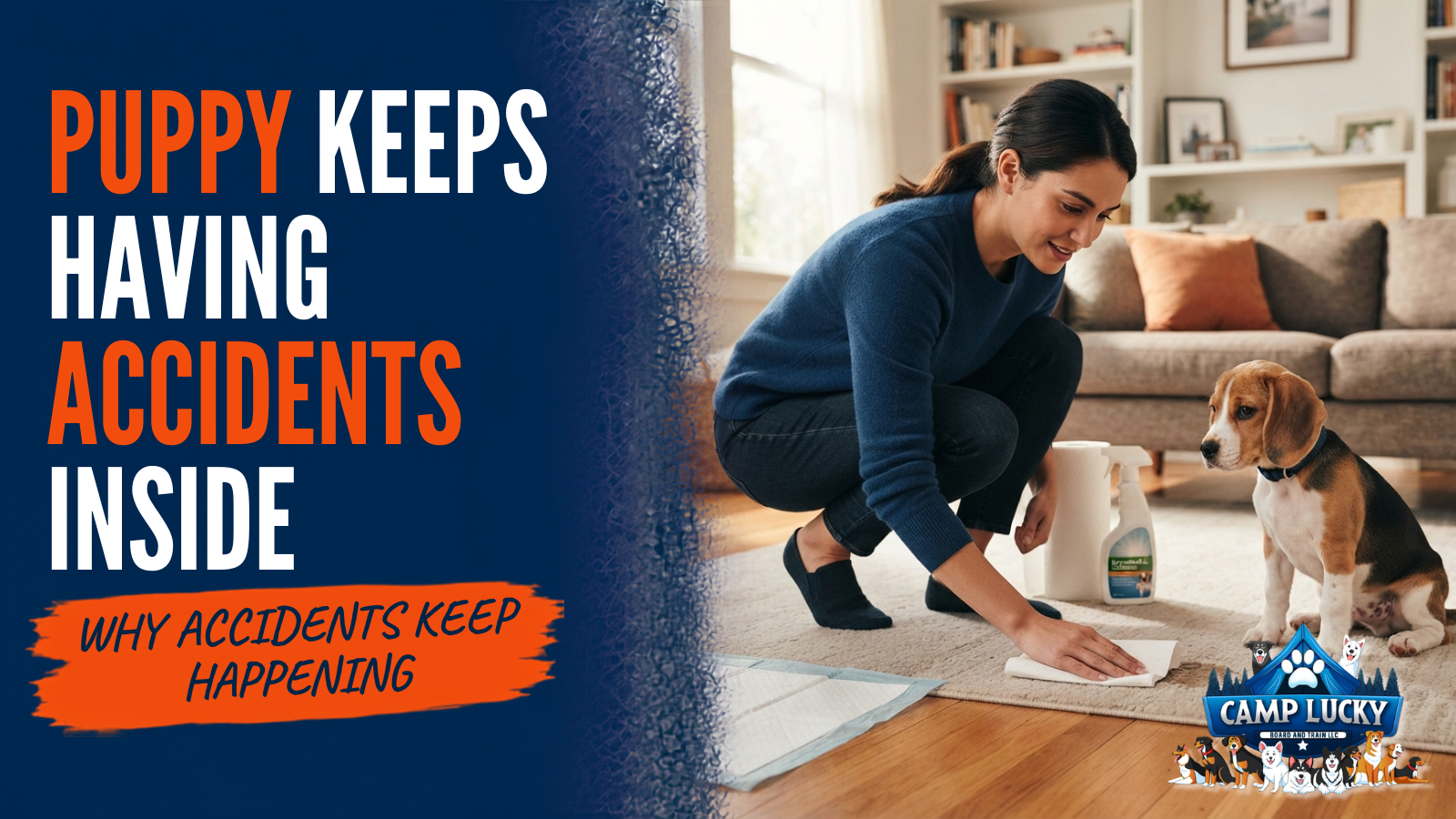
If you’ve tried everything and your puppy still has accidents inside, the problem probably isn’t your dog—it’s three fixable mistakes in your daily routine. Here’s what professional trainers say you’re getting wrong (and one medical red flag you can’t afford to ignore).
Key Takeaways
- Most puppy accidents inside the house are a setup and management problem — not a personality flaw in the dog.
- Too much unsupervised freedom, a mismatched potty schedule, and inconsistent reinforcement are the three most common culprits.
- Punishment after an accident doesn’t teach the puppy anything useful — and can actually make housetraining harder.
- Persistent accidents despite a solid routine may signal a medical issue like a urinary tract infection, which requires a vet visit before assuming it’s a training problem.
- When the right structure just isn’t clicking at home, a professional board and train program can rebuild the foundation fast — keep reading to see how that works.
Puppy accidents are one of the most frustrating parts of bringing a new dog home. The puddle on the rug, the smell that won’t seem to go away, the feeling that no matter what’s tried, nothing sticks — it’s exhausting. But here’s what most owners don’t hear early enough: the puppy usually isn’t the problem. The setup is.
It’s Not a Bad Puppy — It’s a Bad Setup
When a puppy keeps having accidents inside, the instinct is often to assume the dog is stubborn, slow to learn, or just being defiant. That framing leads owners down the wrong path — toward frustration, punishment, and eventually, giving up on a system that might have worked with one or two adjustments.
Puppies learn through repetition and immediate consequences. Every single time a puppy relieves itself indoors without any intervention, that habit gets a little stronger. It’s not malice — it’s neurology. The puppy is not choosing the living room carpet over the backyard. It’s responding to bladder pressure, an unclear environment, and a lack of guidance about where the right spot actually is.
The fix, in almost every case, comes down to tighter management: more frequent trips outside, closer supervision indoors, and a schedule that actually matches the puppy’s physical ability to hold it. Changing the environment changes the behavior — and that’s the real lever most owners haven’t pulled yet.
The Real Causes of Indoor Accidents
Housetraining rarely fails because the puppy can’t learn. It fails because one or more pieces of the system are off. Understanding which piece is broken is the fastest way to fix the problem.
Too Much Freedom Too Soon
Giving a new puppy free run of the house is one of the most common — and most damaging — mistakes in housetraining. It feels kind. It feels natural. And it almost always results in accidents.
When a puppy has access to multiple rooms, consistent supervision becomes nearly impossible. The puppy wanders, finds a quiet corner, and eliminates there. That spot now carries a scent signal that says bathroom. The next time the puppy needs to go, that scent pulls it right back to the same location.
The solution is to dramatically shrink the puppy’s accessible space. Keep the puppy in the same room at all times. Use baby gates, closed doors, or a leash tethered nearby to prevent unsupervised wandering. Freedom in the house is something a puppy earns after housetraining is solid — not before.
Missed Potty Signals and Inconsistent Supervision
Puppies do signal before they go — sniffing the floor, circling, suddenly breaking away from play, or pausing mid-activity. But those windows are short, and they’re easy to miss when attention drifts for even a minute.
Consistent supervision means active, eyes-on watching — not just being in the same room while scrolling through a phone. When direct supervision isn’t possible, the puppy should be in a crate or enclosed playpen. That’s not harsh; it’s practical. A puppy that can’t be watched can’t be guided.
Timing also matters more than most owners realize. Young puppies need to go out after waking up, after eating or drinking, after play, and roughly every 45 to 90 minutes in between during active waking hours. A commonly cited guideline suggests puppies can hold their bladder for approximately one hour per month of age, plus one — but this reflects an absolute maximum for calm or crated periods, not a reliable window during active play. A three-month-old puppy should not be expected to hold it for four hours while awake and active; the 45-to-90-minute schedule is the more practical target during the day.
When It Might Be Medical: Signs of a UTI
Before blaming training entirely, it’s worth ruling out a physical cause — especially when accidents seem to come out of nowhere or a previously reliable puppy suddenly regresses.
Urinary tract infections are surprisingly common in puppies and can cause the same symptoms that look like housetraining failure: frequent urination, accidents in unusual spots, straining to go, or blood in the urine. If any of those signs are present, a vet visit comes before any training adjustment.
Other medical causes can include incontinence or bladder issues that no amount of management or reinforcement will fix. The rule of thumb: if the routine is solid and the accidents keep happening, get a vet involved. Training problems and medical problems can look identical from the outside.
Why Punishment Makes It Worse
Rubbing a puppy’s nose in an accident, scolding loudly, or swatting with a rolled-up newspaper — these approaches have been around forever, and they are consistently counterproductive.
Here’s why: puppies don’t connect a punishment delivered after the fact to the act of eliminating indoors. By the time the accident is discovered and the scolding begins, the puppy has already moved on mentally. What it does register is that the owner is unpredictably frightening — and that sometimes bad things happen around urine on the floor.
The most common outcome? The puppy learns to hide when it needs to go. It sneaks behind the couch, ducks into a back bedroom, or waits until no one is watching. The accidents don’t stop — they just become harder to find and harder to address. Punishment teaches fear. It doesn’t teach where the bathroom is.
Humane veterinary and behavioral guidance consistently points in the same direction: if the accident already happened, let it go. Clean it up, adjust the management, and prevent the next one. The only productive response to an accident is to use it as information — something in the routine needs to change.
The Setup That Actually Works
Housetraining is a system, and systems work when every part is in place. Below are the four components that make the biggest difference — and the most common places things go wrong with each one.
1. Match the Schedule to Your Puppy’s Bladder
The most important variable in housetraining is timing. A schedule that doesn’t account for the puppy’s actual bladder capacity sets everyone up for failure.
As a starting point, take the puppy outside:
- Immediately after waking up (every time — naps included)
- Within 15 minutes of eating or drinking
- After any burst of play or excitement
- Every 45 to 90 minutes during waking hours for young puppies
Consistent feeding times help too. When meals happen on a schedule, elimination becomes predictable. Limiting water intake one to two hours before bedtime can also reduce overnight accidents — though water should never be withheld during the day.
2. Use a Crate as a Management Tool, Not a Punishment
Crate training works because puppies have a natural instinct to avoid soiling the space where they sleep. A properly sized crate — just big enough for the puppy to stand, turn around, and lie down — creates a space where the puppy is far less likely to eliminate unsupervised.
The key word is properly sized. A crate that’s too large gives the puppy room to designate one corner as a bathroom area, which defeats the purpose entirely. Most crates with adjustable dividers solve this by letting owners shrink the interior as needed and expand it as the puppy grows.
The crate is a management tool between potty trips, not a place to leave a puppy for hours at a stretch. Puppies who spend too long in a crate will eventually be forced to soil it out of necessity — and that undoes the instinct the crate training is built on.
3. Reward Outside Immediately — Not a Second Later
Timing of reinforcement is everything. When a puppy eliminates in the right spot outdoors, the praise and treat need to land the moment the puppy finishes — not when they come back inside, not after the leash is clipped back on, not when everyone makes it back through the door.
If the reward comes even thirty seconds later, the puppy may associate it with walking back toward the house, or with the leash being removed, rather than with the act of going to the bathroom outside. The window for meaningful reinforcement is genuinely that short.
Stay outside with the puppy during every potty trip. Wait for the elimination, then immediately reward with enthusiastic praise, a treat, or both. That immediate payoff is what builds the habit — it’s the only signal clear enough for a puppy to learn from reliably.
4. Clean Accidents Completely With an Enzymatic Cleaner
Dogs rely heavily on scent, and their noses are exponentially more sensitive than human ones. A spot that looks clean to the eye — and smells clean to a human — may still carry a strong urine signal to the puppy, effectively marking that location as a bathroom.
Standard household cleaners don’t break down the organic compounds in urine. Enzymatic cleaners do. These products contain enzymes that digest the proteins and bacteria in urine and feces, eliminating the scent at the molecular level rather than masking it.
Any spot where an accident has occurred should be treated with an enzymatic cleaner, allowed to soak in and air dry fully before the puppy has access to that area again. Skipping this step is one of the quietest reasons housetraining stalls — the puppy keeps returning to the same spot because that spot still smells like a bathroom.
Still Struggling? A Board and Train Can Reset the Foundation
Sometimes the management system is as solid as it can get at home, and accidents are still happening. Schedules are tight, the crate is being used correctly, and rewards are going out immediately — but the puppy still isn’t reliable. That’s when outside help can change the trajectory faster than another month of adjustments at home.
A board and train program puts the puppy in an intensive, structured environment with a professional trainer who can identify exactly what’s breaking down and address it consistently — without the gaps in supervision that are almost unavoidable in a normal household. Camp Lucky Board and Train accepts puppies as young as eight weeks old, and their trainers address foundational housetraining and home manners as part of the one-week program.
What a One-Week Program Covers
A one-week board and train isn’t just about commands — it’s about establishing reliable habits in a structured setting. In a well-designed program, a puppy spends the week living inside a trainer’s personal home, not in a kennel. That matters because the skills being built — door manners, crate behavior, responding to household routines — are practiced in the same type of environment where they’ll eventually need to transfer.
At Camp Lucky, the one-week program introduces foundational commands including sit, down, heel, and place, while also addressing common home-manners issues: jumping on people, bolting through doors, and housetraining habits. The consistency a trainer can provide over seven days — without breaks in supervision or gaps in the schedule — can compress what might take weeks at home into a much tighter window.
Worth being upfront: one week builds a strong foundation. It doesn’t finish the job on its own. Long-term success depends heavily on what happens after the puppy comes home.
Trained in the Right Environment — But Owner Follow-Through Is What Makes It Stick
One of the most honest things a trainer can say about board and train programs is this: the training doesn’t transfer automatically. A puppy that has learned a reliable outdoor bathroom habit in a trainer’s home still needs consistent reinforcement, supervision, and scheduling when it returns to its own house with its own family.
The habits built during a board and train are real — but they’re new, and new habits need repetition in a new environment to become permanent. That means owners need to continue the same schedule, use the same crate approach, reward in the same way, and clean accidents with the same thoroughness used during training.
What the program provides is a reset: the puppy comes home already knowing what’s being asked of it. The owner’s job shifts from teaching from scratch to maintaining and reinforcing something already established. That’s a meaningfully easier starting point — but it still requires active follow-through every single day.
Accidents Are a Training Problem — and Training Problems Have Solutions
Puppy accidents inside the house feel personal. They feel like failure. But the evidence consistently points somewhere less dramatic: a schedule that didn’t match the puppy’s bladder, too much unsupervised freedom, reinforcement that came a few seconds too late, or a spot that didn’t get cleaned thoroughly enough to remove the scent signal.
None of those are character flaws. They’re fixable variables. Tighten the schedule, shrink the accessible space, stay outside long enough to reward the right behavior immediately, and clean every accident with an enzymatic cleaner. Those four adjustments alone resolve the majority of housetraining problems — without punishment, without frustration, and without writing the puppy off as unteachable.
If a medical cause seems possible, a vet visit is the right first step — not a training adjustment. And if the home environment makes consistent supervision genuinely difficult, a structured program can accomplish in a week what months of inconsistent effort sometimes can’t.
The puppy isn’t broken. The setup just needs work — and that’s always a solvable problem.
Families looking for professional help building that foundation can find programs for puppies and dogs of any age at Camp Lucky Board and Train.