Think your dog is just being stubborn when they refuse to walk? That frustrating sidewalk freeze is almost never defiance—it’s actually a fear response you’re probably misreading. And the way most owners react? It’s accidentally making the problem worse.
Key Takeaways
- A dog that refuses to walk on a leash is almost never being stubborn — it’s usually communicating fear, discomfort, or overwhelm.
- Physical signals like freezing, tail tucking, and refusing treats are reliable indicators of a fear response, not defiance.
- Common owner reactions — dragging the dog or offering treats when it stops — can accidentally make the problem worse over time.
- Always rule out pain with a vet visit before starting any behavioral training plan.
- Some fear-based leash refusals run deep enough that structured, professional help — like a board and train program — produces results that DIY methods simply can’t match.
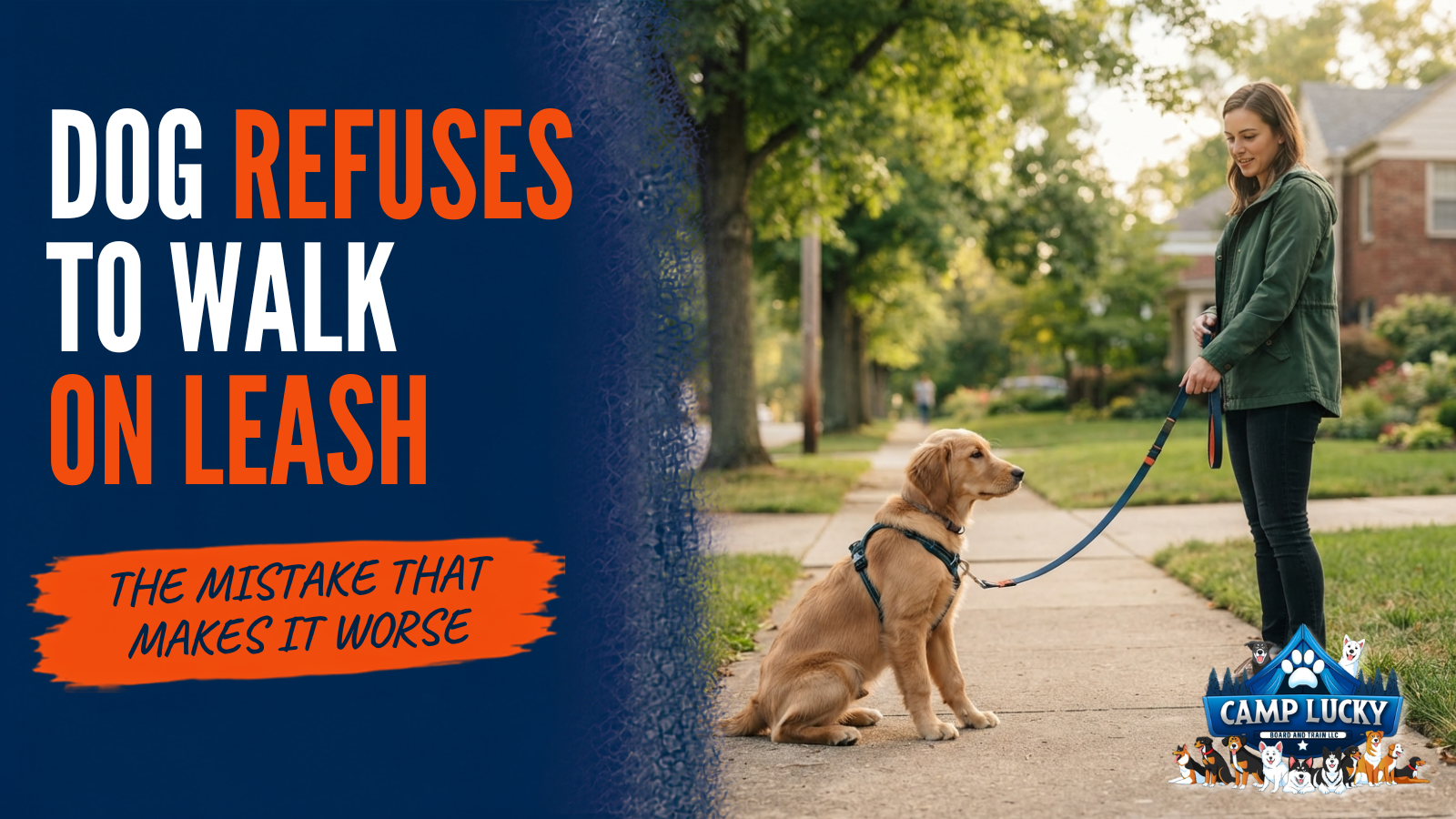
Every dog owner has been there: you clip the leash, open the front door, and your dog plants all four paws and refuses to budge. Or it walks half a block and then pancakes on the sidewalk like a furry anchor. It’s frustrating, confusing, and honestly a little embarrassing when the neighbors walk by.
The instinct is to call it stubbornness. But that label misses what’s actually happening — and more importantly, it points toward the wrong solutions. Understanding the real signal behind leash refusal is the first step to fixing it for good.
Refusing to Walk Is Rarely Stubbornness
When a dog refuses to walk on a leash, it’s tempting to assume it’s testing boundaries or simply being difficult. Behaviorally speaking, though, that framing almost never holds up. Dogs don’t refuse walks out of spite. What looks like defiance is almost always a form of communication — the dog is telling you something feels wrong.
The three most common patterns owners describe all point to the same root cause:
- The dog plants or “pancakes” — dropping its weight, freezing, or lying flat and refusing to move forward.
- The dog braces or pulls backward — toward home, toward the car, or away from a specific street or area.
- The dog walks selectively — fine in some directions but refusing to pass a certain point or enter a busier area.
From a behavioral science perspective, these patterns typically fall into one of three categories: a fear or anxiety response, a pain avoidance response, or a learned behavior loop where stopping has reliably worked in the past — ending the walk, getting carried, or earning a treat. Our dog trainers at Camp Lucky Board and Train work through all three of these categories regularly, and the starting point is always the same: identifying which one is actually driving the behavior before attempting any fix.
Mislabeling the behavior as stubbornness is where most owners go wrong. It leads to solutions — like dragging, scolding, or powering through — that address a willfulness that doesn’t exist, while leaving the actual emotional problem completely untouched.
What Fear Actually Looks Like on a Leash
The “Shutdown” Dog Most Owners Misread
Fear in dogs doesn’t always look the way people expect. Most owners picture a fearful dog as visibly trembling, whimpering, or cowering — and while those signals do happen, many fearful dogs show something far less obvious: they go completely still and quiet.
This is called a shutdown response. The dog isn’t being lazy or defiant. Its nervous system has essentially hit a wall — overwhelmed by the environment, it stops responding to cues, stops taking treats, and stops moving. To an outside observer, it can look almost identical to stubbornness. The dog just… won’t go.
This misread is incredibly common and genuinely costly. When owners push, drag, or correct a dog in shutdown, they’re adding pressure on top of an already overloaded system — which deepens the fear association and makes future walks harder, not easier.
Physical Signs That Confirm Fear, Not Defiance
Learning to read a dog’s body language during a walk is one of the most valuable skills an owner can develop. Fear during walks typically shows up as a cluster of signals:
- Freezing or sudden refusal to move forward
- Tail tucked low or pressed tightly against the body
- Panting when the temperature doesn’t explain it
- Shivering or trembling without cold weather as a cause
- Pulling intensely backward — away from the trigger, not forward toward excitement
- Refusing treats that the dog normally loves
That last point — refusing high-value food — is one of the clearest indicators that a dog is emotionally over threshold. When a dog is too stressed to eat, it’s not choosing to ignore the treat. Stress has physiologically shut down its appetite. No amount of better treats or firmer commands will fix that. The environment needs to change first.
Why Your Dog’s Brain Is Saying “Stop”
When the Leash Itself Becomes the Trigger
Here’s something that surprises a lot of owners: the leash itself can become a fear trigger. Through a process called classical conditioning, dogs build strong emotional associations with objects, places, and routines. If the leash has consistently appeared right before stressful or overwhelming experiences — loud traffic, an encounter with an aggressive dog, being dragged down a busy street — the brain starts to treat the leash as a warning signal.
By the time the clip snaps onto the collar, the dog’s stress response is already activated. It hasn’t even left the house yet, and it’s already on edge. That emotional state follows it out the door and onto the sidewalk, making everything that comes next harder to handle.
The same pattern applies to specific locations. A dog that was startled by a garbage truck on a particular corner may freeze every time it approaches that corner — not because it remembers the truck exactly, but because the location has been emotionally tagged as dangerous by its nervous system.
How Freezing Gets Reinforced Without You Knowing
There’s another layer to this that makes leash refusal so persistent: freezing often works. And when a behavior works, dogs repeat it.
Think about what typically happens when a dog plants on the sidewalk. The owner stops walking. The scary thing — the loud bus, the other dog, the unfamiliar street — stays at a distance or the walk ends entirely. From the dog’s perspective, freezing successfully made the threat go away. That’s called negative reinforcement, and it powerfully strengthens the behavior.
This isn’t the dog being manipulative. It’s just learning. The freeze worked, so the freeze becomes the go-to response. Without intentionally interrupting that cycle, the behavior will keep getting more entrenched — even in owners who are doing everything else right.
Well-Meaning Responses That Make It Worse
Dragging Intensifies the Fear Association
Dragging a reluctant dog forward is probably the most common owner response to leash refusal — and unfortunately, one of the most counterproductive. It feels like the logical move: the dog needs to walk, it isn’t walking, so apply forward pressure until it does.
The problem is what that pressure communicates to a fearful dog. Rather than learning that the scary environment is safe, the dog experiences the terrifying environment plus physical discomfort and a loss of control. That combination strengthens the negative association between the leash, the street, and the feeling of being overwhelmed. Forcing a fearful dog through a triggering situation doesn’t desensitize it — it tends to make the fear more intense and the refusal more extreme over time.
Treat-Bribing Can Accidentally Reward Stopping
Offering treats the moment a dog freezes is another well-intentioned strategy that often backfires. The thinking makes sense — use something positive to make the scary thing less scary. And in the right context, that’s exactly right. But timing matters enormously in dog training.
When treats appear specifically after the dog stops, the dog isn’t learning that the environment is safe. It’s learning that stopping produces food. Over time, the treat becomes a reward for the freeze behavior itself, making the dog more likely to stop — not less. The fix isn’t to stop using treats altogether; it’s to use them strategically, paired with movement and forward progress, rather than as a response to refusal.
Rule Out Pain First — Always
Before doing anything else — before changing gear, before adjusting walking routes, before starting any formal training — schedule a vet exam. This step gets skipped constantly, and it’s a critical mistake.
Physical pain is one of the most common and most overlooked causes of leash refusal. Joint problems, soft-tissue injuries, paw soreness, spinal discomfort, and skin irritation beneath a collar or harness can all make walking genuinely painful. A dog that stops or refuses to move forward may simply be trying to protect itself from discomfort that’s invisible to its owner.
The cases most worth flagging to a vet are:
- Refusal that appeared suddenly in a dog that previously walked without issue
- Refusal that’s directional — the dog hesitates in one specific gait or on one side
- Refusal accompanied by limping, licking at paws, or overall low energy
Behavioral training cannot fix physical pain. Addressing the wrong root cause wastes time, frustrates both the dog and the owner, and can make the underlying medical issue worse. A clean bill of health from the vet is the foundation everything else is built on.
A Step-by-Step Path Back to Confident Walks
Once pain has been ruled out, the goal shifts to changing the emotional experience the dog associates with walks. That’s not a quick fix — it’s a systematic process. But it works, and here’s how it unfolds:
1. Rebuild Neutral Associations With Gear
If the leash or harness has become a stress trigger, the rebuilding process starts indoors — before a single step outside is taken. Introduce the gear calmly, pair it with low-key treats and affection, and then remove it before the dog shows any stress. Let the dog drag a light leash around a safe indoor space while doing something it enjoys — simple games, a bit of sniffing, easy movement. The goal is straightforward: the leash should start predicting good things, not bad ones.
This step feels overly basic to most owners, which is exactly why it gets skipped. For a dog that’s already built a negative association with its gear, though, it’s the most important reset available.
2. Start Micro-Walks Below Threshold
“Below threshold” is one of the most important concepts in fear-based behavior work. It means working at a level of intensity where the dog notices its environment but isn’t overwhelmed by it. The dog can still take treats, still respond to its name, still move — it’s aware, not panicking.
Micro-walks start as small as a few meters — inside the home, in a hallway, in a garage or quiet courtyard. The reward comes for taking even one or two steps forward on a loose leash. Sessions stay short and end before stress has a chance to build. Distance, duration, and environmental complexity all increase gradually — but only when the dog is consistently moving willingly and responding to cues.
3. Use Desensitization and Counterconditioning for Specific Triggers
Desensitization and counterconditioning are the two most scientifically supported tools available for fear-based behavior. They work together: desensitization means exposing the dog to a trigger at a distance or intensity low enough that it doesn’t panic, while counterconditioning means pairing that exposure repeatedly with something genuinely positive — high-value food, play, calm praise.
The first step is identifying the specific triggers by tracking when and where the dog freezes. Is it at a particular corner? Near traffic noise? Around other dogs? Once the pattern is clear, the work happens at the edge of the dog’s comfort zone — close enough to the trigger to create awareness, far enough away to avoid a full stress response. Done consistently, this process rewires the emotional association: the scary thing starts to predict good things instead.
4. Refine Leash Handling to Reduce Pressure
How a leash is handled matters more than most owners realize. Many fearful dogs become particularly reactive to steady, consistent tension on the leash — that constant pressure can feel like being trapped, which escalates anxiety fast.
Effective low-pressure leash handling means keeping slack in the line whenever possible, avoiding repetitive nagging tugs, and building clear, predictable communication patterns — a cue, a step, a reward — so the dog develops a reliable understanding of what earns forward movement. Consistency in handling gives the dog something to trust. Unpredictable leash handling is itself a stressor for sensitive dogs, and smoothing it out is a meaningful part of the fix.
When Board and Train Solves What DIY Can’t
For many dogs with mild hesitation and patient owners in manageable environments, the steps above are genuinely enough. But there are real situations where DIY training hits a wall — and recognizing that threshold early saves a lot of time and stress.
Hundreds of Repetitions in Controlled Environments
Fear-based behavior change requires volume and consistency. Doing a good session once or twice a week isn’t enough. The nervous system needs repeated, calm experiences stacked on top of each other before a new emotional default takes hold — and that volume is very hard for most owners to deliver on their own, especially in dense urban environments with constant, unpredictable stimuli.
A structured board and train program creates the conditions that make this possible. Dogs live inside a trainer’s home — not a kennel — going through real domestic routines, practicing door manners, working around real foot traffic, and building controlled exposure repetitions throughout every day. That immersive consistency accelerates behavioral change in a way that weekly sessions simply can’t replicate. Our programs specifically address fear and reactivity in our three- and four-week tiers, building a foundation through distraction desensitization before layering in more advanced work.
Owner Coaching Is the Missing Piece
Here’s the part of professional training that doesn’t get talked about enough: what happens after the program ends matters just as much as the training itself. A dog can make tremendous progress in a structured environment and then regress within weeks if the owner inadvertently reintroduces the same stress patterns that caused the problem in the first place.
This is why genuine owner coaching on the back end of a board and train program is non-negotiable. Owners need to understand not just the commands but the why behind them — how to read their dog’s body language on walks, how to respond when the dog hits its threshold, and how to maintain calm, consistent handling day to day. The dog learns in the program; the owner learns during the handoff. Both pieces have to work together.
Your Dog Isn’t Broken — They’re Telling You Something
A dog that refuses to walk on a leash isn’t a bad dog. It’s not stubborn, it’s not dominant, and it’s not trying to make life difficult. It’s a dog that has connected walking — or the gear, or a specific location, or the whole experience — with something that feels unsafe. That’s a solvable problem.
The path forward starts with curiosity instead of frustration: What is this dog actually trying to communicate? Is it pain? Is it a fear of something specific? Is it a pattern that’s been accidentally reinforced over months of well-meaning responses? The answer shapes everything — the tools, the timeline, and the training approach that will actually work.
Most dogs with leash refusal can learn to walk calmly and confidently again. It takes patience, the right plan, and a commitment to working with the dog’s emotional state rather than against it. The dogs that seem the most stuck are often the ones that respond most dramatically once the right approach finally clicks.
To find out about professional board and train options for a dog struggling with leash refusal or fear-based behaviors, we at Camp Lucky Board and Train offer free in-home consultations across multiple locations and works with dogs of any age, breed, or behavior level.